Lead: When the market’s attention turns to a long-dormant cryptocurrency and witnesses its astonishing increase of over tenfold since the end of September, this is by no means accidental speculation. The explosive rise of Zcash is not only a rallying cry for the “financial privacy rights” narrative but also a signal that a brand-new sector may be on the verge of taking off.
Ⅰ. The True Manifestation of Zcash’s Surge: A Frenzied Coin Price and Soaring On-Chain Adoption Rate
The Zcash-led frenzy isn’t just a price-driven spectacle — it’s solid evidence of growing real-world demand and heightened on-chain activity.
- Price Performance: Restoring Market Confidence
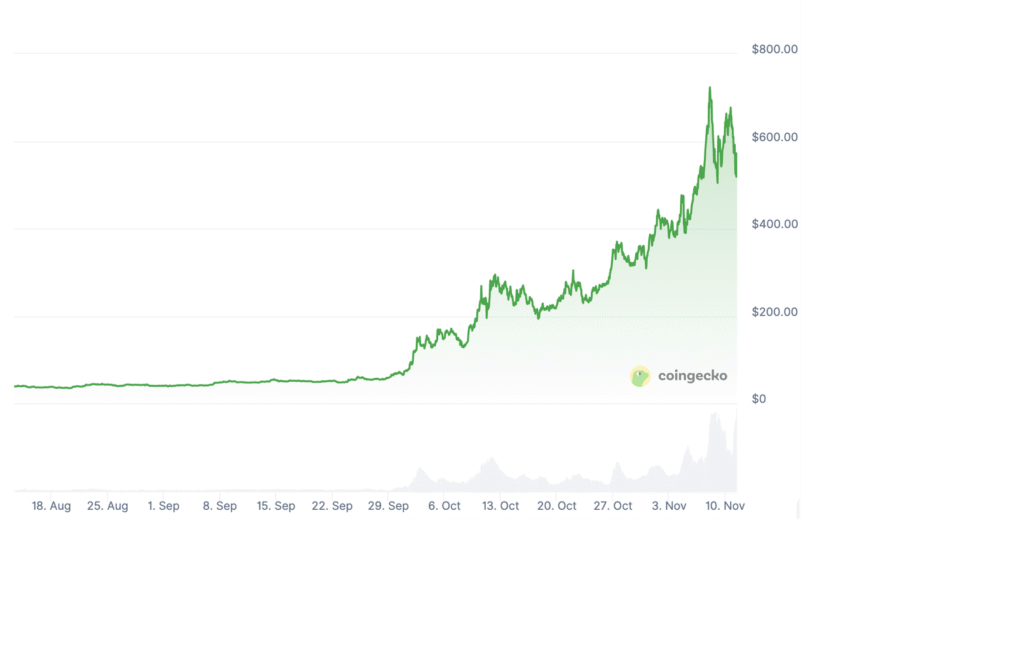
After years of dormancy, Zcash (ZEC) has experienced a breathtaking “epic awakening” over the past 2 months. The coin price has skyrocketed by more than 10 times in just 2 months, from a long-term low, in a vertical upward trend. At the time this article was published, the price had reached $560.
The core signal behind this surge is clear: ZEC has successfully and decisively broken through the four-year-long bearish resistance line (as shown by the key turning points on the chart). This marks not only a historical technical breakout but also sends a strong message to the market — the sleeping giant of the privacy sector has fully awakened. The move instantly triggered massive speculative buying and algorithmic trading activity, pushing ZEC back into the spotlight.
- The Golden Signal of On-Chain Data: Soaring Privacy Adoption Rate
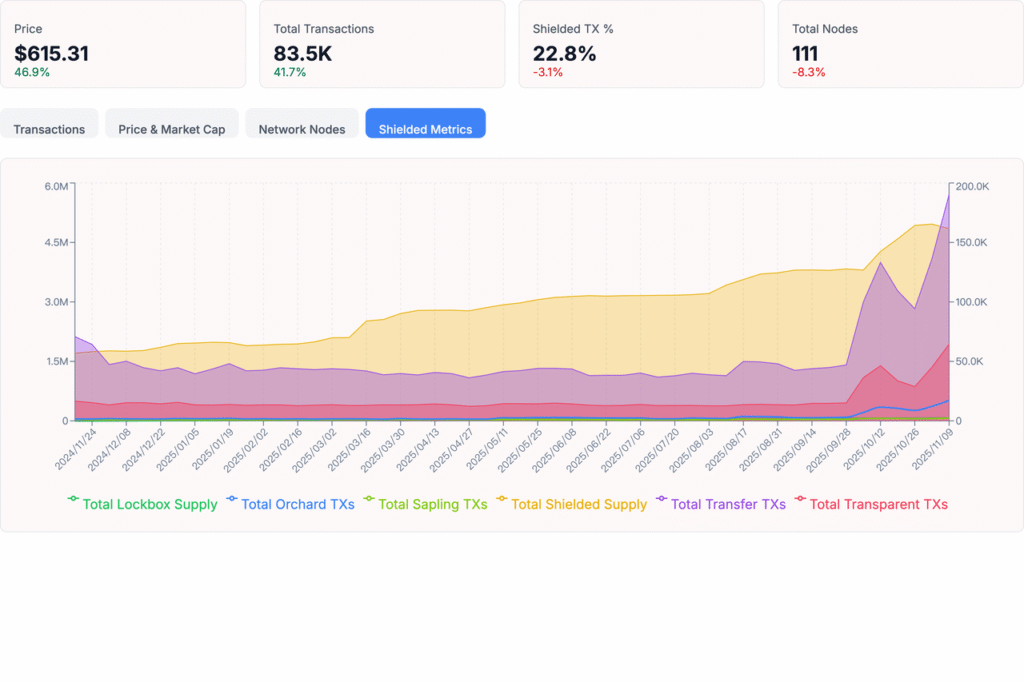
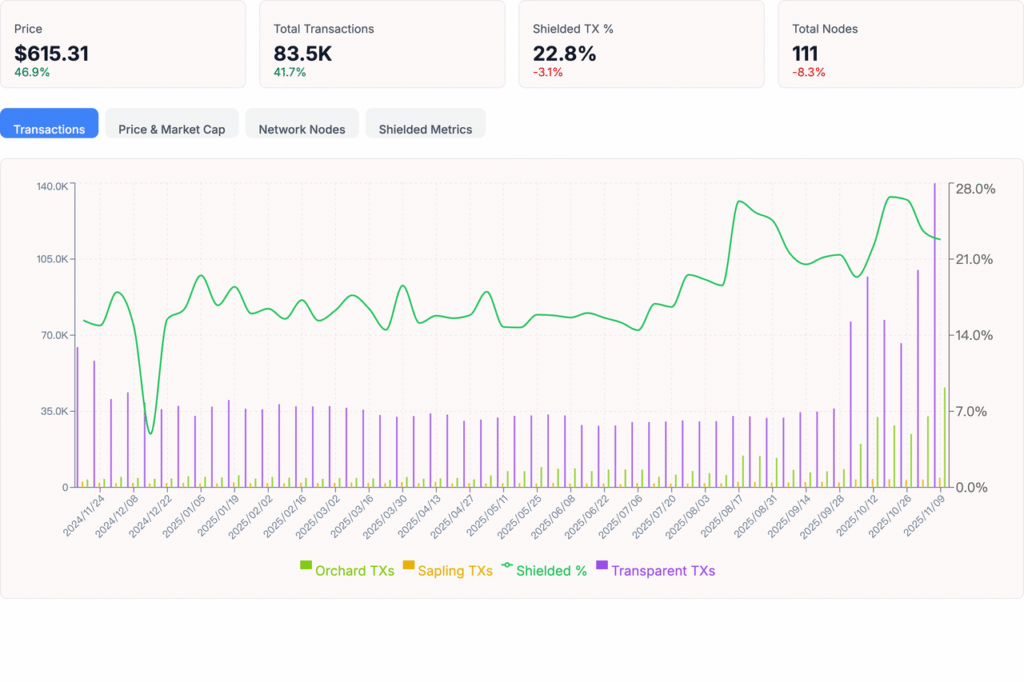
Equally important as the price rally are the positive shifts in Zcash’s on-chain metrics. These data points serve as the most authentic evidence of “the return of the privacy narrative”:
| Core Metric | Data Performance | Market Significance |
| Total Shielded Supply | Continuously Increasing | This is the core indicator. The surge in the amount of ZEC locked in shielded addresses shows that both whales and real users are rapidly increasing their demand for and trust in privacy features. |
| Shielded Percentage (Shielded %) | Percentage Rising Steadily | Measures the prevalence and importance of privacy features across the entire Zcash ecosystem, indicating that user behavior is shifting toward stronger privacy protection. |
II. Core Reasons for the Surge: Macro Trends, Technical Awakening, and Influencer Catalysts
The explosive rise of Zcash is the result of the combined effects of strong fundamentals, macroeconomic trends, technical signals, and the influence of top KOLs (key opinion leaders). Together, these factors have built the foundation for this market frenzy.
- Macro Background and Scarcity Expectations: The Call of the Times and the Approaching Halving
A. Explosive Demand Under Regulatory Pressure As global regulators tighten their oversight of cryptocurrencies (including stricter KYC requirements and on-chain tracking mandates), the “naked anxiety” in the digital financial world has been magnified infinitely. This rising desire to resist censorship and protect individual financial sovereignty has reignited a strong, rigid market demand for privacy-oriented assets. As a pioneer in adopting zero-knowledge proofs (zk-SNARKs), Zcash has become a focal point for capital inflows.
B. Halving Scarcity Expectations: Declining Sell Pressure Zcash is expected to undergo its block reward halving in November 2025. This event not only reduces miners’ selling pressure but also creates a strong perception of scarcity within the market, triggering behavior similar to the run-up before Bitcoin halvings. Traders recognize this as a prime opportunity — a period of ample liquidity and a straightforward narrative for strategic positioning.
- Resonance Between Technology and Capital: Long-Term Accumulation and Grayscale’s Layout
A. Awakening and Breakthrough at the Technical Level ZEC’s price has successfully broken through a four-year-long descending resistance line, signaling a decisive shift from a long-term bearish to a bullish trend. Throughout the prolonged bear market, ZEC underwent years of consolidation and accumulation, completing an adequate accumulation period for institutions and early investors. Once the price broke through critical resistance levels, it immediately triggered a massive wave of short liquidations and algorithmic buy signals.
B. Institutional Interest Boosted: The Grayscale Trust Effect Grayscale Investments announced that it would allow qualified investors to invest in Grayscale Zcash Trust, significantly increasing institutional interest and speculative enthusiasm. Grayscale’s endorsement marked the formal entry of privacy assets into the view of large-scale investors, paving the way for subsequent large inflows of assets.
- The “Prophecy” of a Top Opinion Leader: Arthur Hayes Ignites FOMO
Among all the catalysts, the public bullish analysis by Arthur Hayes, the co-founder of BitMEX, undoubtedly served as the most crucial catalyst that ignited the FOMO (Fear of Missing Out) sentiment among retail investors.
A. A Striking $10,000 Prediction Hayes published a bullish analysis predicting that ZEC could reach $10,000 in the next privacy-focused market cycle — an eye-catching target that immediately drew widespread attention. His core argument: “The four-year cycle is dead; the liquidity cycle lives on.” He positioned Zcash as “insurance against Bitcoin’s transparency,” fundamentally elevating ZEC’s investment value and narrative importance. Recently, Hayes posted another tweet stating: “Due to the rapid price increase, ZEC has become the second most liquid holding in Maelstrom’s (the family office’s) investment portfolio, trailing only Bitcoin.”
B. Influence Review: Proof of the Hayes Effect Arthur Hayes is widely regarded as one of the most influential voices in the crypto world. As a co-founder of BitMEX, he is known for his independent, macro-driven market insights. His analytical essays and public statements are frequently cited by leading crypto media outlets, and his opinions often exert a tangible impact on short-term market sentiment.
(1) Macro Narrative and Long-Term Conviction: The Million-Dollar Bitcoin Prediction
In May 2025, Hayes predicted in his personal blog and subsequent media interviews that Bitcoin could reach $1 million by 2028 — a view later reported by CoinTelegraph, The Defiant, and Decrypt. He emphasized that Bitcoin’s primary price driver lies in global liquidity — especially the U.S. dollar liquidity — and central bank balance sheet expansion, rather than the halving mechanism alone. This macro perspective lends strong logical consistency and foresight to his market analyses.
(2) The HYPE Token Forecast: From Words to Market Reaction
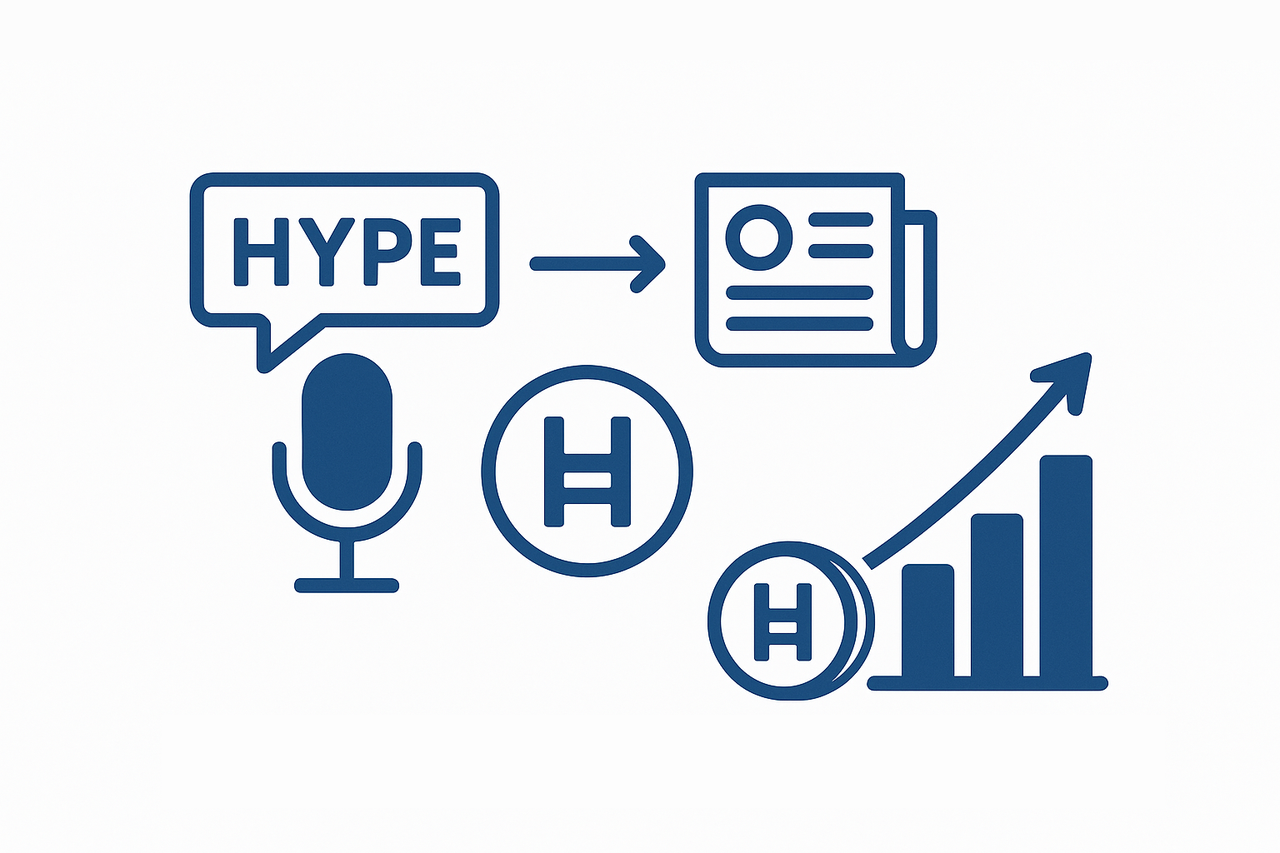
In August 2025, at the WebX 2025 conference, Hayes publicly expressed optimism toward Hyperliquid’s native token HYPE, predicting it could increase by up to 126 times within the next three years. The statement quickly sparked heated discussion across the community and was reported by CoinMarketCap and Yahoo Finance. Although the short-term impact was hard to quantify, CoinMarketCap data showed a modest increase in HYPE’s price within a week of his remarks, which some observers attributed to FOMO triggered by the “Hayes Effect.” In September 2025, according to CoinMarketCap, Hayes sold part of his HYPE holdings, realizing about 19.2% in profit. Though this was a short-term move, it was seen as a textbook example of his tactical approach to speculation and liquidity management — further reinforcing the market’s perception of the “Hayes Effect.”
- Endorsements from Top Talent and Technology Leaders: Amplifiers of Conviction
Following Hayes’s prediction, more of the industry’s most influential figures stepped forward in support, further strengthening market confidence:
- Naval Ravikant and other well-known investors publicly expressed their support.
- Mert Mumtaz, former Coinbase engineer and current CEO of Helius, also voiced his endorsement. Mumtaz emphasized that Zcash’s upcoming technical upgrade would deliver a 1,000x performance improvement, reigniting enthusiasm for its zk-SNARK–based privacy architecture.
III. Team Response Following the Surge
The Zcash development and supporting entities (ECC and the Zcash Foundation) have avoided directly commenting on the price action, instead emphasizing its technical core strengths and ongoing fundamental growth.
- Expansion of Core Development Talent (The Manhattan Project): Helius Labs CEO Mert Mumtaz is working to assemble a new, independent core team for Zcash, focused on large-scale scalability and security, aiming to build a “Manhattan Project” for privacy coins. This move signals to the market that top-tier talent is deeply engaged in shaping Zcash’s future.
- Driving Adoption and Infrastructure: The team is actively highlighting Zcash’s technical advantages, such as the zero-knowledge proofs zk-SNARK, while also improving the Zashi wallet. These product innovations aim to provide superior, convenient privacy and cross-chain experiences.
- Data Presentation and Transparency: The team and its supporters are actively sharing on-chain data, particularly growth in total shielded ZEC and the number of shielded transactions, demonstrating that the price surge is backed by actual user adoption and improved fundamentals.
- Exploring Compliance-Friendly Solutions: ECC continues to address privacy coin compliance challenges. For example, Selective Disclosure mechanisms allow users to prove the source of funds when necessary, meeting institutional and regulatory requirements while preserving core privacy features.
IV. Impact of the Surge: Collective Boom and Differentiation in the Privacy Sector
The explosive rise of Zcash (ZEC) has triggered a significant chain reaction in the cryptocurrency market. It has successfully brought the theme of “privacy” back into the spotlight, attracting asset flows from mainstream assets into this previously “forgotten sector.” As a result, the entire privacy coin segment experienced collective gains, while also triggering profound industry reflection and comparison.
- Market Influence
| Impact Dimension | Specific Manifestation | Market Significance |
| Sector Rotation Effect | Some profits realized from Zcash began flowing into other privacy coins that had not yet surged, such as Monero (XMR) and Dash (DASH), driving their price catch-up. | Validates the value of the “privacy” narrative, spawning high-risk/high-reward investment rotation opportunities. |
| Renewed Institutional Attention | The privacy sector re-entered the view of large-scale investors, raising liquidity expectations across the segment. | Rising demand for hedging against macro regulatory risks positions privacy coins as part of institutional hedge portfolios. |
| Validation of the Privacy Narrative | Zcash’s surge demonstrated to the market that “privacy” is a strong, capital-recognized narrative, dispelling previous pessimism that “privacy coins are dead.” | Narrative consensus is re-established, laying the foundation for future privacy tech innovation and broader market adoption. |
- Collective Boom and Differentiation in the Privacy Coin Sector
The success of ZEC is almost a signal of a “privacy coin bull market“, but the market performance and technical strengths of different tokens have shown clear differentiation:
| Privacy Coin | Core Privacy Mechanism | Market Reaction | Key Features & Positioning |
| Monero (XMR) | Ring Signatures | Price increased, but gains lagged significantly behind ZEC | Leading privacy coin, emphasizes default privacy and strong anti-regulation capabilities. Its fully private nature may lead to delisting risk on certain exchanges. |
| DASH | PrivateSend (Coin Mixing Mechanism) | Experienced significant gains, with the highest rise reaching 7 times. Currently, it has slightly declined, but it still has a 3.5 times increase compared to the end of September. | Positioned as “digital cash”, supports InstantSend and decentralized governance (DAO). Optional privacy mode (PrivateSend) allows partial anonymity while maintaining better regulatory compatibility and exchange liquidity than mandatory privacy coins. |
| Tornado Cash (TORN) | Coin Mixing Protocol | Brief large rebound in early October, currently retraced | Decentralized coin mixing protocol; the price rebound indicates strong market demand for on-chain privacy. |
The high-profile performance of Zcash and the collective frenzy across the privacy coin sector also bring a potential risk: it may prompt global regulators to accelerate legislation and oversight of privacy coins, posing a potential threat to privacy coins that rely on centralized infrastructure such as exchanges.
V. From “Privacy Coins” to “Privacy Payment Solutions”
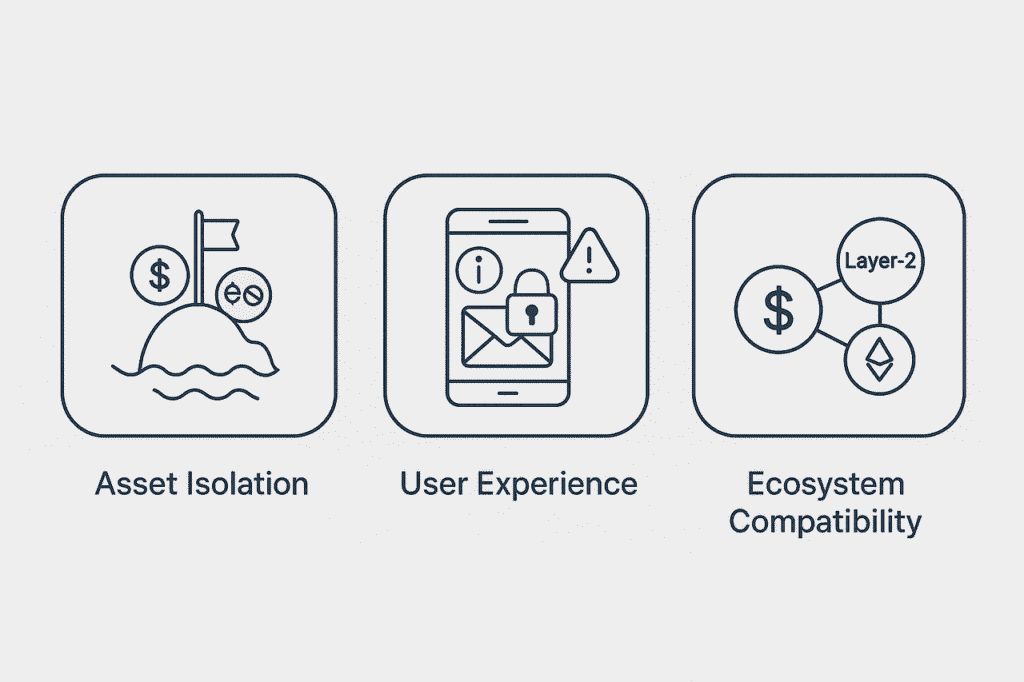
The recent phase of explosive growth in privacy coins like Zcash is not an isolated speculative event, but rather a signal that privacy has regained focus in the crypto industry. While short-term price fluctuations are still influenced by market sentiment, KOL statements, and liquidity rotations, privacy protection is becoming one of users’ core demands — a “functional vote” cast with real capital in the crypto market. However, the current privacy coin ecosystem (e.g., Zcash, Monero) faces three structural limitations at the technical and ecological levels, which hinder mainstream, large-scale, seamless adoption of privacy technology.
- “Asset Island” Limitation
In most privacy coin models, users must use the project’s native token (ZEC, XMR) to conduct private transactions. This means that to gain privacy functionality, users must purchase and hold specific coins, incurring additional asset allocation costs and exposure to price volatility. This structure makes “privacy” a feature tied to a particular coin, rather than an optional service. Increasingly, research and industry trends show that users prefer privacy on existing assets (USDT, ETH, mainstream stablecoins), rather than being forced into a new token ecosystem just for privacy.
- “User Experience” Limitation
The user experience of privacy coins and privacy protocols generally involves barriers. Taking Zcash as an example, users need to distinguish between transparent addresses and masked addresses (the latter, although providing privacy, causes compatibility issues with wallets; the transaction construction and signature process of Monero are relatively slow, resulting in confirmation delays; while in on-chain privacy protocols (such as Railgun, Aztec), the computational load for generating zero-knowledge proofs is large, and the gas cost is still relatively high. On this point, the Messari report “State of Privacy Tokens Q3 2025” states: “The complex usage experience and high transaction costs are one of the biggest obstacles preventing privacy protocols from achieving mainstream adoption.” An ideal privacy payment should not make users perceive technical complexity. Sending a privacy transaction should be as simple, instantaneous, and secure as sending a red envelope.
- “Ecosystem Compatibility” Limitation
Most privacy coins still operate on isolated chains, disconnected from the rapidly expanding DeFi, GameFi, and Layer-2 ecosystems. Zcash and Monero currently lack native cross-chain interoperability, making it difficult for users to use privacy assets across mainstream multi-chain environments. As Messari points out: “Privacy coins’ independence is their security foundation, but also their biggest barrier to adoption — they are inherently isolated from the mainstream economic layer.” The future of privacy technology should not come at the cost of usability and openness. A truly effective privacy payment solution should be a foundational standard, like HTTPS on the Internet, rather than an isolated ecosystem.
Paradigm Shift: From “Privacy Coins” to “Privacy Payment Solutions”
What we need is not just a privacy coin, but a privacy payment solution or universal privacy layer that addresses the above pain points:
- From Asset to Function: Privacy should no longer be tied to a specific token; it should be abstracted as a feature or service accessible by any digital asset.
- Ecosystem Composability: It should seamlessly integrate with DeFi, GameFi, and other Web3 applications. Users should be able to bridge privacy assets or interact with other protocols within the privacy layer while maintaining anonymity.
- Optimized User Experience: Transaction confirmations must be instant or near-instant, with low fees and a simple, intuitive interface, enabling ordinary users to transact without friction.
VI. New Opportunities in the Privacy Payment Sector: The Potential of Privacy Payment Public Chains as Seen from the soaring Zcash
The explosive rise of Zcash has brought privacy coins and the broader privacy payment sector back into the spotlight. With Zcash breaking long-term lows and achieving an increase of more than 10 times in a short period, the market has re-priced the long-underappreciated narrative of “privacy”. For investors, this price movement is not merely a market fluctuation — it serves as a strong signal that privacy payment technologies and privacy-centric assets are entering a new cycle of attention.
Investor Perspective: From Price Signal to Sector Insight
For many market participants, Zcash’s rapid rise amplified sentiment: a rebound from the low point to around $560 in two months is difficult to dismiss as a “technical rebound.” In an environment of tightening global regulation and highly visible on-chain activity, privacy protection is transitioning from an “optional feature” to a “core necessity”. Investors are beginning to ask based on the price signals:
Could privacy payments become one of the next mainstream applications of crypto technology?
Traditional privacy coins have long struggled to balance performance, usability, and regulatory pressure. The era of simply “creating an anonymous coin” is clearly over. The market now expects “infrastructure that can protect privacy while being genuinely usable” — not a post-facto privacy layer on an existing blockchain, but a system deeply optimized from the ground up for privacy payment scenarios.
Awakening of the Privacy Payment Sector: A New Narrative after Zcash’s Surge
After Zcash’s price surge, attention to the privacy payment sector has noticeably increased. Market discussions have shifted from “anonymous speculation” to “privacy rights and financial infrastructure.” Whether in the trading of crypto assets, cross-border asset transfers, or the multi-chain combination usage of DeFi protocols, users began to realize that completely transparent addresses and fund trajectories are bringing actual behavioral pressure and risk exposure.
In this context, the privacy payment solution of BenFen Chain (BenFen) — a representative of the next-generation privacy public chain — has emerged as a notable case study within the sector.
Unlike traditional “external plug-in privacy layers,” BenFen Chain integrates “privacy” as a system-level design goal from the outset:
- Not just an L2 or application-layer mask,
- But a full-stack solution from base architecture to application interfaces, optimized for privacy payments.
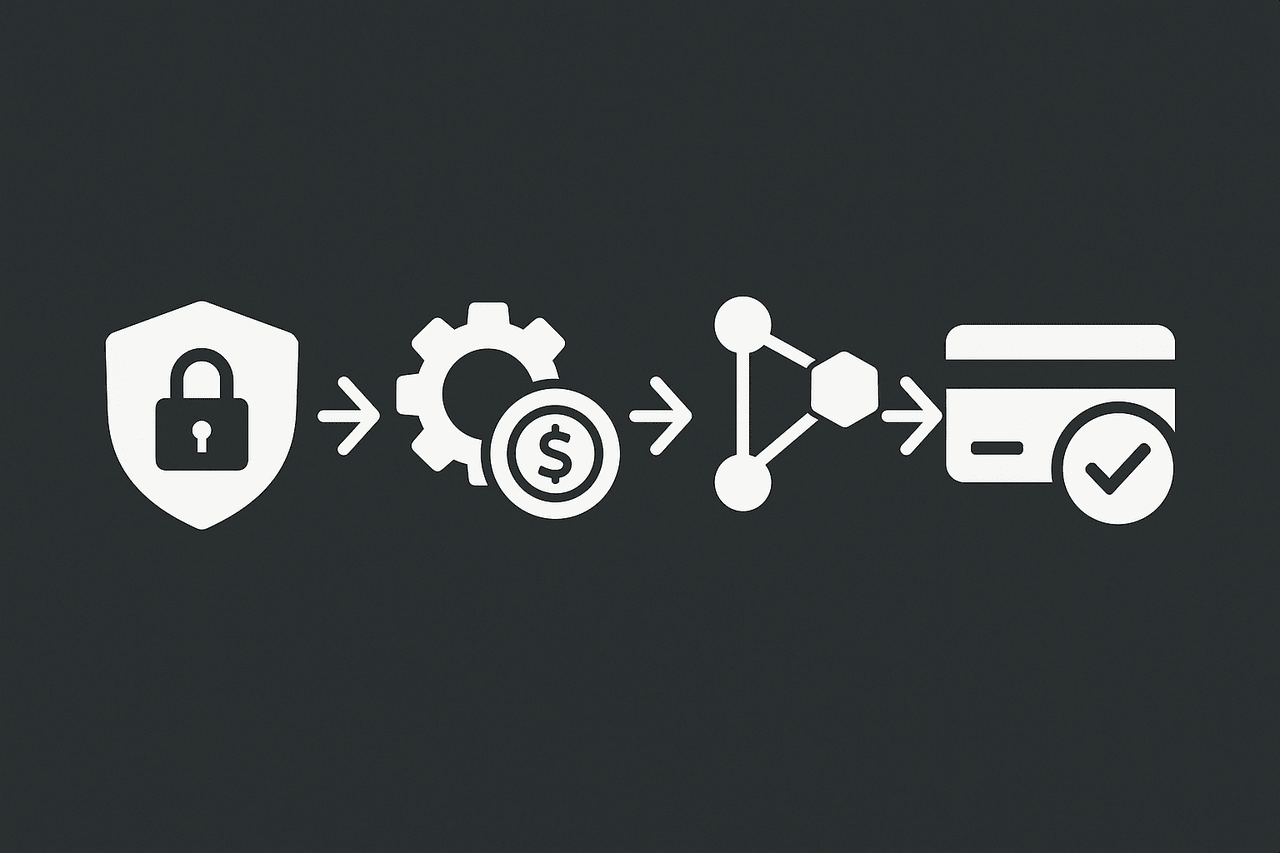
Its technical stack — a security-first Move language, high-performance DAG consensus, and native stablecoin integration — collectively aims to provide the next-generation privacy payment infrastructure, balancing security, performance, and usability. The design explicitly weighs “can it be used,” “is it convenient,” and “is it secure” on the same table.
“Usable Privacy”: Balancing Privacy and Verifiability
Unlike some traditional privacy coins that emphasize “full data concealment”, BenFen Chain’s approach targets “usable privacy” — a practical engineering balance between privacy protection and verifiability.
In its confidential transaction layer, BenFen Blockchain combines multi-party computation (MPC) and key sharding, aiming to make “data usable but not visible”:
- Assets can move across the network,
- Nodes achieve consensus and update states,
- Core sensitive transaction details are never exposed in plaintext on-chain.
Meanwhile, at the protocol level, BenFen Public Chain employs a threshold decryption mechanism: only under specific conditions and through the collaborative efforts of multiple parties can certain transaction details be selectively disclosed. This design not only retains privacy but also reserves “verifiable” technical interfaces for scenarios such as compliance audits, risk control checks, etc. It leaves room between privacy protection and the trust infrastructure.
User Experience: Making Privacy the “Default Option”
From the user perspective, BenFen Blockchain hides complexity behind the scenes, making privacy a “default feature”:
- Privacy transactions are operationally similar to regular transfers,
- Users do not need to learn extra steps or understand complex cryptography,
- Privacy enforcement occurs automatically in the system background.
Through a sponsored transaction model, the protocol can cover gas fees, allowing “near-zero gas” usage in certain scenarios. This lowers the barrier, transforming privacy payments from a “high-threshold, expert-level feature” into a naturally accessible daily capability.
From “Anonymous Narrative” to “Practical Privacy”: The Direction Represented by BenFen Chain
Zcash’s surge has reignited market attention to privacy. BenFen Chain’s technical solution reflects the evolving narrative of the privacy sector, moving from a single “anonymous story” to a “practical privacy infrastructure that balances performance, compliance interfaces, and everyday usability.”
At its core, BenFen seeks a balance among three priorities:
- Privacy protection: Data is not exposed, and funds and transactions are shielded from arbitrary profiling.
- Performance efficiency: Capable of handling high-frequency payments and complex asset flows.
- User experience: Minimizing friction for end-users, lowering participation barriers.
For individual users, this means a “privacy-on-by-default” option for everyday on-chain payments, multi-chain asset management, and cross-border transfers. For institutions and protocol developers, it provides a foundational framework for building privacy-friendly payment, settlement, and clearing systems.
As traditional privacy coins like Zcash re-enter the market spotlight, BenFen’s “practical privacy payment” approach emerges as a key reference point for understanding the evolving privacy payment sector. Privacy payments are gradually evolving from a marginal narrative into a potential driver of payment infrastructure evolution and the reconfiguration of financial trust.