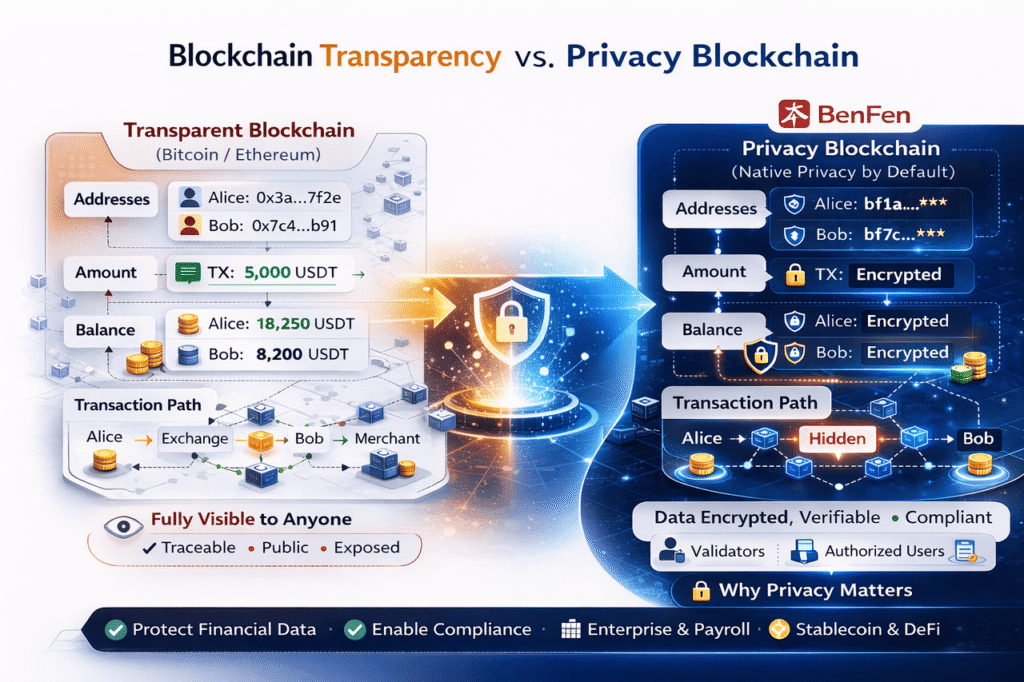
Blockchain technology was originally built on transparency. Every transaction on networks like Bitcoin and Ethereum is publicly visible — including wallet addresses, transaction amounts, historical balances, and asset flow paths.
This radical transparency helped build trust in decentralized systems. However, as blockchain adoption moves beyond speculation into payments, payroll, enterprise settlement, and stablecoin use cases, full transparency becomes a liability rather than a feature. A critical question becomes unavoidable:
Can blockchain achieve true financial privacy while maintaining verifiability?
This shift toward blockchain privacy and privacy blockchain infrastructure marks the next evolution of Web3. At the application layer, this evolution takes form as privacy payments.
The Financial Problems of Transparent Blockchain
Most public blockchains operate as fully open ledgers. Anyone can:
- View transaction amounts
- Trace wallet balances
- Analyze transaction histories
- Map financial relationships between addresses
For casual peer-to-peer transfers, this level of transparency may seem acceptable. However, in real financial environments, full transparency creates serious risks:
- Exposure of personal wealth
- Leakage of business transaction data
- Business activities monitored by competitors
- Long-term on-chain data profiling
- Barriers to institutional and enterprise adoption
In traditional finance, bank transfers are not publicly searchable. Payroll records are not broadcast globally. Supplier payments are not visible to competitors.
Yet on most blockchains today, financial activity is fully exposed. This contradiction severely limits the large-scale, compliant blockchain adoption in real-world finance.
What Is Blockchain Privacy?
Blockchain privacy is a core capability of privacy blockchain infrastructure that allows transactions to be validated and settled without publicly exposing sensitive financial data.
In other words, the network can verify that a transaction is valid — without revealing transaction details to everyone. Modern blockchain privacy architectures aim to protect:
- Transaction amounts
- Account balances
- Asset types
- Sender and receiver address
But privacy alone is not enough. To support financial-scale applications, privacy must also be:
- Compliant
- Auditable at the protocol layer
- Efficient at high transaction volumes
This is where privacy payments become critical.
What Are Privacy Payments?
Privacy payments are the practical execution layer of blockchain privacy in real financial scenarios.
It is an on-chain payment method with three core features:
- The transfer is cryptographically verified
- The ledger state updates correctly
- But the transaction amount and balance details remain encrypted on-chain
Unlike anonymous payments, privacy payments are designed to be confidential but accountable. This distinction matters:
- True anonymity removes all traceability.
- Privacy payments protect sensitive data while allowing regulatory compliance mechanisms when legally required.
Privacy payments introduce a new financial model of default privacy with selective disclosure, where sensitive information remains encrypted and is accessible only under authorized conditions.
How Privacy Payments Work on Modern Blockchains
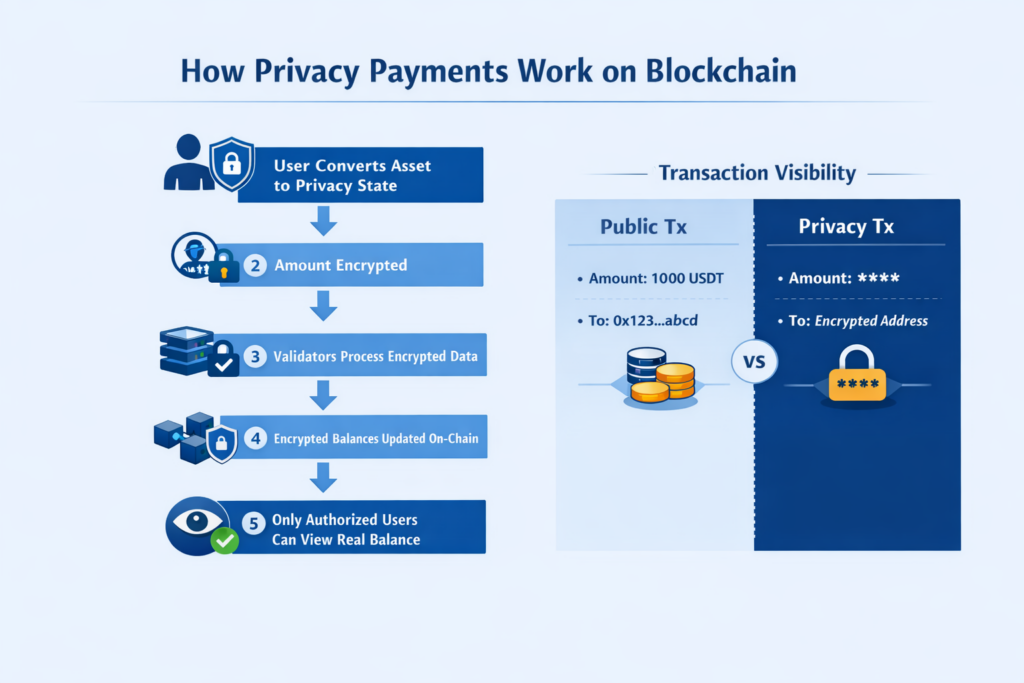
Traditional blockchain transactions are recorded in “plain text” at the ledger level. Privacy payment systems introduce a different architecture:
- Assets are converted into a privacy state
- Transaction amounts are encrypted
- Validators process encrypted data
- The blockchain records encrypted balance updates
- Only authorized parties can view real balances
Externally, observers see state changes — but not the underlying financial details.
This model allows:
- Secure personal payments
- Confidential business settlement
- Enterprise payroll processing
- Stablecoin transactions without public exposure
The blockchain remains verifiable, but financial data is no longer publicly visible.
BenFen’s Privacy Payments: Data Usable but Not Visible
While many blockchains attempt to add privacy as an external layer, BenFen builds privacy natively into its execution environment.
BenFen introduces a privacy payment architecture directly at the virtual machine layer. Confidential account, asset, and transaction logic are integrated into the blockchain’s core execution system — not bolted on as plugins or mixers.
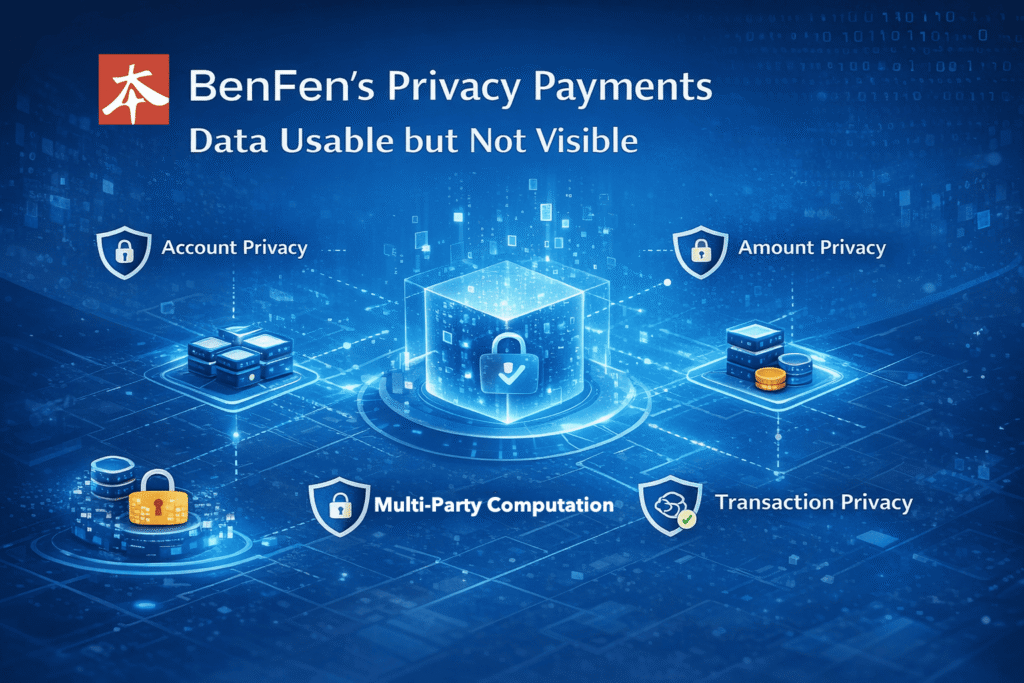
The result is a system where financial data remains fully usable for computation, settlement, and compliance — but is not publicly visible on-chain by default.
BenFen’s privacy payments protect three core dimensions of financial privacy:
- Account Privacy – account balances and asset exposure are shielded
- Amount Privacy – transaction values are encrypted on-chain
- Transaction Privacy – fund movements cannot be reconstructed by third parties
Privacy Accounts: Account-Level & Balance Privacy
When users deposit assets into a BenFen privacy account:
- The balance is hidden
- The real value is encrypted into secure data fragments
- On-chain observers cannot see the true amount
The blockchain stores encrypted state objects rather than plain balances.
Encrypted Transactions: Amount Privacy & Transaction Privacy
When a privacy payment is executed:
- Transaction amounts are encrypted
- On-chain observers only see state transitions, not transaction details
- The transaction becomes opaque to third parties
This protects:
- Personal financial privacy
- Corporate treasury movements
- Enterprise payroll flows
- High-value settlement routes
Even advanced chain analysis tools cannot reconstruct payment paths or amounts.
The Core Technology: Multi-Party Computation Architecture
BenFen’s privacy payments are powered by an optimized Fast Multi-Party Computation (FAST MPC) framework. MPC allows multiple participants to jointly compute a function without revealing their individual inputs.
In the context of privacy payments:
- Transaction values are transformed into encrypted fragments
- Validators process those fragments without exposing the original data
- Updated encrypted balances are written back to the ledger
FAST MPC is optimized for:
- High throughput
- Low computational cost
- Blockchain-scale performance
This ensures privacy without sacrificing usability.
To better understand how multi-party computation (MPC) enhances blockchain privacy, you can explore our in-depth guide on MPC in Blockchain: How Multi-Party Computation Reshapes Privacy & Web3 Payments.
Compliance and Experience: Making Privacy Payments Practical
In the design of the privacy payment function, BenFen also takes into account:
- KYC identity foundation: Provide a compliant identity system for enterprise and institutional users to meet regulatory and risk control requirements.
- Protocol-level auditable privacy: Under the premise of legality and compliance, it supports on-demand auditing. Privacy is enabled by default, but it can be disclosed in compliance with regulations when authorized or required by law.
- Native-sponsored transaction payment for Gas: Supports project parties or merchants in paying Gas fees for users, allowing users to enjoy a nearly “zero-threshold” usage experience.
- Second-level confirmation, high TPS: Balancing privacy protection and high performance, it meets high-frequency scenarios such as payment and settlement.
- Batch enterprise payment support: Such as salary disbursement, subsidies, and settlements for enterprises.
Privacy payments evolve from a niche crypto tool into a real financial infrastructure.
Built on BenFen’s native privacy architecture, BenPay provides users and enterprises with a simple way to access privacy payments and compliant on-chain transactions.
Why Blockchain Privacy Matters for the Future of Finance
Privacy blockchain architectures are becoming the core foundation for compliant on-chain finance. For blockchain to support:
- Global payroll
- Business settlement
- Stablecoin payments
- Institutional capital markets
Financial confidentiality must become standard. Privacy payments represent the evolution from speculative crypto transfers to real financial infrastructure.
The future of blockchain finance is not radical transparency — it is verifiable systems with protected data.
Summary
The future of blockchain finance is not radical transparency — it is verifiable systems with protected data. Privacy payments are the bridge between open blockchain infrastructure and real-world financial systems.
As native privacy architectures mature, BenFen‘s principle of “data usable but not visible” may become a foundational design paradigm for the next generation of Web3 finance.
FAQ: Blockchain Privacy & Privacy Payments
Q1: What is blockchain privacy?
A: Blockchain privacy means transactions can be verified on-chain without publicly exposing sensitive data like amounts, balances, or fund flows. It enables real-world financial use cases while keeping data confidential and compliant.
Q2: What is a privacy payment?
A: A privacy payment is an on-chain payment where transactions are verified normally, but amounts and balances remain encrypted and hidden from the public.
Q3: Are privacy payments illegal?
A: No. Privacy payments are designed to protect data, not bypass regulation. BenFen supports compliance through KYC foundations and protocol-level auditable privacy for lawful disclosure.
Q4: What’s the difference between anonymous payments and privacy payments?
A: Anonymous payments remove traceability. Privacy payments protect data by default while allowing lawful disclosure when required.
Q5: Why does blockchain need privacy for payments?
A: Fully transparent blockchains expose personal and business financial data, limiting enterprise adoption. Privacy payments enable payroll, settlement, and stablecoin use without public exposure.
Q6: How do privacy payments work on BenFen?
A: BenFen encrypts transaction values and balances at the protocol level using FAST MPC, allowing transactions to be verified without revealing real amounts on-chain.
Q7: Can privacy payments on BenFen be audited?
A: Yes. Transactions are private by default, but can be audited under lawful and authorized conditions.
Q8: What’s the difference between a privacy blockchain and a privacy wallet?
A: A privacy blockchain provides protocol-level privacy by default (like BenFen). A privacy wallet (like BenPay) lets users access privacy payments and encrypted balances.