Blockchain is one of the most disruptive technologies in recent years. It not only powers crypto assets like Bitcoin and Ethereum, but is also reshaping industries such as finance, supply chains, and digital identity.
In this guide, we will explain blockchain from four key perspectives: definition, technical principles, core characteristics, and real-world applications. Whether you’re a beginner or a technical professional with some background, this article will provide you with a complete, in-depth, and practical understanding framework.
What Is Blockchain?
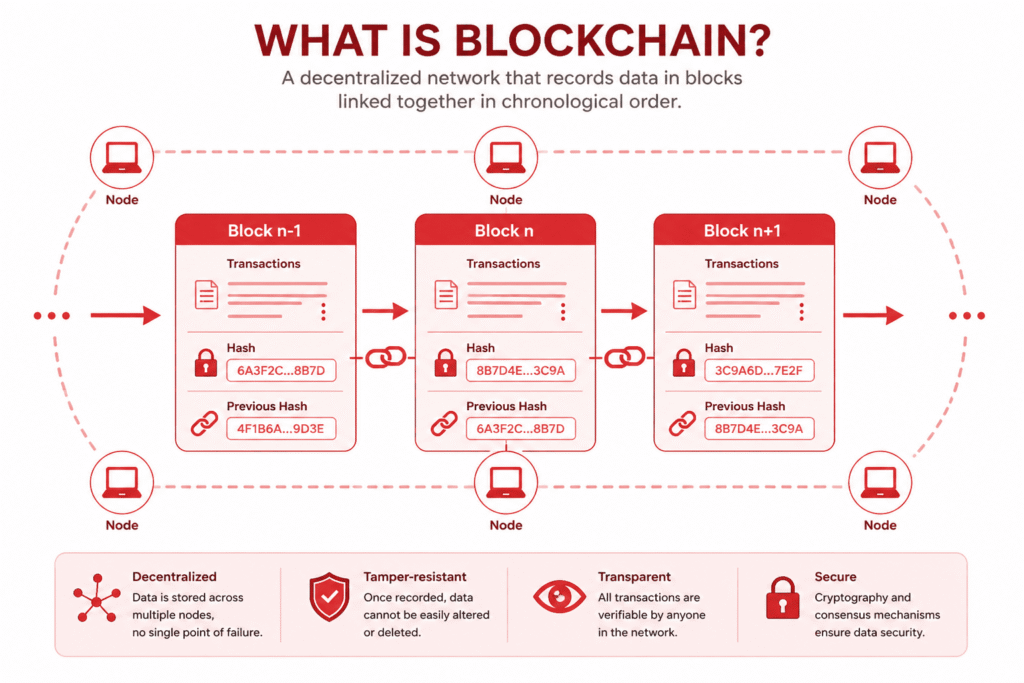
A blockchain is a decentralized, distributed ledger technology that uses cryptography and consensus mechanisms to organize data into blocks, link them in chronological order, and store them across multiple nodes.
This structure creates a database system that is highly tamper-resistant, transparent, and does not rely on trusted intermediaries.
At its core, blockchain can be broken down into three key actions:
- Packaging data into blocks
- Linking those blocks in chronological order to form a chain
- Synchronizing and storing data across multiple nodes in the network
Blockchain vs. Traditional Databases
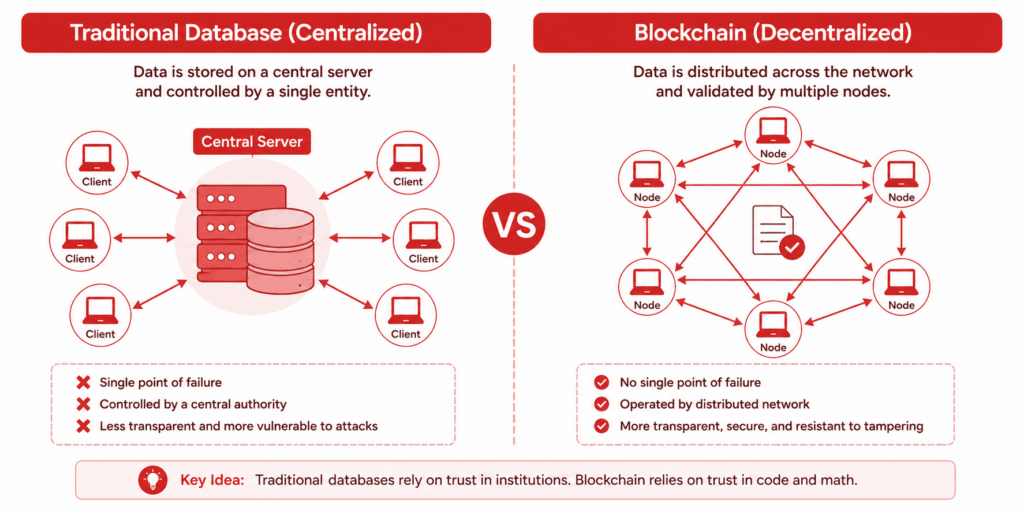
To make this easier to understand, here’s a direct comparison:
| Dimension | Traditional Database (e.g., banking systems) | Blockchain |
| Control | Single authority (bank or company) | All network participants |
| Read/Write Access | Controlled by centralized administrators | Governed by consensus rules |
| Ability to Modify History | Possible (with admin privileges) | Nearly impossible |
| Fault Tolerance | Depends on central servers | No single point of failure |
| Trust Model | Trust in institutions | Trust in code and mathematics |
A traditional database is like a ledger maintained by a single accountant. In contrast, a blockchain is maintained collectively by all participants in the network, where every transaction must be verified by multiple parties before being recorded.
Core Technical Principles of Blockchain
Blockchain is not a single technology, but a combination of multiple disciplines, including cryptography, distributed systems, and consensus mechanisms. Let’s break them down one by one.
- Block Structure
A block is the fundamental storage unit of a blockchain. You can think of it as a page in a ledger.
A standard block typically contains the following components:
| Field | Description |
| Transactions | All transaction records included in the block |
| Timestamp | The exact time the block was created |
| Previous Hash | The “fingerprint” of the previous block, linking the chain |
| Hash | The unique “fingerprint” of the current block |
| Nonce | A variable used in consensus mechanisms like Proof of Work |
| Merkle Root | A summarized hash of all transactions for efficient verification |
How Does the Chain Structure Ensure Immutability?
Once a block is modified, its hash changes completely. Since the next block stores the previous hash, the link breaks immediately.
This means:
- Any change to a historical block invalidates all subsequent blocks
- To tamper with data, an attacker would need to recompute every block after it
On large public blockchains, this is computationally infeasible.
- Hash Functions
Hashing is one of the most fundamental cryptographic tools in blockchain. It converts data of any size into a fixed-length string.
Common hashing algorithms used in blockchain include:
| Algorithm | Use Case |
| SHA-256 | Bitcoin, Bitcoin Cash |
| Keccak-256 | Ethereum |
| BLAKE2 | Some emerging blockchains |
Key Properties of Hash Functions:
- Deterministic: The same input always produces the same output
- One-way (irreversible): It is infeasible to recover the original input from the hash
- Avalanche effect: A tiny input change (even one character) produces a completely different output
- Collision resistance: Extremely difficult to find two different inputs that generate the same hash
These properties ensure data integrity and tamper resistance in blockchain systems.
- Distributed Network (Decentralization)
Blockchain operates on a peer-to-peer (P2P) network:
- Each node holds a full or partial copy of the ledger
- There is no central server — no “master node” or admin backend
- Data is broadcast across the network — transactions propagate quickly to all nodes
Key Advantages of a Distributed Network:
- Fault tolerance: Even if many nodes go offline, the network continues to operate
- Transparency: Anyone can run a node and independently verify the full history
- Censorship resistance: No central authority can block valid transactions
- Consensus Mechanisms
Since there is no central authority to approve transactions, blockchains need a way to decide:
- Who gets to produce the next block?
- How do all nodes agree on the state of the ledger?
This is the role of consensus mechanisms.
Comparison of Major Consensus Mechanisms:
| Mechanism | Representative Chains | Principle | Advantages | Disadvantages |
| PoW (Proof of Work) | Bitcoin | Miners compete using computational power | Extremely secure, high attack cost | Energy-intensive, low throughput (~7 TPS) |
| PoS (Proof of Stake) | Ethereum, Solana | Validators stake tokens and are selected proportionally | Energy efficient, higher throughput | More complex design, “nothing at stake” issues |
| DPoS (Delegated PoS) | EOS, Tron | Token holders vote for a small set of validators | Very fast (thousands of TPS) | Some degree of centralization |
| PoA (Proof of Authority) | Private/consortium chains | Pre-approved validators produce blocks | High performance, low latency | Trust based on identity rather than math |
Core Functions of Consensus:
- Ensure all nodes agree on the ledger state
- Prevent double-spending (spending the same asset twice)
- Incentivize honest behavior and penalize malicious actors
- Smart Contracts
Smart contracts are self-executing programs deployed on a blockchain. The concept was first proposed by computer scientist Nick Szabo in 1994, but only became widely adopted with the rise of Ethereum.
Key Characteristics:
- Code is law: Once deployed, it cannot be altered unilaterally
- Automatic execution: Actions are triggered when predefined conditions are met
- No intermediaries: No need for lawyers, notaries, or third-party platforms
Real-World Examples:
| Scenario | Smart Contract Logic |
| Automated payments | “Release funds once goods are delivered” |
| Decentralized lending | “Deposit ETH as collateral to borrow USDC” |
| NFT trading | “Transfer ownership when payment is received” |
| Prediction markets | “Distribute rewards if event A occurs” |
Smart contracts transform blockchain from a simple “ledger for transactions” into a programmable global computer.
Core Characteristics of Blockchain
Based on the technical principles discussed above, blockchain exhibits five key characteristics:
- Decentralization
Blockchain operates without a central controlling authority. There is no need to rely on a trusted third party.
Instead, trust shifts from institutions and individuals to code and mathematics.
- Immutability
Once data is confirmed by the majority of network participants and recorded in a block, it becomes extremely difficult to alter.
This property provides a strong foundation for use cases such as:
- Auditing
- Traceability
- Data notarization and proof of existence
- Transparency
On public blockchains, all transaction records are technically open and verifiable.
Anyone can use a block explorer to view:
- The balance of any address
- The amount, timestamp, and participants of any transaction
- Smart contract code and execution history
- Security
Blockchain security is built on multiple layers:
- Hash functions ensure data integrity
- Digital signatures ensure that transactions are authorized by private key holders
- Consensus mechanisms prevent malicious actors from taking control of the network
Together, these mechanisms create a highly secure system without centralized oversight.
- Programmability
Through smart contracts, developers can build complex application logic directly on the blockchain.
This programmability has enabled entirely new ecosystems, including:
- Decentralized Finance (DeFi)
- NFTs (Non-Fungible Tokens)
- DAOs (Decentralized Autonomous Organizations)
Blockchain has evolved from a simple transaction ledger into a flexible and programmable infrastructure layer for the internet.
Major Public Blockchains and Technical Approaches
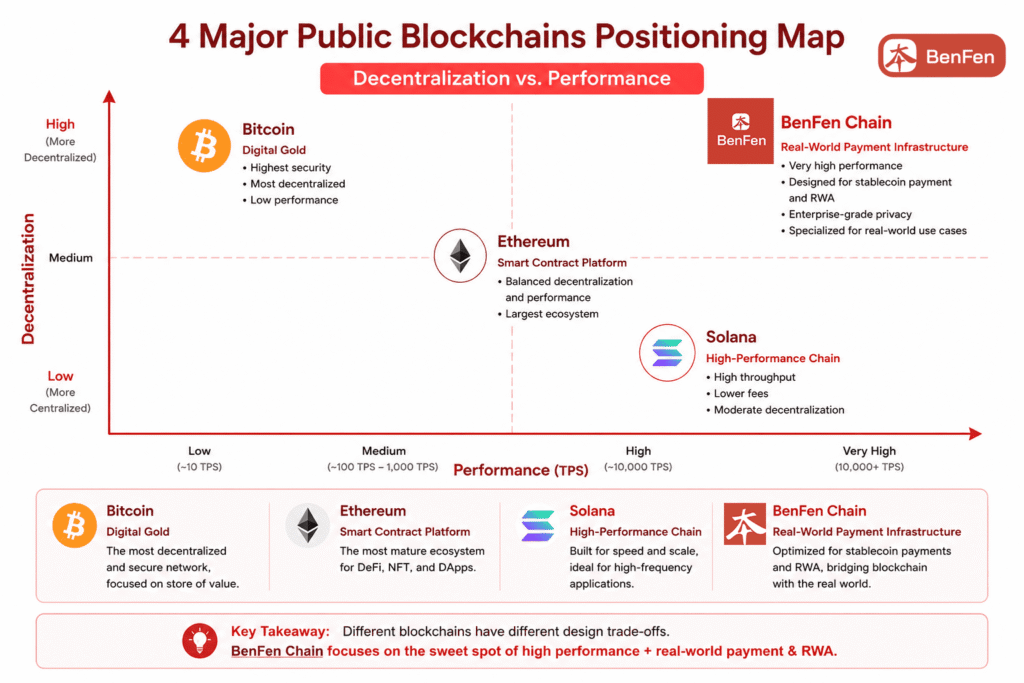
Public blockchains are no longer competing to be a “one-chain-fits-all” solution. Instead, the industry has entered an era of specialization, where each blockchain optimizes for a specific dimension.
Below are four representative public blockchains:
- Bitcoin: Digital Gold
- Consensus Mechanism: Proof of Work (PoW)
- Smart Contracts: Minimal, non-Turing complete
- Block Time: ~10 minutes
- Throughput: ~7 TPS
- Finality: ~60 minutes (6 confirmations)
Design Philosophy: Bitcoin is the original blockchain application. Its design prioritizes minimalism and absolute security. It does not aim to support complex smart contracts—it focuses on one thing: securely recording value transfers.
Core Strengths: Trust is established through real-world energy expenditure (computational work). Attacking the network would require controlling over 51% of total hash power, making it extremely costly. This makes Bitcoin the most secure blockchain network to date.
On-chain Reality: Roughly 60% of BTC has not moved in over a year, reinforcing its role as a store of value rather than a payment system. In the blockchain ecosystem, Bitcoin serves as “digital gold” and a trust anchor.
Limitations: Low speed, high energy consumption, and lack of support for complex applications.
- Ethereum: Decentralized Application Platform
- Consensus Mechanism: Proof of Stake (PoS, after The Merge in 2022)
- Smart Contracts: Turing-complete
- Block Time: ~12 seconds
- Throughput: ~15–30 TPS (Layer 1), thousands TPS via Layer 2
- User Confirmation: ~12 seconds; Finality: ~13 minutes
Design Philosophy: Ethereum introduced smart contracts at scale, transforming blockchain from a “transaction ledger” into a programmable global computer. Developers write code in Solidity and deploy it on the Ethereum Virtual Machine (EVM).
Core Strengths: Ethereum has the largest decentralized application ecosystem, including DeFi, NFTs, and DAOs. Its architecture is evolving, with the mainnet increasingly acting as a settlement and data availability layer, while execution is offloaded to Layer 2 solutions such as Arbitrum and Optimism.
On-chain Reality: Ethereum consistently holds over 50% of the total value locked (TVL) in DeFi, making it the de facto standard for decentralized finance.
Limitations: High and volatile gas fees on Layer 1 (transactions can cost tens of dollars during peak periods). Its fully transparent ledger model can also pose challenges for enterprise privacy and regulatory compliance.
- Solana: High-Performance Execution Layer
- Consensus Mechanism: PoS + Proof of History (PoH)
- Smart Contracts: Turing-complete with parallel execution (Sealevel engine)
- Block Time: ~400 milliseconds
- Throughput: ~2,000–10,000 TPS (theoretical peak ~65,000 TPS)
- Finality: ~1–2 seconds
Design Philosophy: Solana follows a “monolithic chain” approach, aiming to handle everything at Layer 1 instead of relying on Layer 2 scaling. Its key innovation, Proof of History, acts as a cryptographic clock that allows nodes to agree on transaction order without constant communication.
Core Strengths: Through parallel execution (similar to multi-core CPUs), transactions that do not conflict can be processed simultaneously. This enables high-performance applications such as order book exchanges and high-frequency trading.
On-chain Reality: Transaction fees are typically below $0.01, and block speeds far exceed Ethereum Layer 1, making Solana a preferred choice for high-frequency trading and on-chain gaming.
Limitations: High hardware requirements for validators, past network instability incidents, and a fully transparent ledger that may not suit enterprise privacy needs.
- BenFen Chain: Real-World Payment Infrastructure
- Consensus Mechanism: DAG-enhanced Proof of Stake
- Smart Contracts: Move language with formal verification
- Block/Confirmation Time: Sub-second (<0.5s)
- Throughput: Tens of thousands TPS
- Finality: <0.5 seconds
Design Philosophy: BenFen Chain is a next-generation public blockchain focused on stablecoin payments and real-world assets (RWA). Instead of aiming to be a general-purpose chain, it focuses on a single core question: How can stablecoins be as usable on-chain as fiat is in the real world?
Core Features:
- Move Language: Compared to Solidity, Move treats digital assets as resources that cannot be duplicated or destroyed arbitrarily, with formal verification providing mathematically provable security—critical for stablecoins and RWA.
- Native Stablecoin (BUSD): Minted 1:1 via cross-chain bridges from USDT/USDC. Users can pay gas fees directly in BUSD without holding the native token (BFC). A gas sponsorship mechanism enables near gasless user experience in many cases.
- Sub-second Finality: DAG-based consensus delivers <0.5s latency and high throughput.
- Privacy Payments: Powered by FAST MPC (multi-party computation) and key sharding, enabling default privacy with selective disclosure—allowing enterprises to protect sensitive data while remaining auditable.
- zkLogin: Users can generate on-chain accounts and sign transactions via Google/Apple accounts, eliminating the need for private key or mnemonic management and significantly lowering Web3 onboarding barriers.
Ecosystem: BenFen Chain is building a stablecoin-centric ecosystem focused on real-world payments and RWA use cases. Currently, the ecosystem is centered around user-facing applications such as BenPay, which enable a range of practical functions—including stablecoin payments (via card integrations), asset swaps, cross-chain transfers, and on-chain earning opportunities. These capabilities are supported by components like BenPay Card, Swap, DeFi Earn, and a cross-chain bridge, forming the foundation for a growing on-chain financial ecosystem. As the network evolves, additional modules are expected to further expand its functionality.
Positioning: BenFen Chain is not designed to replace Ethereum. Instead, it focuses deeply on the stablecoin payment and RWA vertical, representing a shift from general-purpose to specialized blockchains.
Limitations: The ecosystem is still in an early growth stage compared to Ethereum’s maturity.
Horizontal Comparison of 4 Blockchains
| Dimension | Bitcoin | Ethereum | Solana | BenFen Chain |
| Consensus | PoW | PoS | PoS + PoH | DAG-enhanced PoS |
| Smart Contract Language | Script (non-Turing complete) | Solidity | Rust | Move |
| Finality | ~60 min | ~12–15 min | ~1–2 sec | <0.5 sec |
| TPS | ~7 | 15–30 (L1) | 2,000–10,000 | Tens of thousands |
| Gas Token | BTC | ETH | SOL | BFC / BUSD |
| Gas Sponsorship | No | No | No | Yes (BenPay) |
| Privacy | No | No | No | Native privacy accounts |
| Core Positioning | Store of value | General-purpose DApp platform | High-performance execution | Stablecoin payments / RWA |
Main Use Cases of Blockchain
Blockchain applications have expanded far beyond “digital currency” into multiple industries. Below is a breakdown of the most important use cases.
- Cryptocurrencies
This is the most typical and mature application of blockchain.
| Category | Representative | Characteristics |
| Peer-to-peer electronic cash | Bitcoin | Fixed supply of 21 million, inflation-resistant, store of value |
| Smart contract platform | Ethereum | Supports DApp development, richest ecosystem |
| Stablecoins | USDT, USDC, DAI | Pegged to fiat currency, used for payments and accounting |
| Privacy coins | Monero, Zcash | Hide transaction participants and amounts |
Cryptocurrencies enable bankless value transfer, offering:
- Global accessibility
- 24/7 operation
- No reliance on traditional financial institutions
- Decentralized Finance (DeFi)
DeFi is the most successful blockchain application in finance, aiming to replace traditional financial institutions with open-source protocols.
Core DeFi Use Cases:
| Use Case | Description | Representative Projects |
| Lending | Borrow stablecoins by collateralizing crypto assets | Aave, Compound |
| Decentralized Exchanges (DEX) | Peer-to-peer trading without intermediaries | Uniswap, Curve |
| Stablecoins | Algorithmic or overcollateralized stable assets | DAI, FRAX |
| Derivatives | On-chain options, futures, perpetual contracts | dYdX, GMX |
| Yield Aggregation | Automated yield optimization strategies | Yearn Finance |
Key Advantages of DeFi:
- No intermediaries: No banks, brokers, or clearing institutions
- Global access: Anyone with internet can participate
- Transparency: Open-source code and traceable fund flows
- Composability: Protocols can integrate like “financial Lego”
- Supply Chain Management
Blockchain can track the entire lifecycle of goods—from production to delivery.
Typical Applications:
- Food safety: Walmart uses Hyperledger Fabric to trace agricultural products from farm to shelf, reducing tracking time from 7 days to 2 seconds
- Luxury authentication: LVMH launched the AURA blockchain to verify the authenticity of handbags and watches
- Pharmaceutical anti-counterfeiting: Drug batch data is recorded on-chain to prevent counterfeit medicines
Problems Solved:
- Anti-counterfeiting and traceability
- Increased transparency
- Reduced fraud risk
- Faster identification of defective batches
- NFTs (Non-Fungible Tokens)
NFTs represent unique digital assets.
Key Differences from Cryptocurrencies:
| Dimension | Cryptocurrencies (e.g., BTC) | NFTs |
| Fungibility | Fungible (1 BTC = 1 BTC) | Non-fungible (each NFT is unique) |
| Divisibility | Divisible (e.g., 0.0001 BTC) | Typically indivisible |
| Representation | Store of value / medium of exchange | Proof of digital ownership |
Main NFT Use Cases:
- Digital art: Artists mint works as NFTs for secondary market trading
- Gaming assets: Skins, weapons, and characters as NFTs (potential cross-game usage)
- Digital identity: Domains, social identities, memberships
- Real-world asset certificates: Future tokenization of real estate or luxury goods
NFTs make true digital ownership possible—you own the asset itself, not just platform access rights.
- RWA (Real-World Asset Tokenization)
RWA refers to mapping real-world assets onto blockchain via tokenization.
Existing RWA Categories:
| Asset Type | Description | Examples |
| Gold | Tokens backed 1:1 by physical gold | Pax Gold (PAXG), BGOLD (Upcoming) |
| U.S. Treasuries | Tokenized short-term treasury funds | Ondo, Backed |
| Private credit | On-chain private lending markets | Maple, Centrifuge |
| Real estate | Fractionalized property ownership | RealT, Lofty |
| Carbon credits | Tokenized carbon offset trading | Toucan, Flowcarbon |
Core Value of RWA:
- Improved liquidity: Illiquid assets (e.g., real estate) become tradable tokens
- Lower barriers: Retail investors can access fractions of assets like bonds or gold
- Global access: Investment without geographic restrictions
- Decentralized Identity (DID)
Decentralized Identifiers (DIDs) allow users to fully control their identity data.
Problems with Traditional Identity Systems:
- Identity data is stored on company servers (e.g., Google, WeChat)
- Accounts can be suspended or restricted at any time
- Users bear the risk of data breaches
DID Solution:
- Users generate public/private key pairs, with the public key serving as identity
- Trusted institutions (e.g., governments, banks) issue verifiable credentials
- Users selectively disclose information (e.g., “over 18” without revealing birthdate)
- Voting and Governance
Blockchain-based voting systems address transparency and auditability issues in traditional electronic voting.
Advantages:
- Immutable voting records
- Publicly verifiable vote counting
- Voters can confirm their vote was counted correctly (without revealing choices)
Real-World Applications:
- Governance voting in DAOs (Decentralized Autonomous Organizations)
- Shareholder voting for public companies
- Pilot programs in university elections
Challenges and the Future of Blockchain
Despite its vast potential, blockchain still faces several real-world challenges.
Current Challenges
| Challenge | Description |
| Performance bottlenecks | Most public blockchains have much lower throughput than Visa (~24,000 TPS). Scaling Layer 1 remains difficult |
| Complex user experience | Private key management, gas fee estimation, and network congestion create barriers for mainstream users |
| Regulatory uncertainty | Policies vary significantly across countries, leading to high compliance costs |
| Privacy vs. transparency | Public blockchains are fully transparent, while enterprises and individuals require privacy protection |
| Energy consumption | PoW-based chains like Bitcoin consume large amounts of electricity, raising environmental concerns |
| Lack of interoperability | Blockchains operate like isolated islands, making it difficult for assets and data to move freely |
Future Trends
| Trend | Description |
| Layer 2 scaling | Rollup technologies (Optimistic Rollups, ZK-Rollups) will significantly increase throughput and reduce fees |
| Zero-Knowledge Proofs (ZKP) | Enable privacy while maintaining verifiability, helping resolve the “transparency vs. privacy” tradeoff |
| RWA at scale | More real-world assets (e.g., U.S. Treasuries, equities, private credit) moving on-chain, with total value potentially reaching trillions |
| Integration with AI | AI agents using blockchain for payments, identity verification, and data integrity |
| Account Abstraction (AA) | Improves usability with features like social recovery and gasless transactions |
| Modular blockchains | Separation of execution, settlement, and data availability layers for specialized optimization |
Conclusion
Blockchain is not just a technology — it is a fundamental redesign of how trust is established. It shifts trust from people and institutions to code and mathematics.
It achieves this through:
- Distributed ledgers — removing control from any single authority
- Cryptography — ensuring data integrity and authenticity
- Consensus mechanisms — enabling mutually untrusted participants to maintain a shared ledger
Together, these elements make trustless collaboration possible—without relying on intermediaries.
From Bitcoin as “peer-to-peer electronic cash,” to Ethereum as a “programmable smart contract platform,” and now to next-generation infrastructures like BenFen Chain focusing on stablecoin payments and RWA, blockchain is evolving from general-purpose platforms to specialized infrastructure.
Looking ahead, with the maturation of technologies such as Layer 2 scaling, zero-knowledge proofs, and account abstraction, blockchain is likely to become a foundational layer of the digital economy—much like the internet itself.
Most users may not even notice it, but every payment, identity verification, and digital asset transfer could eventually run on transparent, secure, and decentralized blockchain networks.
Blockchain Frequently Asked Questions (FAQ)
Q1: Is blockchain data truly immutable?
Almost. Modifying a historical block requires rewriting all subsequent blocks and obtaining a majority of the network’s computing power or staking rights. On large public chains like Bitcoin and Ethereum, this is economically and computationally impractical.
Q2: Is decentralization always more secure?
Not entirely. Decentralization improves resistance to censorship and tolerance to single points of failure, but risks such as code vulnerabilities, lost private keys, and smart contract attacks still exist. Security is a combined result of “decentralization + code quality + user habits.”
Q3: How can ordinary people participate in blockchain?
If you are a beginner, you can start with mainstream wallets or trading platforms; you can also choose next-generation infrastructure like BenFen, which lowers the barrier to entry through mechanisms like zkLogin, eliminating the need for complex private key management.
Q4: Why are blockchain transfers sometimes slow and expensive?
The cost (Gas) and confirmation speed of blockchain transfers are essentially determined by the supply and demand of block space. When network transaction demand increases, users need to pay higher fees to compete for limited block packaging opportunities, thus obtaining faster confirmations. Furthermore, differences in the architectural design of different blockchains (such as block size, block time, and parallel processing capabilities) also significantly affect fee levels. For example, Bitcoin transaction fees can reach tens of dollars during peak periods, while high-performance networks like Solana can typically maintain lower fees.
Q5: With so many public chains, will they unify in the future?
No. Different public chains have different design trade-offs (security, speed, decentralization, cost), and no single chain can achieve the best simultaneously. The future trend is multi-chain coexistence + cross-chain interoperability, with each chain focusing on its own specific area.
Risk Disclaimer
This content is for educational and informational purposes only and does not constitute investment, legal, or financial advice. Digital assets are highly volatile and may result in significant losses. Any projects or tokens mentioned are for illustrative purposes only and should not be considered endorsements or recommendations. Readers should independently assess risks and make decisions based on their own circumstances.