Understanding How Sponsored Transactions Work and Gas Sponsorship Model
Introduction: Gas-Free for the User Does Not Mean Cost-Free
Sponsored transactions allow a user to authorize an on-chain action while an application, wallet, project, merchant, or another third party pays the transaction fee.
In a conventional blockchain transaction, users usually need to hold the network’s native token before they can pay gas and complete a transfer or smart contract interaction. Even if a user only wants to transfer stablecoins, they may first need to acquire another asset to cover the network fee.
This introduces several additional steps:
- Confirm which network the stablecoin is on;
- Buy the network’s native gas token;
- Transfer the gas token to the same wallet;
- Maintain a sufficient balance for transaction fees;
- Only then initiate the stablecoin transfer or on-chain interaction.
This process may be familiar to experienced blockchain users. For new users who simply want to make a payment, claim an asset, or try an application, however, it can become a barrier to completing their first transaction.
Sponsored transactions separate “who authorizes the transaction” from “who pays the fee.” The user still reviews and signs the transaction intent, while the sponsor decides whether to cover the gas according to predefined rules.
A sponsored transaction therefore does not eliminate the cost of an on-chain transaction. It transfers that cost from the user to the application or service provider. In practice, it is a mechanism for gas abstraction, user subsidies, and operational risk control.
For a broader explanation of how stablecoin payments move through wallets, on-chain confirmation, merchant settlement, and compliance processes, read the Stablecoin Payments Infrastructure Guide: How Settlement, Wallets, and Compliance Work.
Key Takeaways
- Sponsored transactions allow a third party to pay gas for users, but users must still authorize the transaction.
- A gas-free experience for the user does not mean that the transaction has no cost. The sponsor ultimately pays the fee.
- Sponsored transactions, gasless transactions, and gas abstraction are related concepts, but they are not interchangeable.
- Different networks may provide similar experiences through a native gas payer, fee payer, Paymaster, or relayer.
- Sponsors need to establish quotas, frequency limits, contract allowlists, transaction simulation, and anti-abuse controls.
- For stablecoin payments, sponsored transactions can remove the need for users to acquire a separate native gas token.
- BenFen separates the transaction sender from the gas payer at the protocol level and combines sponsored transactions with multi-currency gas payments.
Table of Contents
- What Are Sponsored Transactions?
- What Is the Difference Between Sponsored Transactions, Gasless Transactions, and Gas Abstraction?
- How Do Sponsored Transactions Differ from Regular Transactions?
- How Does a Sponsored Transaction Work?
- Which Use Cases Are Suitable for Sponsored Transactions?
- How Do Major Blockchain Networks Implement Sponsored Transactions?
- What Risks Must Sponsors Control?
- How Does BenFen Support Sponsored Transactions?
- Why Do Sponsored Transactions Matter for Stablecoin Payments?
- Frequently Asked Questions
What Are Sponsored Transactions?
A sponsored transaction is a transaction in which a third party pays the user’s on-chain transaction fee.
A typical sponsored transaction involves two separate roles:
- Transaction sender: Decides which action to execute and signs to confirm the transaction intent;
- Gas payer: Agrees to pay the network fee generated by the transaction.
Paying gas does not give the sponsor permission to bypass the user’s signature or transfer the user’s assets at will. The user must still confirm the asset, amount, recipient address, smart contract, and scope of authorization involved in the transaction.
From the user’s perspective, a sponsored transaction may appear gas-free. From the network’s perspective, gas still exists and is deducted from the sponsor’s account or Paymaster funds.
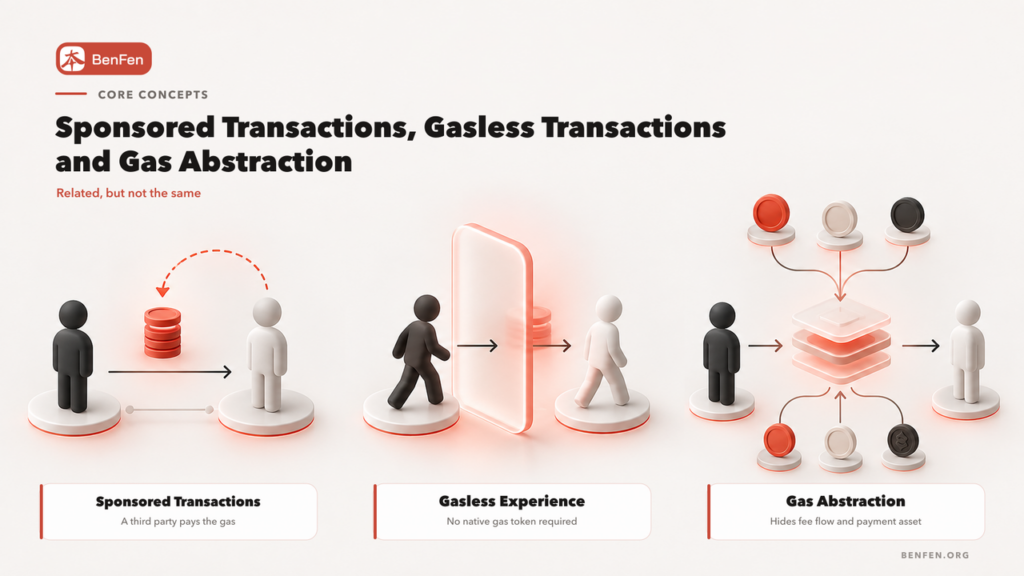
What Is the Difference Between Sponsored Transactions, Gasless Transactions, and Gas Abstraction?
These concepts are often used interchangeably, but they do not mean exactly the same thing.
| Concept | Core Meaning | Who Ultimately Bears the Cost? |
|---|---|---|
| Sponsored Transactions | A third party pays the network fee on behalf of the user | An application, wallet, merchant, or another sponsor |
| Gasless Transactions | A user experience in which the user does not need to prepare the native gas token directly | It may be the sponsor or the user |
| Gas Abstraction | The gas token, payment method, and fee process are abstracted away from the user interface | Depends on the implementation |
| Token-Based Gas Payment | The user pays the fee using a stablecoin or another supported token | Usually the user |
| Paymaster | A component that sponsors fees or processes gas payments in other tokens according to defined rules | The Paymaster initially covers the underlying fee and may charge the user in another asset |
For example, in some ERC-20 gas payment models, users do not need to hold ETH but still pay the Paymaster an equivalent amount in stablecoins. This is a form of gas abstraction, but it is not necessarily full third-party sponsorship.
A user not paying with the network’s native gas token does not automatically mean that the user bears no transaction cost.
How Do Sponsored Transactions Differ from Regular Transactions?
| Dimension | Regular Transaction | Sponsored Transaction |
|---|---|---|
| Transaction authorizer | The user | The user |
| Gas payer | Usually the user | An application, wallet, merchant, or another third party |
| Native gas token | The user usually needs to hold it in advance | The user may not need it, but the sponsor must be able to pay |
| User experience | The user manages gas directly | The application can handle the fee in the background |
| Cost model | The user pays each transaction fee | The sponsor treats gas as a customer acquisition, service, or operating cost |
| Eligibility | The user is willing to manage gas | The transaction must satisfy the sponsor’s rules |
| Risk control | The user manages their own balance and fees | The sponsor controls quotas, frequency, transaction scope, and abnormal requests |
| Service dependency | Primarily depends on the blockchain network | May also depend on a sponsorship service, Paymaster, or backend system |
Sponsored transactions are not necessarily more suitable than regular transactions in every situation.
For professional trading, complex DeFi operations, or high-value asset management, directly controlling gas may be more straightforward for the user. Sponsored transactions are generally more useful for applications that need to lower first-use friction, manage fees centrally, or provide targeted subsidies.
How Does a Sponsored Transaction Work?
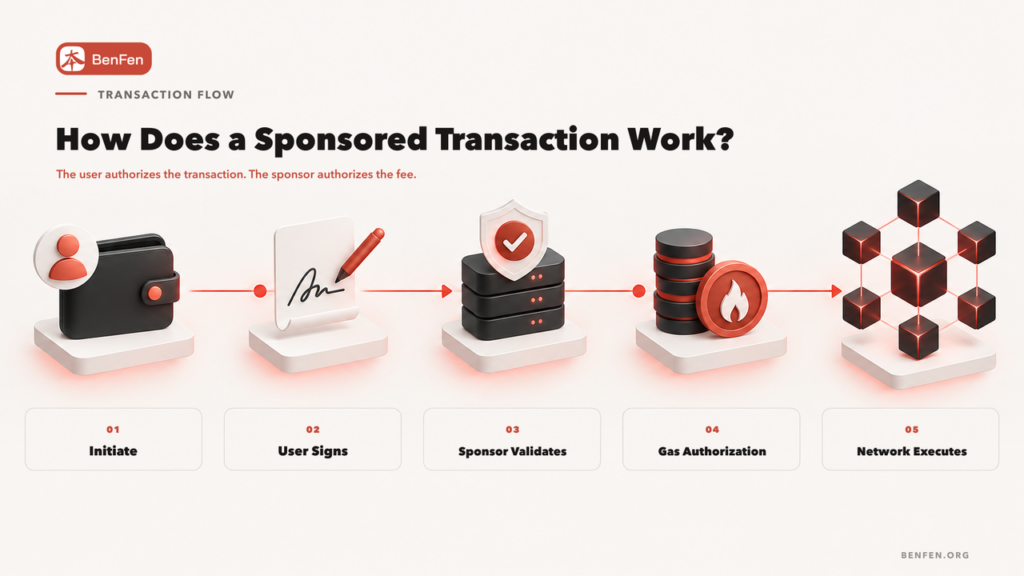
The exact transaction structure differs across networks, but a sponsored transaction generally includes the following steps.
1. The User Initiates an Action
The user selects a transfer, payment, asset claim, or smart contract interaction in a wallet or application.
The application constructs the transaction based on the user’s action. The transaction may include:
- The sender address;
- The recipient address;
- The asset and amount;
- The smart contract being called;
- The permitted method;
- The transaction expiry time;
- Other execution parameters.
2. The User Reviews and Signs
The user reviews the transaction details and signs to confirm that they agree to the proposed action.
The wallet should clearly display the asset, amount, recipient address, and scope of authorization. Sponsored transactions should not be used to conceal transaction details or encourage blind signing.
3. The Sponsor Validates the Request
The signed transaction request is sent to the sponsorship service. The sponsor determines whether it is willing to cover the fee according to predefined rules.
The validation process may examine:
- Whether the user or wallet is eligible for the subsidy;
- Whether the contract and method are within the permitted scope;
- Whether the user has exceeded a daily sponsorship limit;
- Whether the estimated gas exceeds the per-transaction limit;
- Whether the transaction is likely to fail;
- Whether the request appears duplicated, automated, or abnormal.
4. The Sponsor Authorizes the Gas Payment
Once the request passes validation, the sponsor adds the required gas payment information and completes the necessary signature or authorization.
Depending on the network, this may involve:
- The sponsor acting directly as the gas payer;
- A fee payer signing to authorize the transaction fee;
- A Paymaster validating the UserOperation and covering the cost;
- A relayer submitting the transaction and paying the underlying gas.
5. The Network Validates and Executes the Transaction
The blockchain network verifies:
- Whether the user authorized the transaction;
- Whether the sponsor authorized the fee payment;
- Whether the transaction satisfies the network rules;
- Whether the sponsor has sufficient balance, deposits, or gas objects.
If the transaction passes validation, it is executed and the fee is deducted from the sponsor’s account or the relevant funding pool.
Some networks may still charge a fee even if transaction execution fails. Sponsors therefore usually need to simulate transactions before submission and restrict gas limits and high-risk operations.
Which Use Cases Are Suitable for Sponsored Transactions?
A User’s First On-Chain Interaction
An application can sponsor account activation, a first transfer, or an initial smart contract call, reducing the need for users to buy gas tokens before trying the product.
Stablecoin Payments
When users hold USDT, USDC, or another stablecoin but do not hold the network’s native gas token, a wallet, merchant, or payment application can sponsor the fee according to predefined rules.
Gaming and Social Applications
Applications can cover fees for claiming in-game items, daily check-ins, character creation, and other low-value interactions, reducing the disruption caused by repeated gas prompts.
NFT and Campaign Claims
Projects can sponsor NFT minting, credential claims, or campaign reward transactions for eligible users.
Merchant Subsidies
A merchant can treat gas as part of its payment service cost, similar to subsidizing transaction fees in traditional payment systems.
Enterprise Batch Operations
Enterprise wallets or custody systems can use a centralized gas payer to manage fees across multiple business addresses instead of funding each address with native gas tokens.
Targeted User Incentives
An application can sponsor selected users, specific smart contract methods, or a limited number of transactions instead of offering unlimited subsidies for every on-chain action.
How Do Major Blockchain Networks Implement Sponsored Transactions?
There is currently no single cross-chain standard for sponsored transactions. Different networks provide similar experiences through protocol-level gas payers, fee payers, account abstraction, Paymasters, or relayers.
| Network | Main Implementation | Key Characteristics |
|---|---|---|
| Sui | Sponsored Transactions | A transaction can use a gas object owned by another address, with the user and sponsor providing separate authorization |
| Aptos | Fee Payer Transactions | The sender authorizes the transaction content, while the fee payer authorizes payment of the transaction fee |
| Ethereum/EVM | ERC-4337 Paymasters and Meta Transactions | A Paymaster can sponsor a UserOperation based on allowlists, signatures, quotas, and other conditions |
| Solana | Designated Fee Payer | A transaction can designate a third party as the fee payer, with the sender and sponsor signing separately |
| BenFen | Sponsored Transactions | The protocol separates the transaction sender from the gas payer, allowing the sponsor to validate the request before adding fee information and signing |
These approaches share the same general principle: transaction authorization and fee payment are separated. They differ in whether the capability is implemented through the protocol, account system, smart contract, or external service.
For example:
- Sui natively allows a transaction to use a gas object owned by another address;
- Aptos uses Fee Payer Transactions to let another account cover the fee;
- An ERC-4337 Paymaster can inspect a UserOperation and decide whether to sponsor it;
- Solana transactions can designate an independent fee payer, although the underlying network fee is still paid in SOL;
- BenFen separates the sender from the gas payer at the protocol level.
Developers should not evaluate these implementations solely according to whether they are described as native or non-native. They should also consider the signing process, backend dependencies, transaction simulation, fund management, service availability, and risk-control requirements.
What Risks Must Sponsors Control?
Sponsored transactions can improve the user experience, but they also transfer costs and some security responsibilities to the sponsor.
Sponsorship Funds Can Be Drained
Malicious users may create large numbers of addresses, repeatedly submit transactions, or deliberately construct high-gas operations to consume the sponsor’s budget.
Sponsors should establish:
- Per-user sponsorship limits;
- Per-address and per-device limits;
- Daily budget limits;
- Per-transaction gas limits;
- Transaction frequency controls.
Sybil Attacks and Automated Requests
Evaluating users only by wallet address may not prevent large-scale account creation. Depending on the business risk, applications may also consider account history, device signals, identity status, or other indicators.
Identity checks are not appropriate for every application, and applications should not collect more personal information than their business requires.
Sponsoring High-Risk Contract Calls
If a sponsor allows users to call arbitrary contracts or methods, attackers may use complex operations to consume excessive fees.
A more controlled approach is to restrict:
- Approved contracts;
- Approved methods;
- Asset and amount ranges;
- Transaction validity periods;
- Maximum gas budgets.
Failed Transactions May Still Generate Fees
Fee rules differ across networks. Even if the intended business operation fails, the sponsor may still pay some or all of the transaction fee.
Pre-execution simulation can help identify insufficient balances, invalid parameters, contract reverts, and abnormal gas estimates.
The Sponsorship Service Becomes an Availability Dependency
If an application depends entirely on a single Paymaster, gas station, or relayer, users may be unable to submit transactions when that service is unavailable or underfunded.
Applications should consider:
- Sponsorship balance monitoring;
- Multiple service nodes;
- Failover mechanisms;
- A fallback path that allows users to pay gas directly;
- Clear error and failure messages.
Wallet Display and Signing Risks
A gas-free experience does not mean users can ignore the transaction details. Wallets should still clearly display the asset, amount, destination address, contract method, and authorization scope.
The sponsorship service should not alter the business operation already authorized by the user.
How Does BenFen Support Sponsored Transactions?
BenFen separates the transaction sender from the gas payer at the protocol level. This allows the user to authorize the transaction content while another account covers the fee.
According to the BenFen English Whitepaper, the sponsored transaction process generally includes:
- The user constructs and signs a transaction based on the intended operation;
- The application sends the transaction and the user’s signature to the sponsor;
- The sponsor verifies identity conditions, transaction frequency, permitted operations, and other sponsorship rules;
- If the request passes validation, the sponsor adds information such as the gas payment address, acceptable gas price, and transaction fee limit;
- The sponsor signs to authorize payment of the network fee from its account;
- The complete transaction is submitted to the BenFen network for validation and execution.
This structure separates authorization of the asset operation from responsibility for the transaction fee. The user retains control over the transaction intent, while the sponsor decides whether to cover the cost according to its own policies.
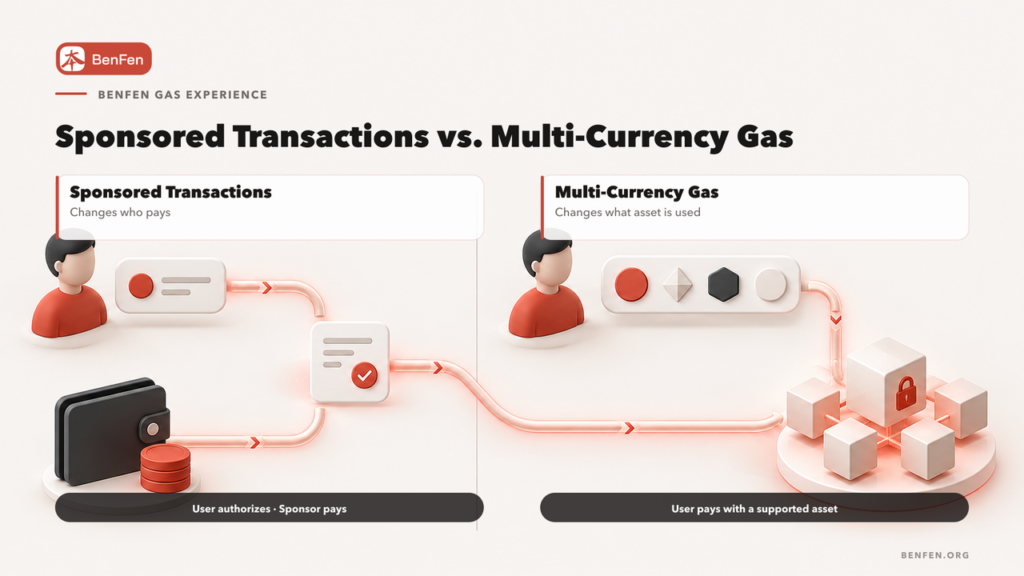
Sponsored Transactions vs. Multi-Currency Gas Payments
BenFen supports both sponsored transactions and multi-currency gas payments, but these capabilities address different problems.
| Capability | Problem Addressed | Who Bears the Cost? |
|---|---|---|
| Multi-Currency Gas Payments | Users are not limited to holding a single native gas token | The user pays with a supported asset |
| Sponsored Transactions | Users do not need to pay the fee for a particular transaction | An application, wallet, merchant, or another sponsor pays |
Multi-currency gas payments change which asset the user can use to pay the fee. Sponsored transactions change who pays the fee.
Assets that satisfy the network’s rules and support requirements may be used for gas payments. Supported assets, allowlisting requirements, and fee calculation methods should be verified through the BenFen official website and the latest technical documentation.
Applications in Stablecoin Payments
In a stablecoin payment scenario, a user may hold only the stablecoin they intend to spend, without holding BFC or another gas asset.
Depending on the application’s business rules, sponsorship can be provided for:
- A user’s first stablecoin transfer;
- Payments to designated merchants;
- Low-value payments;
- The first on-chain action after assets enter through a cross-chain bridge;
- A limited number of promotional interactions;
- Specific contracts and payment methods.
The user must still review and sign the payment intent, while the sponsor manages the fee and subsidy rules.
BenFen’s sponsored transactions primarily address on-chain fees and user onboarding. They do not mean that merchant acquiring, fiat settlement, refunds, KYC, licensing, or other regulatory procedures are automatically handled by the blockchain.
For a broader explanation of BenFen’s position within the stablecoin payment stack, read Why Do We Need Stablecoin-Native Blockchains?.
Why Do Sponsored Transactions Matter for Stablecoin Payments?
The core stablecoin payment experience should focus on the payment asset, amount, and recipient—not on requiring every user to understand the network’s native token.
Sponsored transactions can reduce friction associated with:
- Buying a separate gas token to make a stablecoin transfer;
- Maintaining small gas balances across multiple networks;
- Payment failures caused by insufficient gas balances;
- New users abandoning the process before their first on-chain interaction;
- Merchants being unable to manage the fee experience consistently.
However, sponsored transactions address only one part of the payment flow.
A complete stablecoin payment may still involve:
- Wallets and transaction authorization;
- On-chain confirmation;
- Cross-chain assets and liquidity;
- Merchant order matching;
- Asset conversion;
- Refunds and disputes;
- Reconciliation;
- KYC, KYB, and transaction monitoring;
- Fiat on-ramps, off-ramps, and settlement.
Sponsored transactions should therefore be understood as a gas and user-onboarding component within stablecoin payment infrastructure—not as a complete payment system.
Conclusion: Sponsored Transactions Are a Fee and Operations Mechanism
Sponsored transactions allow users to authorize on-chain actions while an application, wallet, merchant, or another third party pays the gas fee. They reduce the need for users to hold native gas tokens in advance and provide a more flexible fee model for stablecoin payments, user onboarding, and frequent low-value interactions.
Sponsored transactions do not eliminate network costs or automatically drive user growth. Instead, they transfer cost, availability, and abuse-prevention responsibilities to the sponsor.
When designing a sponsorship system, developers should look beyond whether the experience appears gas-free and answer several operational questions:
- Which users are eligible for sponsorship?
- Which transactions can be sponsored?
- How many sponsored transactions can each user receive?
- Who bears the cost of failed transactions?
- How will automated and abusive requests be controlled?
- What happens when the sponsorship service is unavailable?
For BenFen, the main value of sponsored transactions lies in separating the user’s signature from gas payment and combining this mechanism with multi-currency gas support and stablecoin payment scenarios. This reduces the need for users to prepare a separate native gas token.
As wallets, payment applications, and consumer-facing services continue to develop, sponsored transactions may become a common user-experience capability. Whether and how they should be implemented, however, still depends on the application’s cost structure, risk tolerance, and business requirements.
Sponsored Transactions FAQ
Are Sponsored Transactions Completely Free?
They can appear gas-free to the user, but the network fee still exists. The sponsor pays it instead of the user.
Are Sponsored Transactions Safe?
Their safety depends on user signatures, wallet transaction displays, sponsor validation, smart contract logic, and key management. Users must still verify transaction details, while sponsors need quotas, allowlists, and abuse-prevention controls.
Can a Sponsor Control the User’s Assets?
Paying gas does not give the sponsor permission to bypass user authorization and control the user’s assets. In a properly designed system, the user still signs the transaction intent and the network verifies the relevant signatures.
What Is the Difference Between a Sponsored Transaction and a Paymaster?
A sponsored transaction describes the outcome in which a third party pays the user’s fee. A Paymaster is a specific component used in some account-abstraction systems to sponsor gas or process fee payments in other tokens.
What Is the Difference Between Sponsored Transactions and Multi-Currency Gas Payments?
Multi-currency gas payments allow users to pay fees with other supported assets. Sponsored transactions allow another party to pay the fee. The two capabilities can be used separately or together.
Does the Sponsor Still Pay Gas If the Transaction Fails?
It depends on the network and implementation. Some networks still charge fees for failed transactions, so sponsors should simulate transactions and set gas limits.
Which Use Cases Are Suitable for Sponsored Transactions?
Common use cases include first-time user interactions, stablecoin payments, gaming actions, NFT claims, promotional subsidies, merchant payments, and frequent low-value transactions.
How Does BenFen Implement Sponsored Transactions?
BenFen separates the transaction sender from the gas payer at the protocol level. The user signs the transaction intent, the sponsor validates the sponsorship conditions, adds the gas information, and signs before submitting the complete transaction to the network.
Risk Disclaimer
This article is for technical and industry information only. It does not constitute investment, legal, tax, or regulatory advice.
Sponsored transactions may involve risks such as sponsorship fund losses, bots and Sybil attacks, fees from failed transactions, Paymaster or relayer outages, blind signing, smart contract vulnerabilities, and incorrect permission configurations.
Before deploying sponsored transaction functionality, developers should review the latest technical specifications of the target network, conduct appropriate testing and security audits, and establish budgets, transaction simulation, limits, abuse prevention, monitoring, and incident-response procedures.
Sources
- BenFen English Whitepaper
- BenFen Official Website
- Sui: All About Sponsored Transactions
- Sui: Scaling Gas Payment Sponsorship with the Sui Gas Pool
- Aptos Developer Documentation
- ERC-4337: Paymasters
- ERC-4337: Paymaster Design Patterns
- Solana: Fee Abstraction