
As the multi-chain ecosystem continues to evolve, cross-chain bridges have gradually become an essential piece of infrastructure in the DeFi world.
In real-world use cases, users need to transfer USDT, USDC, ETH, and other assets across different blockchains; developers need assets to circulate across multiple ecosystems; and emerging scenarios such as stablecoin payments, on-chain finance, RWA, PayFi, and AI Agent payments are increasingly dependent on cross-chain capabilities.
At the same time, however, cross-chain bridges are also becoming one of the most dangerous security weak points in the entire blockchain ecosystem.
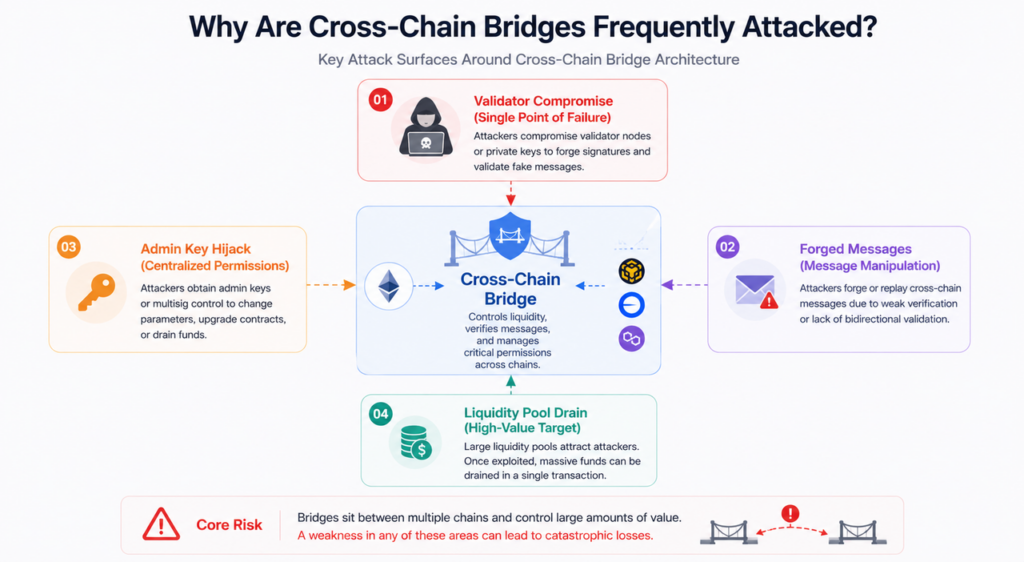
After two major cross-chain bridge attack incidents drew industry attention in April 2026, the attacks have not ceased in May:
- In April, KelpDAO lost approximately $292 million due to a cross-chain verification flaw that allowed attackers to forge messages.
- In April, Syndicate Commons suffered an exploit involving bridge permissions and messaging issues, resulting in roughly $330,000–$400,000 in SYND tokens being stolen and the token price dropping nearly 35%.
- On May 18, the Verus-Ethereum Bridge was hacked due to a validation logic defect (insufficient checking of source chain asset totals against minted amounts), leading to the theft of about $11.58 million in assets (ETH, tBTC, and USDC).
These attacks were not traditional “smart contract hacks.” Instead, attackers exploited trust vulnerabilities within cross-chain bridge designs.
In fact, this is far from the first time cross-chain bridges have become primary targets in major Web3 security incidents. Historically, well-known bridges such as Ronin Bridge, Wormhole, and Harmony Horizon have also suffered massive security breaches resulting in losses worth hundreds of millions of dollars.
As a result, more users are beginning to rethink several critical questions:
- Are cross-chain bridges actually safe?
- Why do cross-chain bridges so frequently become hacker targets?
- How can ordinary users reduce cross-chain risks when using bridge protocols?
In the following sections, we will provide a comprehensive overview of cross-chain bridge security from four perspectives:
- How cross-chain bridges work
- Common attack vectors
- Major risk categories
- Best practices for both users and projects
What Is a Cross-Chain Bridge?
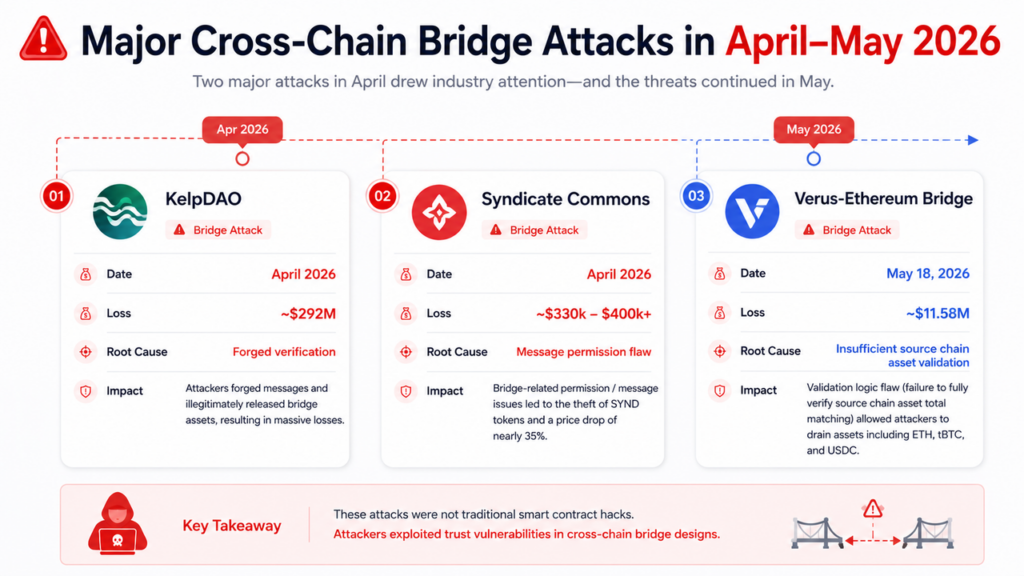
A cross-chain bridge is essentially a protocol used to transfer assets and data between different blockchains.
You can think of it as an interchange connecting two otherwise disconnected highways:
- When a vehicle reaches the interchange, it continues onto another road while preserving its value and state.
In the crypto world, this “switching roads” process may involve:
- Transferring USDT from Ethereum to BNB Chain
- Moving assets from Arbitrum to Base
- Bridging stablecoins from Polygon to BenFen Chain
- Managing multi-chain asset transfers within a Web3 wallet
Because different blockchains are naturally incompatible with one another, cross-chain bridges must handle several critical responsibilities:
- Verifying transactions on the source chain
- Locking or burning assets on the source chain
- Minting mapped assets on the destination chain
- Synchronizing cross-chain messages
- Releasing funds on the destination chain
Throughout this process, cross-chain bridges effectively control significant assets and permissions, including:
- Control over liquidity pools
- Verification rights for cross-chain messages
- Administrative permissions for key parameters and contract upgrades
This is why cross-chain bridges are not merely “channels” for asset transfers. They are highly complex, high-risk infrastructure systems — and therefore one of the most attractive targets for hackers.
Why Are Cross-Chain Bridges Frequently Attacked?
Many users assume: “As long as the smart contract has passed an audit, it must be safe.”
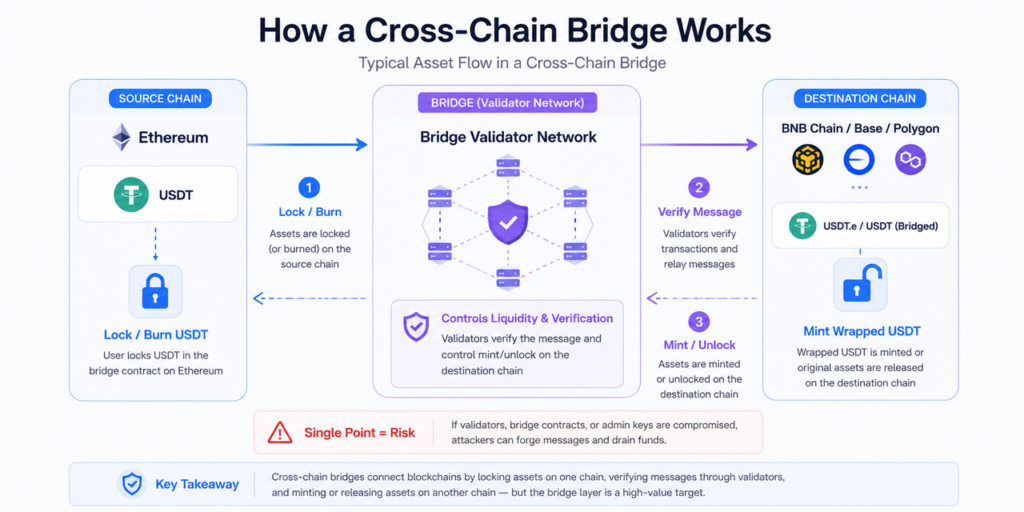
Reality is far more complicated. The security risks of cross-chain bridges do not come solely from the smart contract code itself. More often, risks stem from broader verification architecture, trust model, and surrounding infrastructure.
The following risks have become some of the most common root causes behind major bridge attacks in recent years.
- Single Point of Failure
Many cross-chain bridges rely on only a small number — or even a single — validation node for the sake of development efficiency and lower operational costs.
Once hackers compromise a core validator, they may be able to:
- Forge cross-chain messages
- Fake deposit records
- Release assets that never actually existed
This attack model was central to incidents such as KelpDAO and Verus. Conceptually, this type of centralized trust model directly conflicts with blockchain’s decentralized philosophy, yet many bridge projects continue to rely on it, making it one of the weakest points in the entire system.
- Lack of Bidirectional Verification
Some bridges only verify whether the destination chain has received a message, without validating whether the source-chain transaction genuinely occurred.
This “one-way verification” model creates major attack opportunities:
Attackers can forge a single cross-chain message and trick the system into believing assets were legitimately deposited, triggering unauthorized releases.
A simple analogy: A bank verifies whether a check looks authentic, but never checks whether the account actually contains sufficient funds.
- Excessively Centralized Permissions
Some bridge projects rely on “super admin privileges” or single-signature control mechanisms:
- One address can withdraw all liquidity pool assets
- One individual can modify critical parameters or upgrade contracts
If these high-privilege accounts are compromised through phishing, leaks, backend breaches, or API hijacking, attackers can quickly reset bridge logic or drain funds entirely.
- Large Liquidity Pools Naturally Attract Hackers
Cross-chain bridges often custody hundreds of millions of dollars in assets, making them extremely high-value targets. Even when attack costs are high, a single successful exploit can easily justify months of preparation for attackers. This is one reason cross-chain bridges consistently rank among the most heavily attacked sectors in Web3.
What Do the 2026 Cross-Chain Bridge Attacks Reveal?
Since 2026, cross-chain bridge attacks have occurred one after another. These consecutive incidents (KelpDAO, Syndicate Commons, Verus, etc.) collectively demonstrate that hackers are consistently targeting aspects such as cross-chain verification, message validation, and accounting logic.
The common thread between the KelpDAO, Syndicate Commons, and Verus-Ethereum bridge incidents is very clear: Hackers attacked the bridge — not the blockchain itself.
These attacks primarily exploit flaws in verification mechanisms, message forgery, and mismatches in accounting logic, rather than traditional smart contract vulnerabilities. This indicates that cross-chain bridges have gradually evolved from early “functional components between chains” into critical infrastructure within the entire DeFi ecosystem. Once a bridge malfunctions, the impact extends beyond a single chain; it affects the liquidity, asset stability, and user trust of the multi-chain ecosystem.
When a bridge fails, the consequences extend far beyond a single chain:
- User assets may be released illegitimately and become unrecoverable
- Stablecoins may experience volatility due to liquidity fragmentation and collapsing confidence
- Multi-chain liquidity can break down suddenly, triggering cascading liquidations across DeFi protocols
- Overall trust in cross-chain infrastructure may decline sharply
As a result, more projects are prioritizing:
- Decentralized verification systems
- Multi-signature governance and permission separation
- Time-lock mechanisms and delayed execution
- Fund isolation and layered risk management
- Continuous monitoring and auditing of cross-chain messages
These are also core principles considered by the BenFen ecosystem and its application-layer product BenPay when designing cross-chain infrastructure capabilities.
Evolution of Cross-Chain Bridge Security Incidents and Industry Improvements (2022–2026)
Over the past few years, cross-chain bridge attacks have shown a clear phased evolution. Hacking techniques have continued to upgrade, while the industry and users have accumulated valuable lessons from these incidents.
2022: The Year of Trust Assumptions and Key Management Disasters
This year was known as the “Bridge Disaster Year,” with cumulative losses exceeding $2 billion. Notable cases include:
- Ronin Bridge (approx. $624 million): 5 out of 9 validation nodes had their private keys compromised;
- Wormhole (approx. $326 million): Signature verification logic vulnerability;
- Harmony Horizon (approx. $100 million), Nomad (approx. $190 million), and others.
Core Issues: Heavy reliance on a small number of validation nodes or multisigs, weak private key management, and obvious flaws in smart contract initialization and verification.
Industry Improvements: Many bridges shifted toward multisig + distributed validation, launched bug bounty programs, and strengthened contract audits.
Lessons for Users: Do not blindly trust “more nodes = safer.” Priority should be given to bridges with transparent and highly decentralized verification mechanisms.
2023–2024: Shift from Key Theft to Logic and Permission Vulnerabilities
As multisig and distributed validation became more widespread, attackers shifted focus to smart contract logic flaws, permission management issues, and centralized components. Typical incidents include:
- Multichain (July 2023, approx. $125 million): Large-scale unauthorized withdrawals caused by compromised keys controlled by the CEO or internal issues.
- Orbit Chain (late 2023, approx. $81 million): 7 out of 10 multisig keys were compromised.
These events exposed a critical problem: even with multisig, if permissions are overly concentrated or upgrade processes are insecure, funds can still be drained in a single transaction.
Industry Improvements: Introduction of timelocks, principle of least privilege, upgradeable proxy patterns, stricter on-chain monitoring, and automatic pause mechanisms.
Lessons for Users: Maintain high vigilance toward new projects or recently launched bridges. Avoid keeping large amounts of assets in bridge liquidity pools for extended periods.
2025–2026: Validation Logic and Accounting Matching Attacks
Hackers began paying more attention to deep validation logic in cross-chain messaging, including message forgery and mismatches between source chain asset totals and target chain minting amounts (accounting logic flaws). Notable cases include KelpDAO and the Verus-Ethereum Bridge.
Industry Improvements: Moving toward more decentralized validation networks (such as multi-DVN, light clients + ZK proofs), bidirectional/complete verification (verifying not only messages but also asset total matching), real-time anomaly monitoring, and fund layering & isolation designs. Some protocols also began adopting native cross-chain protocols (e.g., improved versions of IBC and CCIP) to reduce reliance on third-party bridges.
Lessons for Users: The importance of small-amount testing has become even more critical. When using any cross-chain bridge, always perform a small test transaction to verify the full process before moving large amounts.
Summary and Key Takeaways:
Cross-chain bridge security is evolving from “trusting a few entities” toward “trust minimization and verifiability.” For ordinary users, the core lessons from these incidents are: the fewer cross-chain operations, the better; always adhere to the small-amount testing principle; prioritize mature bridges that have been operating for a long time, enjoy strong community recognition, and feature high decentralization; and develop good habits such as wallet separation and regular authorization revocation.
Although attacks have not stopped, every major incident has driven significant progress in the industry’s verification mechanisms, permission controls, and monitoring systems. In the future, cross-chain bridges will place greater emphasis on on-chain provability and real-time risk control.
Common Types of Cross-Chain Bridge Risks
No matter which bridge protocol you use, it is important to develop a structured understanding of common bridge risks rather than relying on vague assumptions that “bridges feel unsafe.”
- Verification Mechanism Vulnerabilities
Verification systems are the first line of defense for any bridge.
Poorly designed mechanisms may include:
- Single-node validation
- Oversimplified signature systems
- Incomplete message verification
Attackers can exploit these weaknesses to forge messages and bypass legitimate validation flows.
For instance, the Verus-Ethereum cross-chain bridge attack in May 2026 was due to a flaw in the verification logic (failing to fully verify that the total assets of the source chain matched the amount released by the target chain), which enabled the attacker to forge cross-chain messages at a lower cost and over-withdraw funds.
- Smart Contract Logic Flaws
Even if the verification mechanism itself works correctly, the underlying smart contracts may still contain vulnerabilities such as:
- Missing permission checks
- Reentrancy vulnerabilities
- Insufficient validation of amounts, chain IDs, or destination addresses
- Unsafe upgrade mechanisms
Many vulnerabilities are discovered long after audits are completed, proving that long-term maintenance matters far more than a one-time audit.
- Centralized Infrastructure Risks
Although many bridges market themselves as “decentralized,” they still rely heavily on:
- Centralized APIs
- Traditional server deployments
- Highly concentrated validator clusters
If these centralized components are compromised, the bridge’s “decentralized” security assumptions can collapse instantly.
- Oracle and External Data Risks
Cross-chain bridges often rely on oracles or off-chain data sources to obtain state information, pricing data, and external proofs. If an oracle is manipulated, an off-chain data source is compromised, or the message synchronization mechanism malfunctions, the bridge may execute incorrect asset transfer operations, resulting in misallocated funds or malicious arbitrage opportunities.
- Liquidity Pool Risks
In many cross-chain bridge designs, user funds are concentrated in one or a small number of liquidity pools, effectively creating a “high-risk amplifier.” Once a liquidity pool is compromised, attackers can drain a massive amount of assets in a single exploit, while the losses distributed across numerous users are often impossible for a single protocol to fully cover.
Overall, every stage of a cross-chain bridge — from source-chain verification, message synchronization, and destination-chain asset release, to underlying permission management and fund custody — can potentially become an attack vector.
Summary of Typical Cross-Chain Bridge Attack Risks
Based on major security incidents in recent years, most cross-chain bridge attacks ultimately stem from weaknesses in three key areas: validation mechanisms, message verification, and permission management.
The table below provides a quick overview of the most common bridge security risks and representative attack cases:
| Risk Type | Core Cause | Representative Cases |
| Single Point of Validation Risk | Too few validator nodes / overly concentrated private keys | KelpDAO, Ronin |
| Message Verification Flaws | Lack of bidirectional verification / forged cross-chain messages | Syndicate Commons |
| Smart Contract & Permission Vulnerabilities | Permission logic flaws / reentrancy attacks | Wormhole |
How Can Ordinary Users Use Cross-Chain Bridges More Safely?
For ordinary users, the most important thing is not to understand all the technical details, but to establish a set of long-term and executable security operation habits. The following points are the “cross-chain security guidelines” that have been widely recognized after being verified by multiple security incidents.
- Minimize Unnecessary Cross-Chain Transfers
Every cross-chain transaction requires assets to pass through a third-party bridging system, increasing exposure to additional attack surfaces. In general, the more frequently assets are bridged across chains, the higher the overall risk exposure.
Recommendations:
- Reduce the frequency of cross-chain transfers whenever possible;
- Avoid repeatedly moving assets back and forth across multiple chains;
- Prioritize mature cross-chain protocols with a long operating history, strong reputation, and verified audit records.
- Avoid Using Newly Launched Cross-Chain Bridges Too Quickly
Newly launched bridges often prioritize functionality over security:
- They lack real-world battle testing, and vulnerabilities may only emerge after a period of operation;
- Risk control and monitoring systems are often still immature;
- Their security models may not have undergone long-term validation.
Many major attacks have occurred during the “honeymoon period” within the first 1–3 months after launch.
Therefore:
- Do not blindly use a new bridge simply because of high APY incentives or subsidies;
- Give preference to bridges with longer operational histories, completed audits, and stronger community feedback, such as the BenFen Bridge.
- Start With a Small Test Transaction Before Large Transfers
When using an unfamiliar cross-chain bridge for the first time, testing the full process with a small amount of funds remains one of the simplest and most effective risk management practices.
Recommendations:
- Begin with a very small cross-chain transfer;
- Carefully verify that the destination chain is correct, the tokens arrive successfully, fees are reasonable, and wallet activity appears normal;
- Proceed with larger transfers only after confirming everything works properly.
In the context of BenPay cross-chain bridge usage, users can first test the route with a small amount of USDT or stablecoins on the target chain before executing larger fund movements. This allows users to experience the bridge functionality while effectively controlling risk exposure.
- Be Cautious With Approval Permissions
In cross-chain scenarios, users are often required to perform “approve” actions or sign transaction messages. In many cases, stolen assets are not caused by the bridge itself being compromised, but rather because:
- Users granted “unlimited approval” permissions to malicious contracts or fake platforms;
- Phishing websites tricked users into signing seemingly legitimate transaction requests.
Recommendations:
- Avoid signing transactions on unknown websites or suspicious links;
- Stay highly cautious when encountering “approve” pop-ups or unfamiliar signature requests;
- Regularly review wallet approval permissions and revoke authorizations that are no longer needed.
- Separate “Asset Wallets” From “Interaction Wallets”
One of the most effective Web3 security practices is separating long-term asset storage from daily interaction activities.
Recommended setup:
- Main wallet: Used only for storing large balances and long-term holdings, with minimal interaction activity;
- Operational wallet: Dedicated to DeFi, cross-chain activity, gaming, governance voting, and other frequent interactions;
- High-risk testing wallet: Isolated specifically for testing new projects or newly launched bridges.
This approach ensures that even if an interaction wallet or testing wallet is compromised due to approval abuse, private key leakage, or operational mistakes, the primary wallet holding larger assets remains protected — reducing the risk of losing all funds in a single incident.
Cross-Chain Applications Within the BenFen Ecosystem
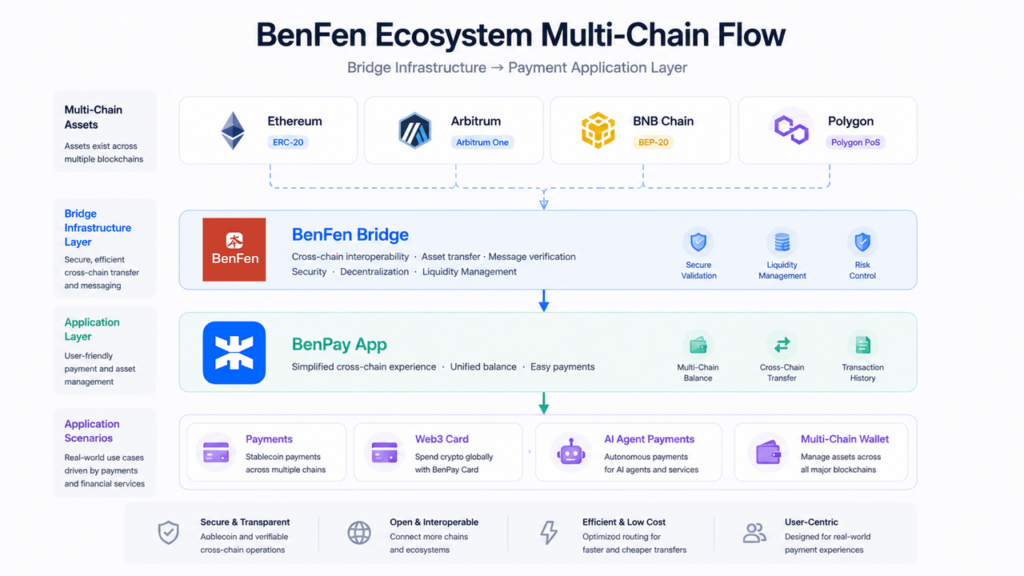
As the multi-chain ecosystem continues to evolve, cross-chain functionality has expanded beyond being a tool used only by a small group of DeFi participants. It is increasingly becoming a broader layer of infrastructure, extending into areas such as PayFi, stablecoin payments, Web3 wallets, on-chain commerce, AI Agent automated payments, and multi-chain asset management.
For public blockchain ecosystems, the importance of cross-chain bridges goes far beyond simple asset transfers. More importantly, they serve as the liquidity connection layer between different chains.
Against this backdrop, multi-chain bridge solutions — including BenFen Bridge — are exploring more open and secure cross-chain infrastructure centered around cross-chain asset circulation, stablecoin transfers, and multi-chain interoperability. Their key objectives include:
- Improving the usability and liquidity efficiency of multi-chain assets;
- Lowering the barriers to asset transfers between different blockchains;
- Supporting the circulation of stablecoins and on-chain assets across ecosystems;
- Providing cross-chain support for DeFi, payments, wallets, and on-chain commerce scenarios.
At the same time, BenPay App — the application-layer product built within the BenFen public chain ecosystem — is further integrating cross-chain functionality into users’ everyday experiences.
For example, in scenarios such as stablecoin payments, multi-chain USDT management, on-chain treasury movement, and Web3 Card top-ups, cross-chain bridges are gradually evolving from “underlying protocols primarily used by developers” into more user-friendly entry points for transfers, payments, and fund collection.
As AI Agent payments, stablecoin payments, and multi-chain wallets continue to develop, cross-chain bridges are also evolving from purely DeFi-focused tools into a broader layer of payment infrastructure.
How Can Projects Improve Cross-Chain Bridge Security?
For protocols and project teams, “cross-chain security” is never something that can be solved through a one-time audit before launch. Instead, it requires a long-term operational security framework and engineering system.
The most effective ways to improve the security level of cross-chain bridges generally focus on the following areas.
- Decentralized Validation to Avoid Single Points of Failure
The validation mechanism is the core security checkpoint of any cross-chain bridge architecture. Projects should avoid allowing a single node — or a small group of nodes — to fully control the validation process. Instead, they should adopt:
- Multi-node validation systems;
- Decentralized validator networks;
- Multi-signature and distributed consensus mechanisms.
This approach helps reduce the risk of the entire system being compromised due to a single point of failure or a malicious actor.
- Principle of Least Privilege and Time Locks
When designing bridge permissions, projects should follow the principle of least privilege:
- Super-admin permissions should be divided and distributed;
- Critical operations (such as contract upgrades, liquidity pool withdrawals, or fee adjustments) should require multi-signature approval;
- Sensitive operations should include time locks or delayed execution mechanisms to provide teams and users with a response window.
With this structure in place, even if privileged access is compromised, teams and users still have time to react instead of seeing funds drained instantly.
- Continuous Security Monitoring Instead of “One-Time Audits”
Many major exploits occur during the post-audit operational phase, because attack vectors and combined vulnerabilities often emerge only after long-term real-world usage.
Therefore, project teams should:
- Establish 24/7 monitoring for abnormal transactions and cross-chain message activity;
- Implement automated alert systems and circuit breaker mechanisms;
- Regularly review and audit liquidity pools, on-chain activity, and contract upgrades;
- Maintain the ability to pause or restrict critical operations when anomalies are detected, keeping risks under control.
Only through an integrated framework combining development, operations, and security can projects build a truly resilient long-term cross-chain bridge system.
- Liquidity Pool Isolation and Risk Segmentation
In traditional finance, institutions do not place all funds into a single account — and the same principle should apply to cross-chain systems.
Projects can improve security by:
- Separating protocol treasury funds, user assets, fees, and collateral into independent vaults or pools;
- Applying different risk management strategies to different categories of liquidity pools;
- Setting withdrawal limits for individual pools to prevent a “single-hit drain” scenario.
This layered and isolated architecture helps contain losses within a manageable scope if one component is compromised, rather than allowing failure to impact the entire protocol.
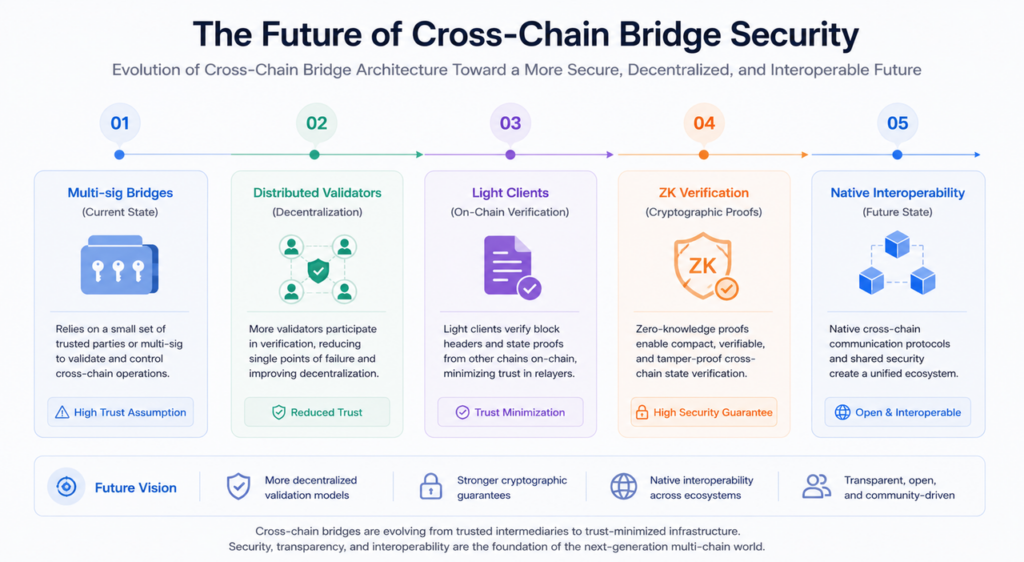
The Future Development of Cross-Chain Bridges
While cross-chain bridges have become one of the most critical security weak points in the blockchain industry, the ecosystem is also actively exploring safer and more advanced architectures. Future developments in cross-chain bridge technology are likely to focus on the following directions:
- More Decentralized Validation Models
Through approaches such as light clients, committee-based systems, and distributed validator networks, the industry is working to reduce reliance on single validators or relay operators. The goal is to move toward “trust-minimized” architectures and gradually move away from the high-risk design of traditional multi-signature bridges.
- Combining Zero-Knowledge Proofs (ZK) With Light Client Verification
Technologies such as zk-SNARKs, zk-STARKs, and ZK-Rollups can enable cross-chain verification to be completed on-chain in a more compact and verifiable manner. This improves both security and provability while reducing dependence on centralized oracles and relayers.
- Native Cross-Chain Communication Protocols and Shared Security Mechanisms
Interoperability protocols such as IBC, LayerZero, and CCIP are pushing the development of native interoperability layers, enabling messages and assets to move across chains in a more secure and standardized way — rather than relying entirely on third-party bridge layers.
- On-Chain SDKs and Standardized Interfaces
By introducing unified on-chain SDKs and standardized interfaces, developers can implement similar cross-chain logic across multiple blockchains. This helps reduce the security blind spots caused by highly customized bridge architectures while also making auditing and formal verification easier.
- More Transparent and Participatory Risk Monitoring Systems
Future cross-chain bridges will increasingly rely on real-time anomaly detection, on-chain behavioral analysis, and public risk dashboards. Some systems may also introduce community governance mechanisms, enabling protocols to respond quickly, pause operations, or upgrade systems during emergencies — instead of depending solely on centralized “black-box” decision-making.
Overall, cross-chain bridges are evolving from relatively crude liquidity pipelines into more secure, provable, and governable interoperability layers.
Under this trend, BenFen and BenPay will also continue to advance by:
- Adopting more decentralized validation mechanisms at the infrastructure layer;
- Providing more transparent user guidance and risk disclosures at the application layer;
- Maintaining long-term investment in security operations rather than relying solely on one-time audits.
Cross-Chain Bridges FAQ
Why are cross-chain bridges hacked so frequently?
Because they simultaneously manage assets, validate messages, and connect multiple blockchains, creating much larger attack surfaces than typical DeFi protocols.
Are cross-chain bridges riskier than exchange transfers?
Not necessarily, but bridge protocols involve more complex smart contract and verification logic.
What is the most important security habit when using bridges?
Small test transfers, avoiding unlimited approvals, and separating storage wallets from interaction wallets.
Which types of bridges are generally safer?
Protocols with more decentralized validation mechanisms, longer operating histories, and stronger auditing/risk management systems generally carry lower risk.
Conclusion: Cross-Chain Bridge Security Is About Risk Management
The KelpDAO, Syndicate Commons and Verus incidents once again prove that cross-chain bridges are not simple transfer tools.
They are high-risk infrastructure systems responsible for connecting chains, managing assets, and handling complex verification logic.
For users, the best protection strategies remain:
- Reduce unnecessary bridging
- Be cautious with approvals
- Use transparent and battle-tested bridge protocols such as BenFen Bridge
- Diversify wallet exposure
- Test with small amounts before large transfers
For projects and ecosystems, real cross-chain security depends on:
- Decentralized verification
- Permission management
- Real-time monitoring and risk control
- Transparent governance
- Long-term security operations
As stablecoin payments and multi-chain ecosystems continue to grow, cross-chain bridges will become increasingly important.
But regardless of how technology evolves, security must always come before functionality.
Disclaimer: This article is for educational and informational purposes only and does not constitute investment or financial advice. Cross-chain operations always involve risks. Users should conduct their own research and only use funds they can afford to lose.