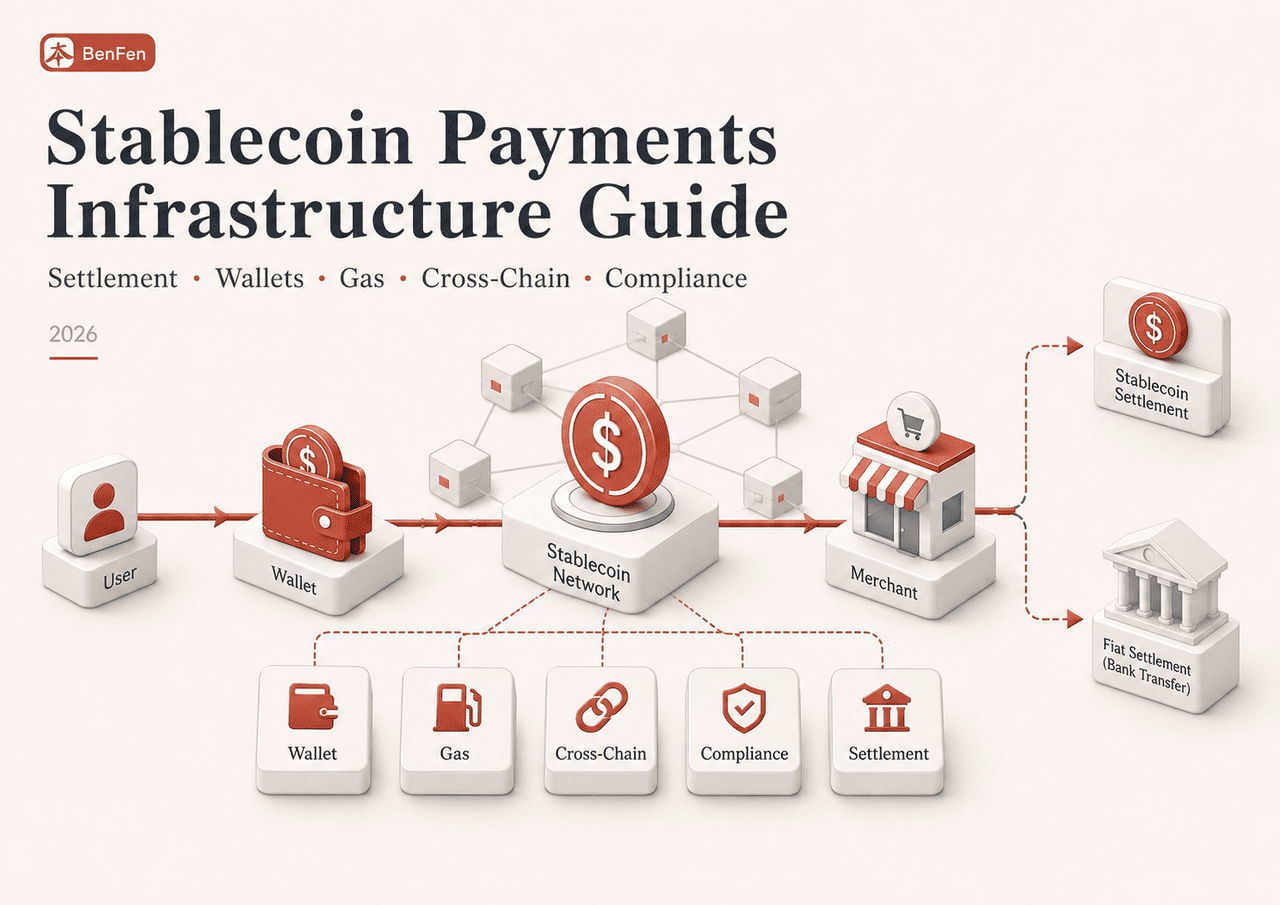
Introduction: Stablecoin Payments Are More Than Sending USDT to Another Address
Stablecoin payments are payments, receipts, or settlements made using blockchain-based assets designed to maintain a relatively stable value.
A complete stablecoin payment involves more than simply sending USDT, USDC, or another stablecoin from a wallet. It may also involve stablecoin issuance and redemption, user on-ramps, wallet signing, blockchain confirmation, gas payments, merchant acquiring, asset conversion, fiat off-ramps, compliance reviews, transaction monitoring, and financial reconciliation.
Stablecoins can shorten certain value-transfer paths, but they do not automatically replace every participant in the payment system. What ultimately determines whether stablecoin payments can be adopted by businesses and everyday users is whether the underlying infrastructure can address all of the following:
- How users obtain and securely hold stablecoins;
- How payment requests are generated and confirmed;
- Which blockchain is used for settlement;
- Who pays the gas fees;
- Whether merchants ultimately receive stablecoins or fiat currency;
- How assets move between different blockchains;
- How KYC, KYB, AML, and sanctions screening are conducted;
- How refunds, reconciliation, and unusual transactions are handled;
- Whether the stablecoin can be redeemed as agreed.
This guide explains what stablecoin payments are, how the complete payment flow works, the roles of wallets and settlement, and which modules stablecoin payment infrastructure requires, as well as how BenFen and BenPay provide support at the network and application layers respectively.
Key Takeaways
- A stablecoin transfer is only one part of the payment flow. A complete payment process also includes acquiring, conversion, settlement, compliance, and reconciliation.
- On-chain confirmation does not necessarily mean that a merchant has already received usable fiat funds.
- Wallets manage accounts, keys, and transaction authorization, but they do not necessarily handle stablecoin issuance, conversion, or merchant settlement.
- Stablecoin payments can operate around the clock, but on-ramps, off-ramps, and bank settlement may still be subject to business hours, regional availability, and service-provider rules.
- A stablecoin-native blockchain is not required for stablecoin payments, but a network optimized for payments can reduce friction around gas, account onboarding, and transaction confirmation.
- BenFen provides underlying capabilities such as blockchain execution, gas, sponsored transactions, and cross-chain infrastructure, while BenPay connects users with payment scenarios through wallets, asset conversion, payment cards, and application-layer interactions.
What Are Stablecoin Payments?
Stablecoin payments refer to the use of stablecoins by a payer to fulfill an obligation for goods, services, or other payments. The recipient may receive the stablecoin directly, or a payment provider may convert it into another stablecoin or fiat currency.
Common use cases include:
- Consumers purchasing goods or services from merchants;
- Businesses making cross-border payments to suppliers;
- Platforms making batch payouts to creators or partners;
- Companies distributing salaries, compensation, or allowances;
- Users making cross-border remittances;
- Merchants consolidating online revenue into treasury accounts;
- On-chain applications using stablecoins for subscriptions, collateral, margin, or service-fee settlement.
What Is the Difference Between a Stablecoin Transfer, Trade, Payment, and Settlement?
| Activity | Primary Purpose | Involves Goods or Services? | Requires Merchant Settlement? |
|---|---|---|---|
| Stablecoin transfer | Move assets from one address to another | Not necessarily | Not necessarily |
| Stablecoin trade | Exchange a stablecoin for another asset | Usually no | Usually no |
| Stablecoin payment | Fulfill an obligation for goods, services, or commercial payments | Usually yes | Usually yes |
| Stablecoin settlement | Complete the transfer of funds between participating parties | Possibly | Yes |
Sending stablecoins to an address does not automatically constitute a commercial payment. A more complete payment flow is formed only when the transfer is linked to an order, contract, invoice, or other payment obligation, and when receipt confirmation and accounting records are completed.
How Does a Stablecoin Payment Work?
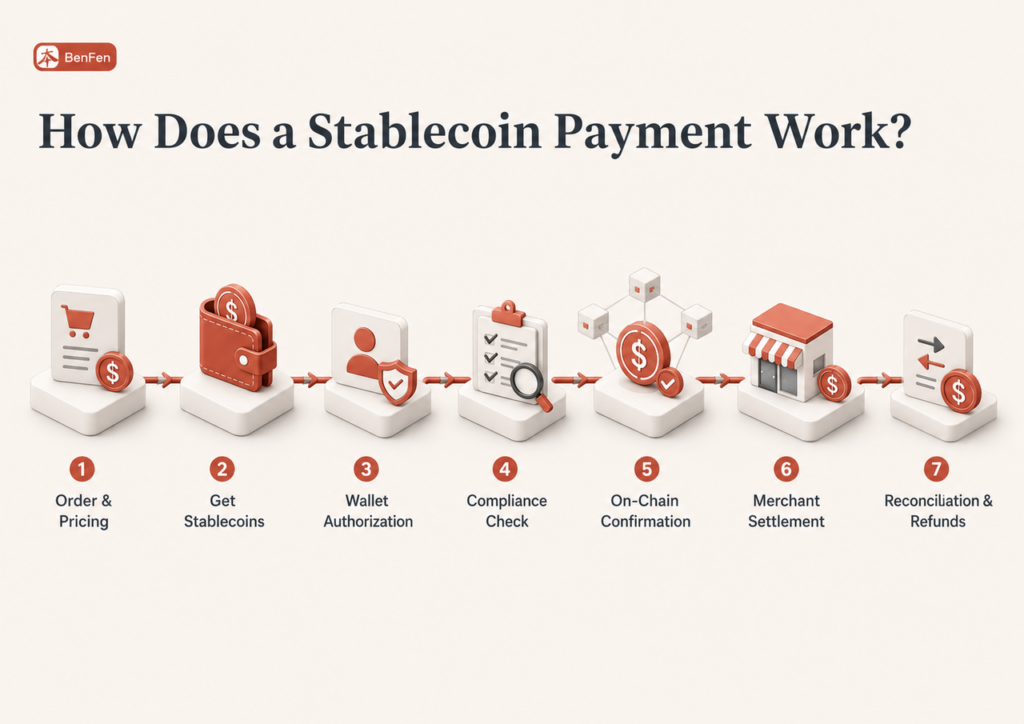
A typical stablecoin payment passes through seven stages:
Order and pricing → User obtains stablecoins → Wallet authorization → Compliance and routing checks → On-chain confirmation → Merchant settlement → Reconciliation, refunds, and recordkeeping
1. Create the Order and Determine Pricing
The merchant or payment platform first creates a payment request specifying:
- The amount of the goods or services;
- Whether the transaction is denominated in fiat currency or stablecoins;
- Which stablecoins are accepted;
- Which blockchain networks are supported;
- The receiving address;
- How long the exchange-rate quote remains valid;
- Who pays the network fees;
- Rules for expired orders, underpayments, and overpayments.
If the product is priced in USD but the customer pays with another currency or stablecoin, the payment platform also needs to determine the conversion rate and the validity period of that quote.
2. The User Obtains Stablecoins
Users can obtain stablecoins in several ways:
- Purchasing them through a supported exchange or conversion platform;
- Using an on-ramp service integrated into a wallet;
- Receiving them from another wallet;
- Bridging them from another blockchain;
- Receiving them directly from a company, platform, or other payer.
This stage may involve payment cards, bank transfers, fiat conversion, blockchain bridges, or centralized service providers. As a result, the cost and time required for funds to arrive are not determined solely by the blockchain.
3. The Wallet Creates and Authorizes the Transaction
The user confirms the following information in the wallet:
- Recipient address;
- Stablecoin;
- Blockchain network;
- Payment amount;
- Gas and other fees;
- Smart contract permissions.
The wallet signs the transaction using the user’s account credentials or cryptographic keys.
With a self-custodial wallet, the user generally retains direct control over transaction authorization. With a custodial wallet, the platform may execute blockchain transactions on behalf of the user within its account system.
In either case, the wallet interface should clearly display the actual recipient, asset, network, and scope of authorization. This helps prevent users from sending assets through the wrong network or granting unnecessary smart contract permissions.
4. Perform Compliance and Transaction Routing Checks
Depending on the provider’s role, the nature of the product, and the applicable jurisdiction, payment providers may need to perform:
- Know Your Customer checks (KYC);
- Know Your Business checks (KYB);
- Sanctions screening;
- Wallet address risk screening;
- Transaction monitoring;
- Source-of-funds checks;
- Geographic and product eligibility checks;
- Suspicious transaction reporting;
- Travel Rule information transmission where applicable.
The blockchain itself does not automatically perform these compliance procedures.
Responsibility for them generally depends on the respective roles played by the stablecoin issuer, wallet provider, exchange, payment service provider, merchant, and other participating institutions.
5. Broadcast the Transaction and Obtain On-Chain Confirmation
Once the user signs the transaction, it is broadcast to the blockchain network, where validators confirm it and record it on the ledger.
This stage mainly depends on:
- Whether the network is operating normally;
- Whether the transaction fee is sufficient;
- Network congestion;
- Whether the smart contract executes correctly;
- Whether the stablecoin contract includes pause, freeze, or address-restriction functions;
- Whether the recipient address matches the selected network;
- How many confirmations the payment platform requires.
Once the transaction meets the platform’s required confirmation threshold, the stablecoin can be considered transferred on-chain.
However, on-chain confirmation does not necessarily mean that the entire commercial payment has been completed. If the merchant wants to receive fiat currency, the stablecoins still need to be converted, withdrawn, and settled through the banking system.
6. Complete Merchant Settlement
Merchants may choose to:
- Hold the stablecoins they receive;
- Convert them into another stablecoin;
- Consolidate them into a corporate treasury wallet;
- Convert them into fiat through an off-ramp service;
- Settle them periodically in batches to a bank account.
As a result, stablecoin payments can lead to three different settlement outcomes:
| Settlement Type | What the Merchant Ultimately Receives | Main Dependencies |
|---|---|---|
| On-chain stablecoin settlement | The original stablecoin | Wallet and blockchain |
| Stablecoin conversion settlement | Another stablecoin | Liquidity and conversion services |
| Fiat settlement | Fiat currency in a bank account | Off-ramp provider and banking network |
When evaluating a payment solution, businesses need to define exactly what “settlement completed” means: whether it refers to on-chain receipt, completion of stablecoin conversion, or fiat funds reaching a bank account.
7. Reconciliation, Refunds, and Recordkeeping
Payment platforms also need to associate blockchain transactions with orders, users, and invoices, while handling:
- Transaction hash records;
- Order status updates;
- Underpayments and overpayments;
- Duplicate payments;
- Refunds;
- Failed transactions;
- Exchange-rate differences;
- Fee aggregation;
- Financial and tax records.
Blockchain transactions generally cannot be unilaterally reversed by the payer in the same way that some card payments can be disputed or reversed.
Refunds usually require the merchant or payment provider to initiate a new blockchain transaction.
This means that stablecoin payment systems still require order management, customer support, and dispute-resolution mechanisms.
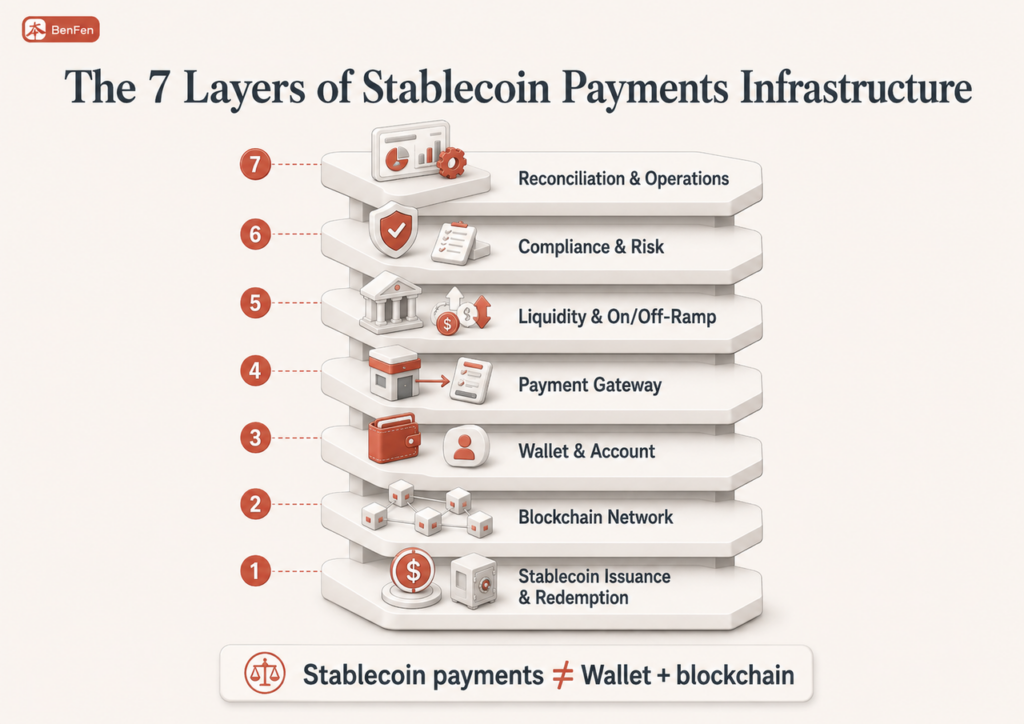
What Layers Make Up Stablecoin Payment Infrastructure?
A relatively complete stablecoin payment system usually consists of the following seven layers.
| Infrastructure Layer | Primary Function | Key Considerations |
|---|---|---|
| Stablecoin issuance and redemption | Issue and burn stablecoins while managing reserves and redemptions | Reserve quality, redemption rights, issuer |
| Blockchain network | Execute transactions and record asset states | Security, performance, gas, finality |
| Wallet and account layer | Manage accounts, display balances, and authorize transactions | Custody model, key security, recovery mechanisms |
| Merchant acquiring and payment gateway | Create orders, identify payments, and notify merchants | APIs, payment status, refunds, merchant integration |
| Liquidity and on-/off-ramp layer | Stablecoin conversion, cross-chain transfers, and fiat on-/off-ramps | Slippage, fees, partners, settlement time |
| Compliance and risk-control layer | Identity verification, screening, and transaction monitoring | KYC/KYB, AML, sanctions, data protection |
| Reconciliation and operations layer | Connect on-chain transactions with enterprise accounting systems | Invoices, financial records, exception handling |
Stablecoin payment infrastructure is not a single wallet, blockchain, or payment card. It is the combination of these different modules.
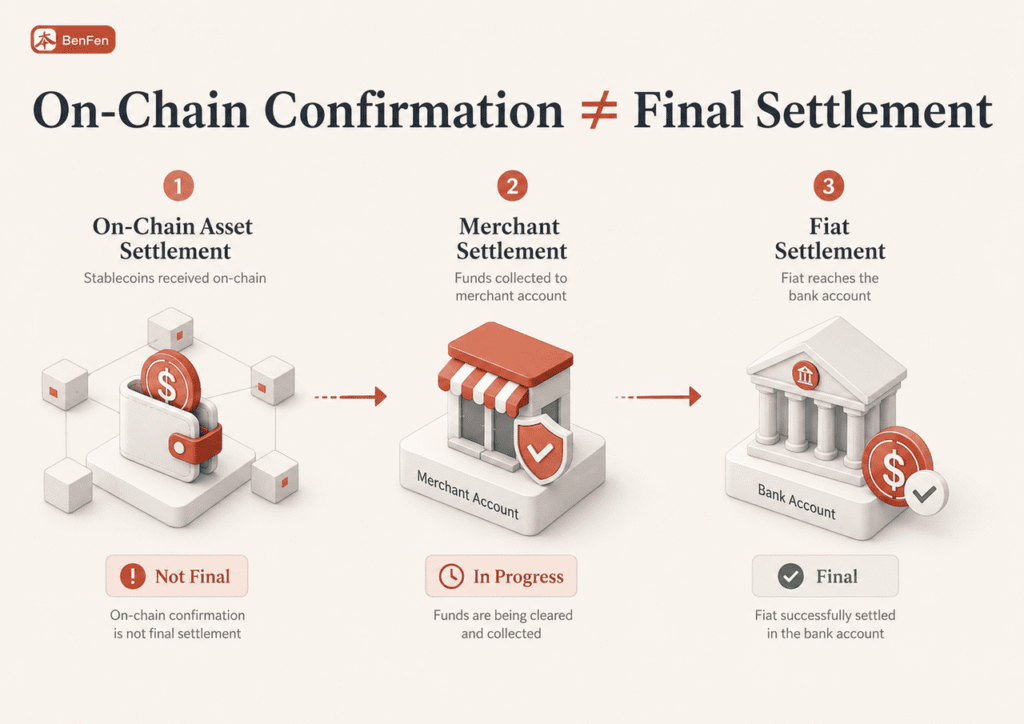
Does On-Chain Confirmation Equal Final Settlement?
Not necessarily. The term “settlement” can refer to different stages in different systems.
On-Chain Asset Settlement
The stablecoin has moved from the payer’s address to the recipient’s address and has reached the confirmation threshold required by the platform.
Merchant Funds Settlement
The payment provider has verified the order and transferred or consolidated the funds into an account controlled by the merchant.
Fiat Settlement
The stablecoins have been converted into fiat currency and deposited into the merchant’s designated account through a bank or payment institution.
Blockchain technology can improve the verifiability and operating hours of on-chain asset transfers, but it cannot guarantee that fiat off-ramping, bank crediting, or legally final settlement will occur at the same time.
For businesses, the more important questions are:
- What asset is used for settlement?
- How long is the settlement cycle?
- Who bears conversion costs and price fluctuations?
- When can revenue be recognized?
- Who handles failures, restrictions, or frozen funds?
What Role Does a Wallet Play in Stablecoin Payments?
A wallet acts as the account and authorization interface between the user and the blockchain. It typically handles:
- Address creation and management;
- Displaying stablecoin balances;
- Blockchain network selection;
- Creating and signing transactions;
- Displaying gas fees and authorization information;
- Connecting to merchants or payment applications;
- Maintaining transaction records.
Self-Custodial vs. Custodial Wallets
| Wallet Type | Who Controls Transaction Credentials? | Main Advantages | Main Risks |
|---|---|---|---|
| Self-custodial wallet | User | Direct control over assets | Lost keys, accidental signatures, and operational errors |
| Custodial wallet | Service provider | Easier recovery and operation | Counterparty, freezing, and custody risks |
| Smart account or hybrid account | Controlled through smart contracts and multiple authentication methods | Configurable recovery, spending limits, and multisig | Smart contract and permission-design risks |
Payment experiences should not focus solely on “one-click” convenience.
Wallets should also clearly display the network, asset, fees, authorized party, and irreversible risks associated with the transaction.
Why Does Gas Affect the Stablecoin Payment Experience?
On many public blockchains, users paying with USDT or USDC still need to hold ETH, BNB, SOL, or another native asset to pay gas fees.
This adds extra steps:
- The user first obtains stablecoins;
- The user then purchases the gas token required by the network;
- The user checks the balances of both assets;
- Only then can the payment be completed.
For everyday payment users, this is not an intuitive experience.
Common approaches to improving the experience include:
Paying Gas With Stablecoins or Other Supported Assets
The network allows specific stablecoins or project tokens to be used for transaction fees, reducing the need for users to acquire an additional native token.
Sponsored Transactions
An application, merchant, or third-party service pays the gas fee on behalf of the user.
The user still confirms and signs the transaction, but the fee is paid by another account.
Account Abstraction and Paymasters
Applications can use smart accounts and Paymasters to define gas sponsorship, spending limits, allowlists, or other fee-payment rules.
These mechanisms do not eliminate blockchain transaction costs. Instead, they change who pays the fee, which asset is used to pay it, and how the cost is presented to the user.
Why Are Cross-Chain Transfers a Challenge for Stablecoin Payments?
Stablecoins with the same name may exist on multiple blockchains, but assets on different networks are not inherently interoperable.
For example, a user may hold USDC on Ethereum while the merchant accepts USDC only on another network. In that case, the assets need to be moved through an exchange, liquidity network, or cross-chain bridge.
Cross-chain payments require particular attention to:
- Whether the stablecoin is supported by the same issuer on both networks;
- Whether the source and destination chains are correct;
- Whether the asset is natively issued or bridged;
- Whether a bridged asset can be redeemed;
- Who validates and operates the cross-chain bridge;
- Whether sufficient liquidity is available;
- Whether transfers can be paused or recovered if something goes wrong;
- Cross-chain fees and settlement times.
Cross-chain bridges can improve asset accessibility, but they can also introduce additional smart contract, validator, custody, and liquidity risks.
For a more detailed discussion of these risks, see BenFen’s Cross-Chain Bridge Security Guide.
What Compliance Capabilities Do Stablecoin Payments Require?
Compliance requirements for stablecoin payments generally depend on:
- Where the service provider operates;
- Where users and merchants are located;
- How the stablecoin is issued and redeemed;
- Whether the service provides custody, exchange, or transfer functionality;
- Whether payment cards or bank on-/off-ramps are involved;
- Whether the product serves individuals or businesses;
- Transaction size, frequency, and risk characteristics.
Common capabilities include:
KYC and KYB
KYC is used to verify individual identities, while KYB is used to identify businesses, ultimate beneficial owners, and the nature of their operations.
Wallet and Transaction Risk Screening
Service providers may screen addresses for links to stolen funds, sanctioned entities, scams, mixers, or other high-risk activity.
Transaction Monitoring
Systems need to identify unusual transaction amounts, frequencies, jurisdictions, transaction paths, and account behaviors, and apply further review, restrictions, or reporting where required by applicable rules.
Travel Rule
Where applicable, regulated service providers may be required to transmit certain necessary information about the originator and beneficiary during virtual asset transfers.
Data and Privacy Protection
Compliance does not mean that all identity information must be publicly recorded on the blockchain.
A payment system can associate necessary verification results with on-chain addresses while storing sensitive identity data in controlled systems.
FATF continues to monitor implementation risks related to stablecoins, virtual asset service providers, unhosted wallets, and the Travel Rule. Businesses designing payment flows should therefore seek professional legal advice based on their own role and target markets rather than assuming that the use of blockchain technology removes existing obligations.
What Are the Main Risks of Stablecoin Payments?
1. Stablecoin Issuance and Redemption Risk
Whether a stablecoin can maintain its value depends on its stabilization mechanism, reserve quality, issuer, redemption arrangements, and market liquidity.
2. Blockchain Network Risk
Network congestion, block production interruptions, node failures, or governance events may affect transaction confirmation.
3. Wallet and Key Risk
Private key compromise, phishing, incorrect authorization, lost devices, or failed recovery mechanisms can result in loss of funds.
4. Smart Contract Risk
Stablecoins, payment gateways, conversion protocols, and cross-chain bridges can all contain smart contract vulnerabilities or risks associated with administrator privileges.
5. Liquidity and Conversion Risk
After receiving stablecoins, a merchant may not always be able to immediately convert them into the desired asset or fiat currency at the expected price.
6. Compliance and Account Restriction Risk
Issuers, wallets, payment platforms, or off-ramp providers may restrict certain transactions or addresses based on legal requirements or terms of service.
7. Operational Risk
Incorrect networks, wrong addresses, duplicate orders, failed refunds, expired quotes, and reconciliation errors can all affect the user and merchant experience.
Why Are Stablecoin-Native Blockchains Emerging?
General-purpose public blockchains can support stablecoin payments. This does not mean that every payment use case needs to migrate to a so-called stablecoin-native blockchain.
Stablecoin-native or payment-optimized blockchains mainly aim to address problems such as:
- Users having to hold a separate native gas token;
- Fee volatility affecting high-frequency, low-value payments;
- Complex wallet creation and account recovery;
- Difficulty moving stablecoins between networks;
- Payment applications having to build large amounts of infrastructure themselves;
- Merchants requiring more predictable confirmation times and transaction costs.
A stablecoin-native blockchain is therefore not a requirement for stablecoin payments, but one possible infrastructure choice.
Asset issuers, payment platforms, and developers should compare:
- Network security and reliability;
- Transaction confirmation speed;
- Gas costs and payment methods;
- Stablecoin issuance and redemption structure;
- Wallet and account support;
- Merchant and developer interfaces;
- Cross-chain and liquidity capabilities;
- Identity and permission components;
- Smart contract upgradeability and administrator privileges;
- Ecosystem maturity and long-term maintenance capabilities.
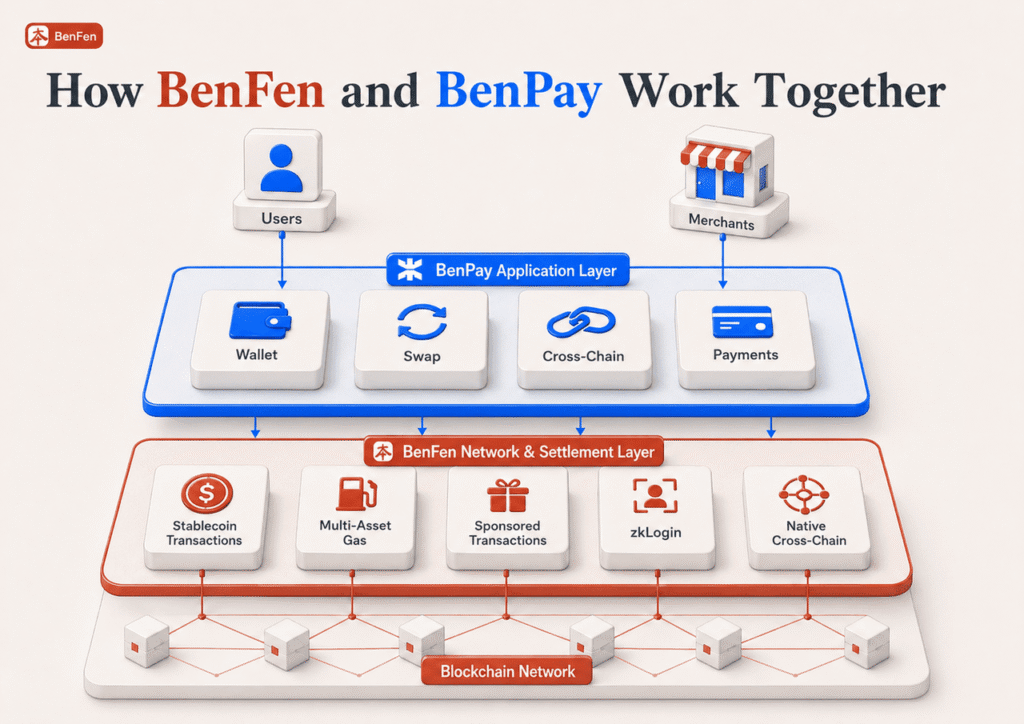
How Do BenFen and BenPay Support Stablecoin Payments?
BenFen and BenPay operate at different layers of the stablecoin payment stack:
| Layer | BenFen | BenPay |
|---|---|---|
| Primary positioning | Infrastructure network for stablecoins and on-chain payments | User- and application-facing entry point for stablecoin finance and payments |
| Core role | Execute transactions, record asset states, and provide on-chain settlement | Wallets, cross-chain transfers, stablecoin conversion, payment cards, and application interactions |
| Gas experience | Supports gas payments with eligible assets and sponsored transactions | Presents the corresponding fees and interaction experience to users at the application layer |
| Account access | Supports account capabilities such as zkLogin | Connects account capabilities to practical wallet and application flows |
| Cross-chain | Provides native cross-chain infrastructure | Provides users with interfaces for cross-chain transfers and asset conversion |
| Compliance boundary | Provides technical capabilities that can support identity and permission configuration | Specific services must still comply with product, jurisdiction, and partner requirements |
BenFen: Network and Settlement Infrastructure
BenFen is a Layer 1 network designed around stablecoins, cross-chain assets, and on-chain payment use cases.
Its payment-related capabilities include:
- A Move-based environment for assets and smart contracts;
- Multi-currency gas payments;
- Gas payments using eligible project tokens or stablecoins;
- Sponsored transactions;
- zkLogin-based account access;
- A native cross-chain bridge;
- A low-cost transaction environment for stablecoins and on-chain applications.
Sponsored transactions allow an application or merchant to cover transaction fees on behalf of the user. The user still authorizes the transaction but does not need to prepare gas separately.
Multi-currency gas and sponsored transactions address on-chain fee payment and user onboarding. They do not mean that merchant acquiring, fiat off-ramping, or regulatory procedures are automatically handled by the blockchain.
BenPay: Wallet and Payment Application Gateway
BenPay is built on the BenFen network and provides self-custodial wallets, cross-chain asset operations, stablecoin conversion, payment cards, and other application features.
Within the stablecoin payment stack, BenPay primarily operates at the user and application layers by:
- Helping users create and use on-chain accounts;
- Displaying and managing stablecoin assets;
- Connecting cross-chain transfer and conversion functions;
- Providing application entry points for online and offline payment scenarios;
- Turning BenFen’s gas, account, and on-chain settlement capabilities into product experiences that users can directly interact with.
The specific assets, networks, payment card coverage, fees, geographic availability, and service conditions are subject to BenPay’s current product pages and applicable terms.
For more information about how the two platforms differ, see the relationship between BenFen and BenPay.
How Should Businesses Choose Stablecoin Payment Infrastructure?
Before integrating stablecoin payments, businesses should be able to answer at least the following questions:
- Which stablecoins and blockchains do customers use?
- Does the merchant want to receive stablecoins or fiat currency?
- Who issues the stablecoin, and how do its reserves and redemption mechanisms work?
- Will the wallet use a custodial or self-custodial model?
- Who pays gas: the user, merchant, or payment service provider?
- Are cross-chain transfers required, and who bears the associated risks?
- Who is responsible for KYC, KYB, AML, and sanctions screening?
- How are refunds, incorrect payments, and disputes handled?
- How will transaction records be integrated into financial and tax systems?
- How are private keys, administrator privileges, and smart contracts protected?
- Which countries, regions, and user types are supported?
- Is there a contingency plan for system failures or partner-service interruptions?
Businesses should not compare only TPS and transaction fees.
A complete payment infrastructure must also address fund security, compliance, asset conversion, merchant settlement, and operational requirements.
Conclusion: Stablecoin Payments Are a System, Not a Single Transfer
Stablecoins provide a new technical path for global value transfer. They can support around-the-clock on-chain transactions and make payment and settlement flows more programmable through smart contracts.
However, turning a stablecoin transfer into a sustainable payment service still requires stablecoin issuance and redemption, blockchains, wallets, gas, merchant acquiring, liquidity, on-/off-ramps, compliance, and reconciliation systems to work together.
Payment-optimized blockchains can reduce friction at the network and account layers, but they cannot replace the responsibilities of issuers, banks, payment institutions, merchants, and compliance providers.
BenFen provides underlying capabilities for stablecoin transactions, gas, sponsored transactions, accounts, and cross-chain transfers. BenPay connects these capabilities to wallets, asset conversion, and real-world payment scenarios.
Their relationship reflects a fundamental division of responsibilities within stablecoin payment infrastructure: the underlying network handles on-chain asset execution, while the application platform turns network capabilities into products that users and merchants can actually use.
Stablecoin Payments FAQ
Q1. What Is the Difference Between a Stablecoin Payment and a Regular Stablecoin Transfer?
A stablecoin transfer simply moves assets from one address to another. A stablecoin payment also needs to be linked to an order or payment obligation and may involve payment confirmation, conversion, settlement, reconciliation, refunds, and compliance requirements.
Q2. Can Stablecoin Payments Completely Bypass Banks?
If both the payer and recipient are willing to hold stablecoins, some transactions can take place entirely on-chain.
However, when fiat on-ramps, fiat off-ramps, or settlement into bank accounts are involved, banks or other relevant payment institutions are still required.
Q3. Has the Merchant Been Fully Paid Once an On-Chain Transaction Is Confirmed?
If the merchant directly accepts and holds the stablecoin, the payment can be considered received on-chain.
If the merchant wants fiat currency, the funds will generally still need to go through conversion, off-ramping, and bank settlement.
Q4. Do Users Need to Hold a Gas Token to Pay With Stablecoins?
It depends on the blockchain network.
Some networks require users to hold the native token. Others allow gas to be paid using stablecoins or other supported assets. Applications may also cover fees for users through sponsored transactions or Paymasters.
Q5. Are All Stablecoins Suitable for Payments?
Not necessarily.
Users and businesses should evaluate the issuer, reserves, redemption mechanisms, liquidity, supported networks, compliance restrictions, and counterparty acceptance.
A relatively stable price does not mean that the stablecoin is free from credit, technical, or regulatory risks.
Q6. Are Stablecoin Payments Legal?
Requirements for stablecoin issuance, custody, conversion, transfers, and merchant services vary across jurisdictions.
Whether a particular service is permitted and which licenses may be required depend on the business model, service provider’s role, user location, and type of stablecoin involved. Professional legal advice should be obtained where appropriate.
Q7. What Is the Difference Between BenFen and BenPay?
BenFen is a blockchain network that provides capabilities such as transaction execution, gas, accounts, and cross-chain transfers.
BenPay is a wallet and stablecoin financial application gateway built on BenFen. BenFen primarily operates at the infrastructure layer, while BenPay primarily operates at the product and user layer.
Q8. Are Stablecoin Payments Safer Than Traditional Payments?
The two payment models have different risk structures.
Stablecoin payments can provide verifiable on-chain records, but they also introduce risks related to wallet keys, smart contracts, cross-chain bridges, stablecoin issuance, and incorrect addresses.
They should therefore not be assumed to be inherently or universally safer than traditional payment methods.
Risk Disclosure
This article is provided for general industry information only and does not constitute investment, legal, tax, or regulatory advice.
Stablecoin payments involve risks related to stablecoin issuance and redemption, wallet security, smart contracts, cross-chain bridges, market liquidity, payment operations, and cross-border regulation. Requirements may differ between countries and regions.
Before integrating or using related services, businesses and individuals should verify the stablecoin issuer, reserve and redemption mechanisms, service-provider qualifications, wallet control model, fees, supported networks, applicable jurisdictions, and user agreements, and seek professional advice based on their own circumstances where appropriate.
Sources
- BIS/CPMI: Considerations for the use of stablecoin arrangements in cross-border payments
- FATF: Stablecoins and unhosted wallets
- BenFen Official Website
- BenFen White Paper (Version Date: June 8, 2026)
- BenPay Official Website
- What Is BenPay?