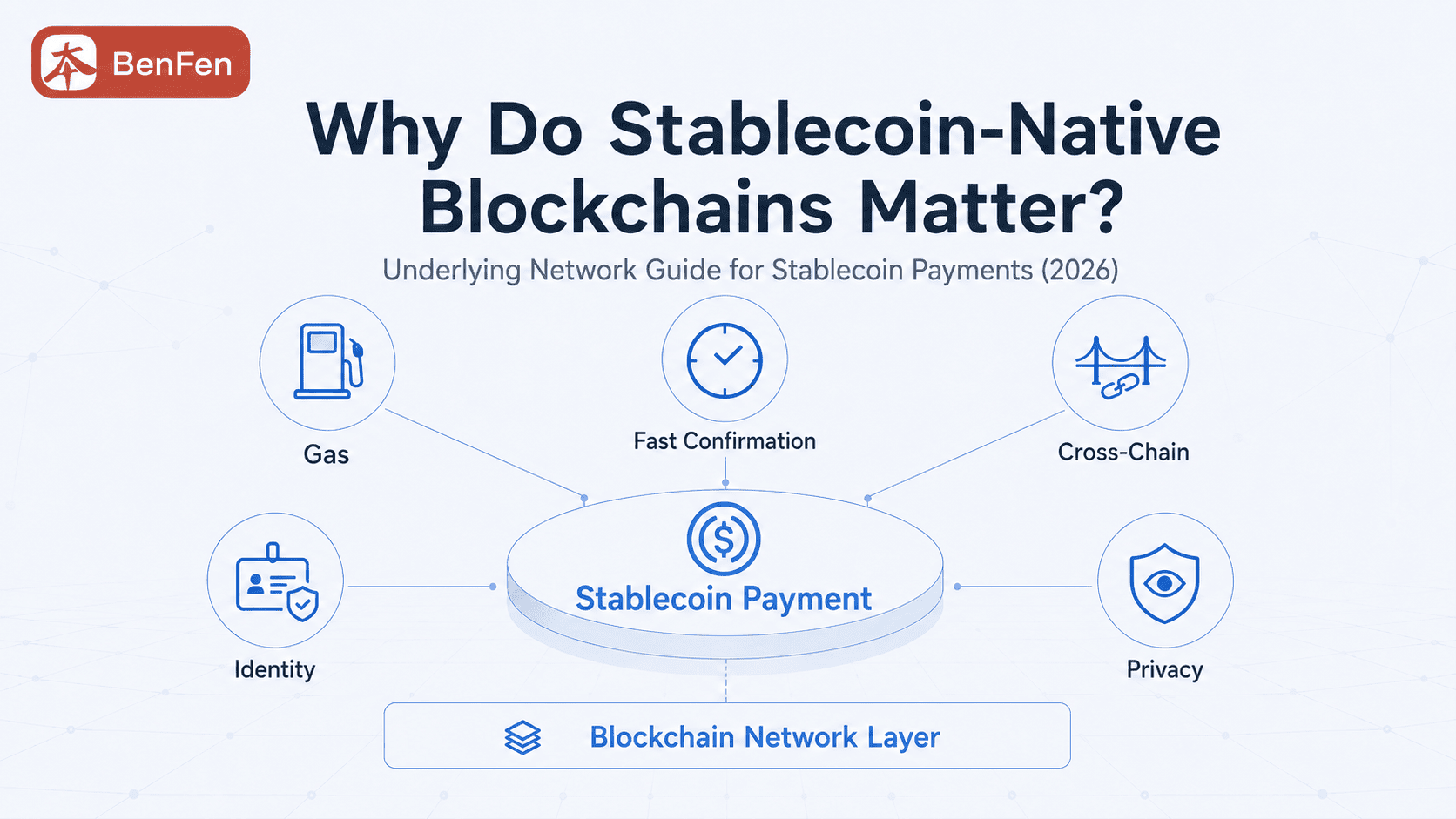
Introduction: Supporting Stablecoins Is Not the Same as Being Designed for Stablecoin Payments
Today, most smart contract blockchains can issue and transfer stablecoins such as USDT and USDC. Technically, stablecoins do not require a dedicated blockchain to operate.
However, being able to transfer stablecoins is not the same as being optimized for payments.
As stablecoins move beyond crypto trading and into cross-border payments, merchant acceptance, corporate treasury management, on-chain finance, and everyday spending, the underlying network must address a more specific set of requirements:
- Must users first acquire another native token to pay for gas?
- Can transaction fees remain low and predictable?
- Can payment status be confirmed quickly and reliably?
- Can new users access wallets without understanding seed phrases or complex on-chain operations?
- How can stablecoins from different networks enter the same payment environment?
- How can applications integrate identity verification, geographic restrictions, and risk controls?
- How can payment data balance privacy, verifiability, and necessary audit requirements?
A stablecoin-native blockchain is blockchain infrastructure optimized at the network level around these requirements.
It is important to clarify that “stablecoin-native blockchain” is not a standardized technical specification, nor does it imply that every stablecoin payment system must migrate to a dedicated network. It is better understood as a design philosophy: stablecoin issuance, circulation, payments, and on-chain settlement are treated as core network use cases rather than stablecoins being treated as just another token category.
If you first want to understand how a stablecoin payment moves through wallets, on-chain confirmation, merchant settlement, and compliance processes, read Stablecoin Payment Infrastructure Guide: How Settlement, Wallets, and Compliance Work.
Key Takeaways
- A stablecoin-native blockchain is an underlying network optimized around stablecoin issuance, circulation, payments, and on-chain settlement.
- General-purpose blockchains can support stablecoins, but their gas, account, cross-chain, and identity systems may not be optimized for mainstream payments.
- Stablecoin payments require more than high TPS. They also depend on predictable fees, reliable confirmation, wallet onboarding, liquidity, and operational tooling.
- Sponsored transactions can allow applications to pay gas on behalf of users, but this does not mean on-chain transactions have no cost.
- A blockchain can provide the technical foundation for settlement, but it cannot replace stablecoin issuers, banks, licensed institutions, merchant service providers, or compliance procedures.
- BenFen provides the underlying blockchain network and on-chain infrastructure, while BenPay operates closer to the application layer, connecting users, assets, and real-world payment scenarios.
Table of Contents
- What Is a Stablecoin-Native Blockchain?
- What Is the Difference Between Supporting Stablecoins and Being Stablecoin-Native?
- Why Do Stablecoin Payments Require Network-Level Optimization?
- Do All Stablecoin Payments Need a Stablecoin-Native Blockchain?
- How Should Businesses Choose a Stablecoin Payment Network?
- What Stablecoin Payment Problems Can a Blockchain Not Solve?
- How Is BenFen Building Stablecoin-Native Infrastructure?
- What Roles Do BenFen and BenPay Play?
- Frequently Asked Questions
What Is a Stablecoin-Native Blockchain?
A stablecoin-native blockchain is a blockchain network that treats stablecoin issuance, transfers, payments, and on-chain settlement as core use cases and designs its fee system, accounts, cross-chain infrastructure, identity layer, and developer tooling around those requirements.
The difference from a general-purpose blockchain is not whether the network can deploy a stablecoin smart contract. The key question is whether the network reduces friction in stablecoin usage at the infrastructure level.
A blockchain optimized for stablecoin payments will typically focus on capabilities such as:
- Paying gas with stablecoins or other supported assets;
- Allowing applications or third parties to sponsor transaction fees;
- Low-cost and predictable transaction confirmation;
- Wallet and account systems that are easier for mainstream users to access;
- Entry, exit, and liquidity management for stablecoins across multiple chains;
- Identity verification, permission controls, and compliance interfaces;
- Privacy protection and selective disclosure;
- Developer, query, and operational tools designed for payment applications.
Therefore, “native” does not necessarily mean stablecoins must be the network’s only assets, nor does it mean every related capability must be implemented directly at the protocol layer. Instead, it describes the priority given to stablecoins within the network’s overall design.
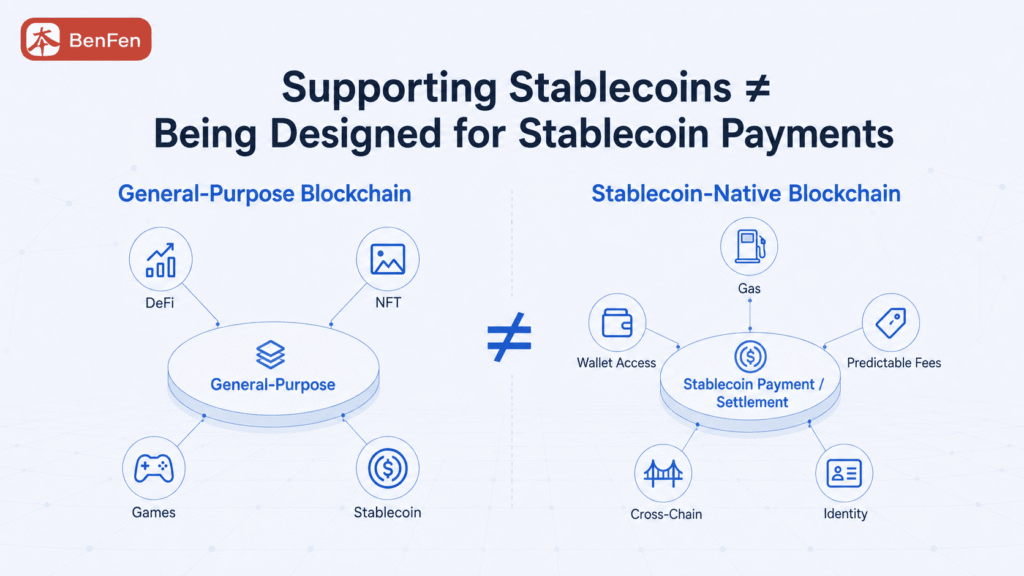
What Is the Difference Between Supporting Stablecoins and Being Stablecoin-Native?
| Dimension | General-Purpose Blockchain Supporting Stablecoins | Stablecoin-Native Blockchain |
|---|---|---|
| Primary design objective | Supports DeFi, NFTs, gaming, and many other applications | Prioritizes stablecoin issuance, payments, and settlement |
| Gas payments | Usually requires the network’s native token | May support stablecoins, stablecoin-as-gas, or sponsored transactions |
| User onboarding | Often requires users to create a wallet and manage private keys or seed phrases | Places greater emphasis on social login, account abstraction, and application-sponsored fees |
| Fee experience | May vary with network congestion and native token prices | Greater emphasis on low costs and fee predictability |
| Stablecoin liquidity | Depends largely on third-party issuers and ecosystem protocols | Treats stablecoin liquidity as a core network resource |
| Cross-chain capabilities | Typically relies on external bridging protocols | May integrate stablecoin cross-chain access at the ecosystem level |
| Identity and permissions | Usually integrated separately by individual applications | Greater emphasis on identity credentials, allowlists, and permission components |
| Privacy design | Depends on individual wallets or protocols | Can be designed around payment privacy and necessary auditability |
| Typical use cases | DeFi, trading, gaming, NFTs | Cross-border payments, merchant payments, PayFi, stablecoin settlement |
This does not mean a stablecoin-native blockchain is superior to a general-purpose blockchain in every respect. General-purpose blockchains may have more mature developer ecosystems, deeper liquidity, and broader institutional infrastructure.
The right choice still depends on specific business requirements.
Why Do Stablecoin Payments Require Network-Level Optimization?
Payment Users Should Not Be Blocked by Native Gas Tokens
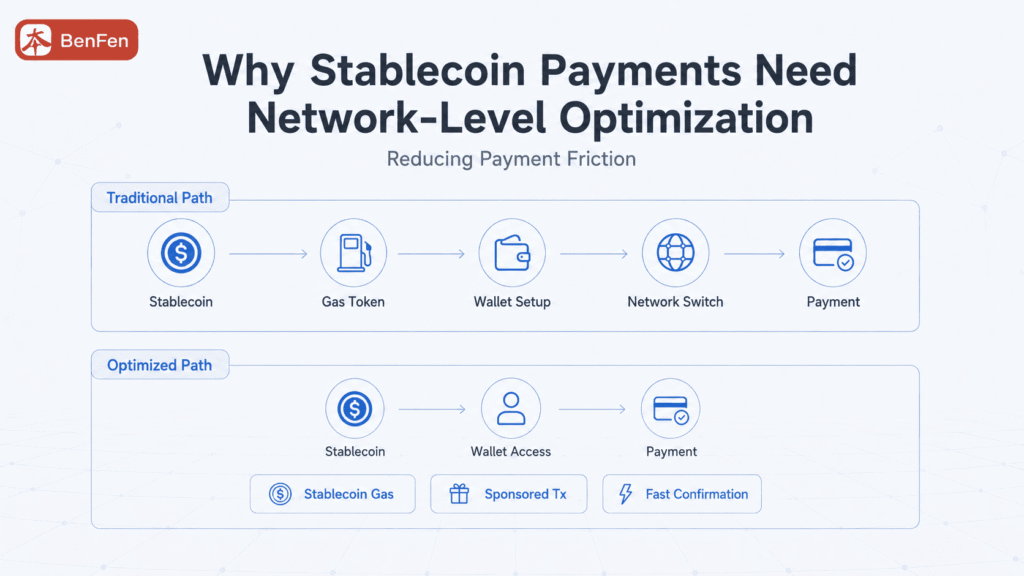
On traditional blockchains, users transferring USDT or USDC usually also need to hold ETH, SOL, or another native token to pay transaction fees.
Crypto-native users may already be familiar with this model. For ordinary users who simply want to pay, receive funds, or transfer stable value, however, it introduces additional steps:
- Acquire stablecoins;
- Confirm which network the stablecoins are on;
- Buy the corresponding network’s gas token;
- Transfer the gas token into the same wallet;
- Only then initiate the stablecoin payment.
This experience is very different from using a bank card or digital wallet.
Stablecoin-native blockchains can reduce this friction in two main ways:
- Allow users to pay gas with supported stablecoins or other assets;
- Allow wallets, merchants, project teams, or applications to cover fees through sponsored transactions.
Sponsored transactions do not eliminate transaction costs. Instead, they shift the cost from the end user to the application or service provider.
Applications still need to define subsidy limits, eligible transaction types, allowlists, anti-abuse controls, and other risk management rules.
Payments Need Low Fees, but They Also Need Predictable Fees
Payment businesses often involve frequent, relatively small, and recurring transactions. If network fees fluctuate significantly with congestion or native token prices, merchants and payment service providers may find it difficult to accurately estimate per-transaction costs.
For stablecoin payments, an ideal fee model should not only be inexpensive. It should also provide:
- Relatively stable costs;
- Clear fee visibility before payment;
- The ability for applications to centrally sponsor or batch-manage fees;
- A cost structure where gas does not outweigh small payment amounts;
- An acceptable payment experience even during periods of high network activity.
A low fee observed in a single test transaction is therefore not enough to prove that a network is suitable for long-term payment activity.
Consistency, predictability, and operational manageability matter just as much.
On-Chain Confirmation Speed Directly Affects the Payment Experience
Blockchain payments require a distinction between three different stages:
- Transaction submission: The wallet has sent the transaction to the network;
- On-chain confirmation: The network has accepted the transaction and recorded it on the ledger;
- Business settlement: The merchant or recipient has confirmed that the funds are available according to its own operational rules.
Fast block production does not necessarily mean that final business settlement is complete.
A merchant may still need to wait for additional confirmation, complete risk checks, convert stablecoins, or update an internal order before considering the payment settled.
A payment-optimized network therefore needs to provide applications with clear transaction states, fast finality, and reliable network availability so merchants can determine when goods or services can safely be delivered.
The Bank for International Settlements’ Committee on Payments and Market Infrastructures has similarly emphasized the importance of settlement arrangements, liquidity, interoperability, and regulatory frameworks in its research on stablecoins for cross-border payments.
Wallet Onboarding Determines Whether Mainstream Users Can Complete Their First Payment
If users must install a browser extension, create a wallet, write down a seed phrase, and learn how to switch networks before making a payment, stablecoin payments will struggle to offer an experience comparable to mainstream internet products.
Payment-oriented networks may therefore need to support more flexible account onboarding methods, such as:
- Social login;
- MPC or other key-management approaches;
- Embedded wallets;
- Sponsored first transactions;
- Account recovery;
- Multisig and enterprise permission management.
Reducing operational complexity does not mean reducing security requirements.
Wallets should still clearly display transaction details, assets, amounts, recipient addresses, and authorization scopes to prevent users from signing transactions they do not understand.
Multi-Chain Stablecoins Need Secure Liquidity Gateways
The same stablecoin may exist across multiple networks. When the payer and recipient use different networks, the payment flow may require:
- Cross-chain bridges;
- Liquidity routing;
- Stablecoin swaps;
- Custody or market-making services;
- Centralized exchanges or other on-ramp and off-ramp channels.
Cross-chain connectivity expands the usable scope of stablecoins, but it also introduces risks related to smart contracts, validation mechanisms, liquidity, counterfeit tokens, and operational mistakes.
A stablecoin-native blockchain therefore needs to consider more than simply “how many chains are supported.” It should also address questions such as:
- Who issues, locks, or represents cross-chain assets?
- Can users verify token contracts and destination networks?
- Can cross-chain transaction status be queried?
- Are pause and recovery mechanisms available when abnormalities occur?
- What happens when liquidity is insufficient?
- Do users clearly understand cross-chain fees and settlement conditions?
For more on bridge architecture and associated risks, read Are Cross-Chain Bridges Safe? 2026 Attack Cases and Security Risk Analysis.
Identity, Compliance, and Privacy Need to Be Considered Together
Stablecoin payments may involve person-to-person transfers, merchant payments, corporate payments, and cross-border financial services.
Depending on the business model, services may need to implement KYC, KYB, sanctions screening, transaction monitoring, geographic restrictions, and transaction limits.
The openness of a public blockchain does not mean every payment service must operate on a permissionless basis.
The network layer can remain open while applications apply identity and transaction policies appropriate to their business requirements.
At the same time, payment data may reveal addresses, balances, transaction amounts, and commercial relationships. If all of this information remains publicly visible indefinitely, it can create privacy and security risks for both individuals and businesses.
A more complete payment infrastructure should balance three objectives:
- Verify necessary conditions;
- Minimize the disclosure of raw identity data;
- Preserve sufficient verification capabilities for authorized audits and risk investigations.
FATF research on stablecoins and unhosted wallets indicates that relevant service providers may still be subject to anti-money laundering and counter-terrorist financing obligations depending on the services they provide.
For a deeper explanation of on-chain identity verification, read What Is On-Chain KYC? How Web3 Identity Verification Balances Compliance, Privacy, and Decentralization.
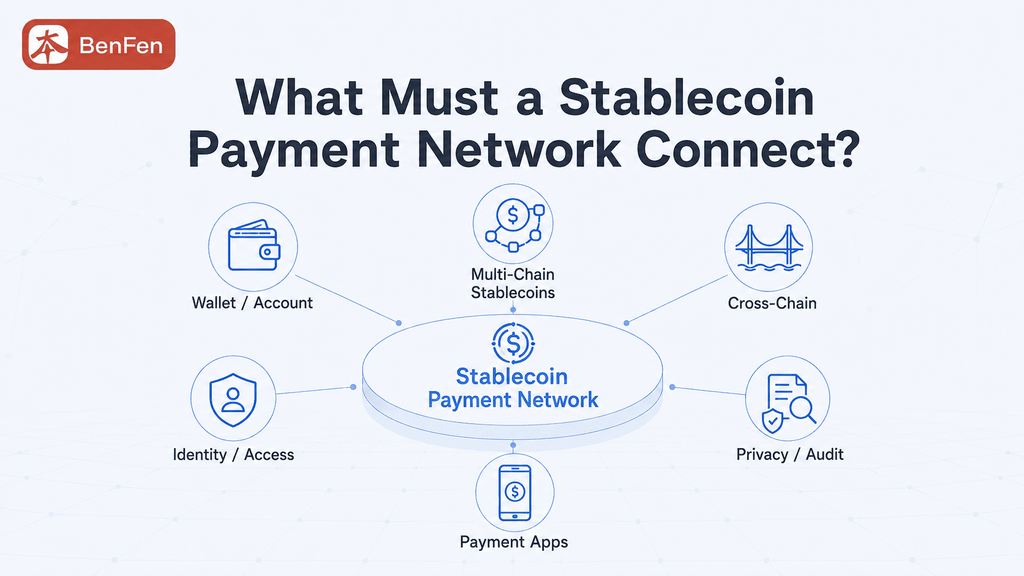
Payment Applications Need Operationally Reliable Network Interfaces
Real-world payment systems also need to handle:
- Transaction status queries;
- Payment notifications;
- Address and order matching;
- Refunds and exception handling;
- Reconciliation;
- Merchant reporting;
- Risk rules;
- Asset conversion and fund withdrawal.
Not all of these capabilities belong directly at the blockchain protocol layer.
However, the underlying network must provide reliable nodes, indexing services, events, and developer interfaces so that wallets, payment gateways, and merchant systems can integrate with it.
In other words, the value of a payment network is not measured only by transaction speed on a block explorer. It is also determined by whether developers and operations teams can depend on the network over the long term.
Do All Stablecoin Payments Need a Stablecoin-Native Blockchain?
No.
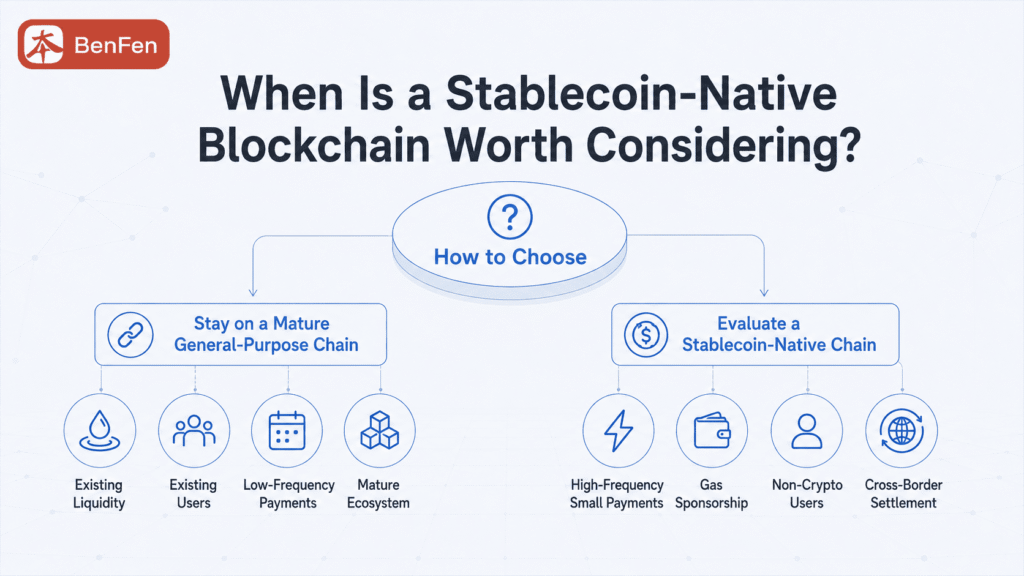
If a business is already built on a mature general-purpose blockchain with strong liquidity, broad user adoption, and extensive wallet support, migrating to another network may not create enough additional value to justify the transition.
Continuing to use a mature general-purpose blockchain may make more sense when:
- Users and assets are already concentrated on that network;
- Payment frequency is relatively low and gas costs have limited impact;
- The business depends on mature DeFi, custody, or institutional infrastructure;
- The application has already solved gas sponsorship, wallet onboarding, and compliance integration;
- Cross-chain migration would introduce additional technical and liquidity risks.
A stablecoin-native blockchain may be more worth evaluating when the business involves:
- High-frequency or low-value stablecoin payments;
- Cross-border merchant or corporate settlement;
- Wallets designed for non-crypto-native users;
- Stablecoin-denominated gas or application-sponsored transaction fees;
- Unified access to cross-chain, identity, or privacy components;
- Long-term management of fees, confirmation times, and transaction status.
A stablecoin-native blockchain is therefore not a mandatory choice for every project. It is an infrastructure approach built around a specific set of payment-oriented trade-offs.
How Should Businesses Choose a Stablecoin Payment Network?
Businesses and developers evaluating a blockchain for stablecoin payments can focus on the following questions:
- Does the network have a proven operating history and clearly defined security mechanisms?
- Are transaction fees suitable for frequent, low-value payments?
- Must users separately hold a native gas token?
- Does the network support sponsored transactions, and how can sponsors implement risk controls?
- Do confirmation times and finality meet the business’s delivery requirements?
- Does the network support the wallets and account models commonly used by the target audience?
- Does the target stablecoin have sufficient issuer support and liquidity?
- What are the issuance, custody, and security models for cross-chain assets?
- Are identity, permissions, privacy, and audit interfaces available?
- Are nodes, indexing, payment notifications, and developer tools sufficiently mature?
- Are emergency procedures available for network, bridge, or smart contract incidents?
- Do the network’s long-term maintenance, governance, and ecosystem development align with the business’s needs?
For more on the relationship between stablecoins, RWAs, and competition among blockchain networks, read The Next Chapter in the Blockchain Landscape: A New Web3 Perspective Driven by Stablecoins and RWAs.
What Stablecoin Payment Problems Can a Blockchain Not Solve?
Even if a blockchain is comprehensively optimized for stablecoin payments, it cannot independently solve issues such as:
- Whether stablecoin reserves are genuine and sufficient;
- Whether the stablecoin issuer can continue meeting redemption obligations;
- Whether the business requires payment, remittance, securities, or other licenses;
- Whether merchants are willing to accept stablecoins;
- How stablecoins are converted into the fiat currencies merchants need;
- Whether bank accounts and on-ramp or off-ramp channels are available;
- Whether KYC, KYB, sanctions screening, and transaction monitoring meet local requirements;
- Who is responsible for refunds, disputes, and consumer protection;
- Which foreign exchange, tax, and data regulations apply to cross-border transactions.
A blockchain addresses network infrastructure and on-chain execution. It does not replace the broader commercial, legal, and financial responsibilities involved in payment services.
How Is BenFen Building Stablecoin-Native Infrastructure?
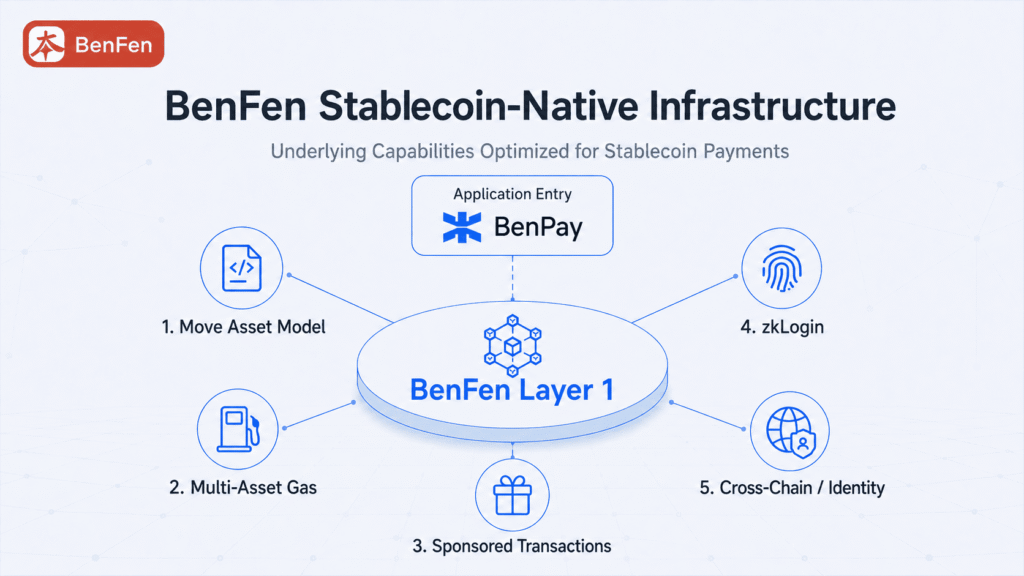
BenFen is a Layer 1 network built around stablecoin issuance, circulation, payments, and on-chain finance.
Its approach is not simply to deploy a payment application on top of a general-purpose blockchain. Instead, BenFen aims to reduce friction in stablecoin usage through its asset model, transaction fee design, account onboarding, cross-chain infrastructure, and identity layer.
For the latest information, refer to the BenFen English Whitepaper and the BenFen official website.
Asset-Oriented Move Execution Environment
BenFen uses the Move programming language for its smart contract execution environment.
Move treats digital assets as resources with explicit ownership and transfer rules, providing a foundation for building stablecoins, payment applications, permission systems, and on-chain financial services.
The language and asset model can reduce certain categories of common smart contract risk, but they do not replace code audits, access controls, multisig management, or continuous security monitoring.
Stablecoin-as-Gas and Sponsored Transactions
BenFen supports paying gas with multiple supported assets.
Stablecoins and project assets that meet the applicable network rules can be used to pay transaction fees, reducing the need for users to acquire and hold a single native gas token in advance.
BenFen also supports sponsored transactions, separating the transaction initiator from the gas payer. Applications, wallets, or project teams can cover transaction costs for users according to their own policies.
Gas-free transactions for the end user do not mean the transaction itself has no cost.
The sponsor still pays the applicable fees and should implement spending limits, allowlists, anti-abuse mechanisms, and abnormal transaction controls.
zkLogin and User Onboarding
BenFen supports zkLogin, allowing users to create and access on-chain accounts through Web2 accounts such as Google and Apple.
This can reduce the onboarding friction associated with installing wallet extensions and managing seed phrases.
zkLogin addresses account creation and transaction signing experience. It is not equivalent to KYC and does not automatically prove that a user meets the eligibility requirements of a particular financial product or service.
Stablecoins and Cross-Chain Connectivity
BenFen provides cross-chain infrastructure designed to bring assets from multiple networks into its ecosystem.
According to the Mainnet Upgrade Announcement published in March 2026, BenFen’s stablecoin ecosystem is expanding beyond BUSD with broader cross-chain and ecosystem support for USDT and USDC.
Cross-chain infrastructure can expand the sources and availability of stablecoins, but it does not eliminate bridge, smart contract, liquidity, or operational risks.
Supported networks, assets, and settlement conditions should always be verified against the latest product information.
Identity, Permissions, and Privacy Infrastructure
Through BenFen ID, on-chain identity credentials, and privacy mechanisms, BenFen provides foundational capabilities for applications to implement identity-based conditions, permission controls, and data-minimized disclosure.
Depending on their business requirements, applications can verify whether users have completed identity checks or meet geographic or product eligibility conditions without placing complete identity documents or other raw personal information directly on-chain.
These tools are designed to help applications implement identity and permission policies. They do not mean BenFen makes legal determinations, operates regulated businesses on behalf of service providers, or fulfills all compliance obligations for them.
What Roles Do BenFen and BenPay Play?
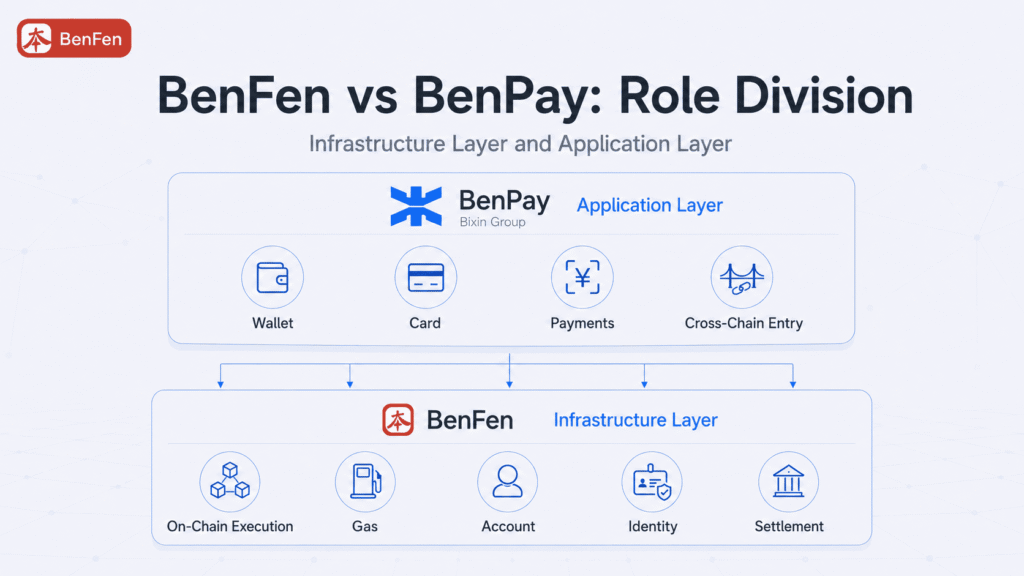
BenFen and BenPay operate at different layers of the stablecoin payment technology stack:
| Layer | Primary Role |
| BenFen | Provides the blockchain network, asset execution environment, gas infrastructure, sponsored transactions, cross-chain connectivity, accounts, identity, and other underlying capabilities |
| BenPay | Serves as an application-layer entry point connecting users, wallets, assets, and specific payment and on-chain financial scenarios |
BenFen provides the infrastructure that allows stablecoins to be created, transferred, and used in on-chain interactions.
BenPay uses wallets, cross-chain functionality, payment cards, and other application features to make these underlying capabilities accessible to users.
This division of responsibilities highlights an important point: stablecoin payments require both network infrastructure and user- or merchant-facing products.
The underlying blockchain alone cannot complete every step of the payment process, while the application layer also depends on reliable on-chain infrastructure.
For more product information, visit the BenPay official website.
Conclusion: Stablecoin Payments Require More Than an On-Chain Transfer
General-purpose blockchains have already demonstrated that stablecoins can be transferred globally on-chain.
However, when stablecoins move into real-world payments and corporate settlement, the underlying network must address much more than simple token transfers. Fees, confirmation, accounts, cross-chain connectivity, identity, privacy, and operational interfaces all become part of the payment infrastructure.
The purpose of a stablecoin-native blockchain is not to reinvent stablecoins or replace every general-purpose blockchain. It is to reduce infrastructure-level friction around payment use cases.
For applications whose assets and users are already concentrated on mature networks, a general-purpose blockchain may remain the right choice.
For high-frequency payments, merchant settlement, cross-border fund flows, and mainstream user onboarding, networks optimized around stablecoins may provide a more consistent fee structure and interaction model.
BenFen is exploring this network model through its Move-based asset framework, stablecoin-as-gas, sponsored transactions, zkLogin, cross-chain infrastructure, and identity capabilities.
Its long-term value will ultimately need to be demonstrated through real-world adoption, reliable operation, security performance, and ecosystem growth.
Stablecoin-Native Blockchain FAQ
Q1. What is a stablecoin-native blockchain?
A stablecoin-native blockchain is a blockchain optimized at the network level for stablecoin issuance, circulation, payments, and on-chain settlement.
It typically places particular emphasis on gas, accounts, cross-chain connectivity, identity, privacy, and developer interfaces for payment applications.
Q2. What is the difference between a stablecoin-native blockchain and a regular blockchain?
A general-purpose blockchain is designed to support many types of on-chain applications, with stablecoins representing only one category of assets.
A stablecoin-native blockchain treats stablecoin payments and settlement as core use cases and focuses on reducing friction around gas, wallet onboarding, and cross-chain liquidity.
Q3. Do stablecoin payments require a dedicated blockchain?
Not necessarily.
Mature general-purpose blockchains already support substantial stablecoin activity. If the target network provides sufficient liquidity, broad wallet support, and acceptable transaction costs, there is no reason to migrate purely for the sake of being “stablecoin-native.”
Whether to use a stablecoin-native blockchain should depend on the specific requirements of the business.
Q4. What does paying gas with stablecoins mean?
It means users can pay on-chain transaction fees with stablecoins or other supported assets instead of separately holding a single native gas token.
The specific supported assets and conditions depend on the rules of the network.
Q5. Are sponsored transactions completely free?
They can appear gas-free to the user, but the on-chain transaction still has a cost.
The fee is simply paid by the application, wallet, project team, or another sponsor instead of the end user.
Q6. Can a stablecoin-native blockchain guarantee the safety of stablecoins?
No.
A blockchain can improve the security of on-chain execution and transaction records, but stablecoins still carry issuer, reserve, custody, redemption, depegging, smart contract, and regulatory risks.
Q7. What is the difference between BenFen and BenPay?
BenFen is the underlying blockchain network providing capabilities such as on-chain execution, gas, cross-chain connectivity, accounts, and identity.
BenPay is an application-layer platform that connects users and assets with specific payment and on-chain financial services.
Risk Disclaimer
This article is for industry information and educational purposes only and does not constitute investment, legal, tax, or regulatory advice.
Stablecoins and blockchain payments involve risks related to issuers, reserve assets, custody, smart contracts, cross-chain bridges, wallet security, market liquidity, regulation, and cross-border fund flows.
Specific products, supported assets, networks, and features may change over time. Before using any service, verify the latest information from official sources and consult professional advisers regarding the applicable jurisdiction and business requirements.
Sources
- BIS/CPMI: Considerations for the Use of Stablecoin Arrangements in Cross-Border Payments
- FATF: Targeted Report on Stablecoins and Unhosted Wallets
- BenFen English Whitepaper
- BenFen Official Website
- BenFen Mainnet V1.24.5 Upgrade Announcement
- BenPay Official Website