Last updated: August 7, 2026
Introduction: The On-Chain RWA Market Cap Has Approached USD 90 Billion
RWA, or Real-World Assets, refers to assets or rights with real economic value. RWA tokenization is the process of representing these assets or rights as on-chain tokens through legal structures, custody arrangements, and smart contracts.
According to The Block’s RWA Market Cap by Asset Class dashboard, as of August 6, 2026, the on-chain RWA market capitalization tracked by the dashboard had approached USD 90 billion. This metric excludes crypto-native assets and stablecoins, and the underlying data is sourced from RWA.xyz.
This data indicates that real-world asset tokenization is moving from proof-of-concept projects toward ongoing issuance and operations, particularly in relatively standardized asset classes such as government bonds, money market funds, and gold.
However, RWA is not simply about “putting assets on-chain.” A credible RWA issuance must address the verification of the underlying asset and its ownership, the mapping of legal rights, asset custody, investor eligibility, smart contract security, income distribution, redemption and settlement, and ongoing disclosure.
Public blockchains and RWA issuance platforms can lower the technical barriers involved in asset digitization, but they cannot replace lawyers, licensed institutions, custodians, auditors, or regulatory procedures. Understanding this boundary is the first step in assessing whether an RWA project is credible.
This article systematically explains what RWA is, what rights RWA tokens represent, how real-world assets are tokenized, how asset owners should select an underlying network, and how BenFen provides on-chain infrastructure for RWA issuance and interaction.
Key Takeaways
- RWA refers to real-world assets or rights, while an RWA token is the on-chain representation of the relevant asset or right.
- The rights held by token holders depend on legal documents, the asset structure, and the issuance terms, rather than the token’s name.
- A complete RWA issuance involves at least title verification, legal structuring, asset custody, contract deployment, identity verification, issuance and settlement, redemption, and disclosure.
- Tokenization can reduce friction in asset registration, transfer, and settlement, but it does not automatically create market demand or liquidity.
- Public blockchains and issuance platforms primarily address technical and interaction-related issues. They cannot replace asset title verification, legal compliance, custody and auditing, or investor suitability management.
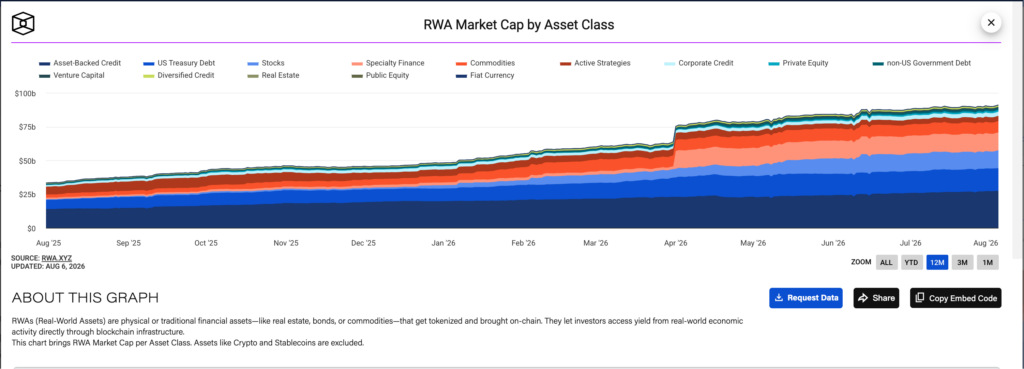
Table of Contents
- What Is RWA?
- What Rights Do RWA Tokens Represent?
- How Does RWA Differ from Crypto-Native Assets?
- Why Tokenize Real-World Assets?
- How Are Real-World Assets Tokenized?
- Should RWA Use a Public Blockchain, Consortium Blockchain, or Private Blockchain?
- What Capabilities Should an RWA Issuance Platform Provide?
- How Does BenFen Support RWA Tokenization and Issuance?
- Which Assets Are Suitable for RWA Tokenization?
- What Are the Risks of RWA Tokenization?
- Frequently Asked Questions
What Is RWA?
RWA is short for Real-World Assets. It refers to assets or rights that exist outside the blockchain and have real economic value, such as ownership rights, creditor rights, fund interests, and rights to income.
Common types of RWA include:
- Government bonds, corporate bonds, and money market funds;
- Gold and other commodities;
- Real estate and rights to rental income;
- Accounts receivable and supply chain receivables;
- Private credit;
- Fund interests and company equity;
- Music copyrights, film and television copyrights, and rights to income from other intellectual property.
RWA tokenization is a process in which an issuer represents real-world assets or related rights as on-chain tokens through legal structures, custody arrangements, and smart contracts.
Therefore, RWA, RWA tokenization, and RWA tokens are not exactly the same concept:
- RWA: Assets or rights in the real world;
- RWA tokenization: The process of converting the relevant assets or rights into an on-chain representation;
- RWA token: The on-chain digital certificate created after tokenization is completed.
Within the industry, “RWA” is also frequently used as a general term for the related on-chain tokens and the entire asset tokenization market. To avoid conceptual confusion, this article explains RWA, RWA tokenization, and RWA tokens separately.
A blockchain itself cannot automatically bring a property, a debt claim, or a piece of gold on-chain. What actually goes on-chain are the rights, certificates, transaction records, and settlement rules associated with those assets.
What Rights Do RWA Tokens Represent?
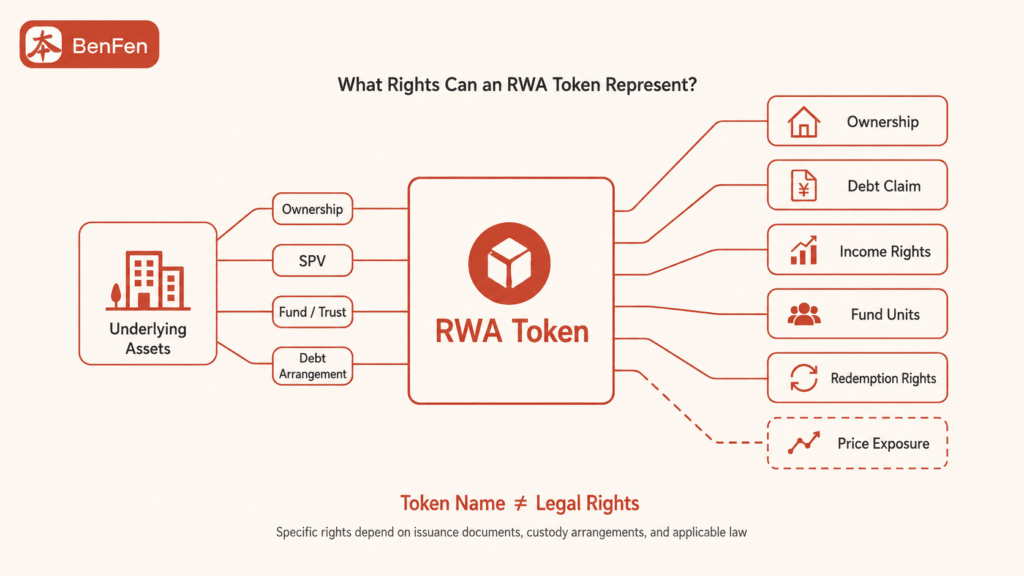
An RWA token does not inherently represent full ownership of the underlying asset. It may represent one or more of the following rights:
- Full or partial ownership of the underlying asset;
- A debt claim against the issuer or a special purpose vehicle;
- Rights to income such as interest, rent, dividends, or accounts receivable collections;
- Interests in a fund, trust, or special purpose vehicle;
- The right to redeem cash or physical assets after certain conditions are met;
- Economic exposure linked to the price of the underlying asset.
The specific rights depend on the issuance documents, custody agreements, smart contract rules, and applicable laws.
Some tokens only provide economic exposure linked to the price of an underlying asset and do not grant holders direct ownership, creditor rights, or redemption rights. These products need to be distinguished from RWA tokens that have clearly defined asset backing and legal recourse mechanisms.
When evaluating an RWA product, investors should not look only at the token’s name. They should focus on confirming:
- Who holds the underlying asset;
- Whether the token represents ownership, creditor rights, or rights to income;
- Whether the asset has been effectively ring-fenced from other risks;
- Who is responsible for custody, auditing, and information disclosure;
- Whether the token can be redeemed and what the redemption conditions are;
- How holders can enforce their rights if the issuer or custodian encounters problems;
- Which jurisdiction’s laws apply to the product and where disputes will be resolved.
How Does RWA Differ from Crypto-Native Assets?
| Comparison Dimension | Crypto-Native Assets | RWA Tokens |
|---|---|---|
| Value Basis | Primarily derived from network utility, market supply and demand, and community consensus | Derived from real-world assets, cash flows, or related legal rights |
| Asset Location | Assets exist natively on-chain | The underlying assets or rights primarily exist off-chain |
| Sources of Return | Network incentives, protocol revenue, or price appreciation | May come from interest, rent, dividends, principal and interest payments on debt, or accounts receivable collections |
| Legal Relationship | Depends on protocol design and applicable laws | Typically requires legal documents to clearly define the relationship among the assets, issuer, and holders |
| Investor Access | Some assets can be held and transferred permissionlessly | Often involves KYC, whitelists, geographic restrictions, and investor suitability requirements |
| Redemption Mechanism | Typically no corresponding off-chain asset redemption mechanism | Some products support redemption for cash, fund shares, or physical assets |
| Core Risks | Market, protocol, governance, and smart contract risks | Also includes asset authenticity, custody, credit, legal enforcement, and redemption risks |
Even when an RWA token is backed by a real-world asset, cash flow, or contractual right, this does not mean that its price will necessarily remain stable or that investors can exit at any time. The credit quality of the underlying asset, secondary-market depth, redemption restrictions, and the enforceability of legal rights will continue to directly affect the token’s value.
Why Tokenize Real-World Assets?
Lower the Barriers to Asset Fractionalization and Participation
Tokens can divide high-value assets into smaller digital units. For example, rights to real estate income, private credit, or fund interests can be divided according to the product rules, allowing investors to participate with smaller amounts.
However, technical fractionalization does not mean that the product can legally be sold to all investors. Investor eligibility still depends on the nature of the product and local regulatory requirements.
Improve Transfer and Settlement Efficiency
Traditional asset transfers may involve registries, custodians, banks, and multiple intermediary systems. Smart contracts can automate certain identity verification, transfer restriction, income calculation, and settlement steps.
For asset transactions across time zones, blockchains can also provide a technical settlement infrastructure that operates around the clock. However, off-chain banking, custody, and clearing arrangements may still be limited by business hours and regulatory procedures.
Improve the Verifiability of On-Chain Issuance and Circulation Records
A blockchain can record token minting, transfers, burning, and changes in holdings, providing investors, issuers, and auditors with a consistent set of on-chain records.
These records can prove what happened on-chain, but they cannot independently prove that a property, debt claim, or quantity of gold actually exists. The underlying assets must still be verified through custody reports, audit documents, legal opinions, and other off-chain evidence.
Support Programmable Asset Rules
Issuers can configure the following through smart contracts:
- Investor whitelists;
- Geographic and identity restrictions;
- Holding limits;
- Lock-up periods;
- Income distribution;
- Redemption and token burning;
- Trading suspension and emergency controls.
These capabilities allow certain compliance conditions to be embedded in the asset transfer process. However, the rules themselves must still be determined by the issuer, legal counsel, and relevant licensed institutions based on the specific product.
Connect with On-Chain Financial Infrastructure
Subject to regulatory and product rules, RWA tokens can connect with wallets, payments, trading, lending, and settlement protocols.
However, tokenization does not automatically create market liquidity. Technical composability can translate into capital efficiency only when the product has credible assets, clearly defined rights, qualified participants, reliable redemption mechanisms, and genuine market demand.
How Are Real-World Assets Tokenized?
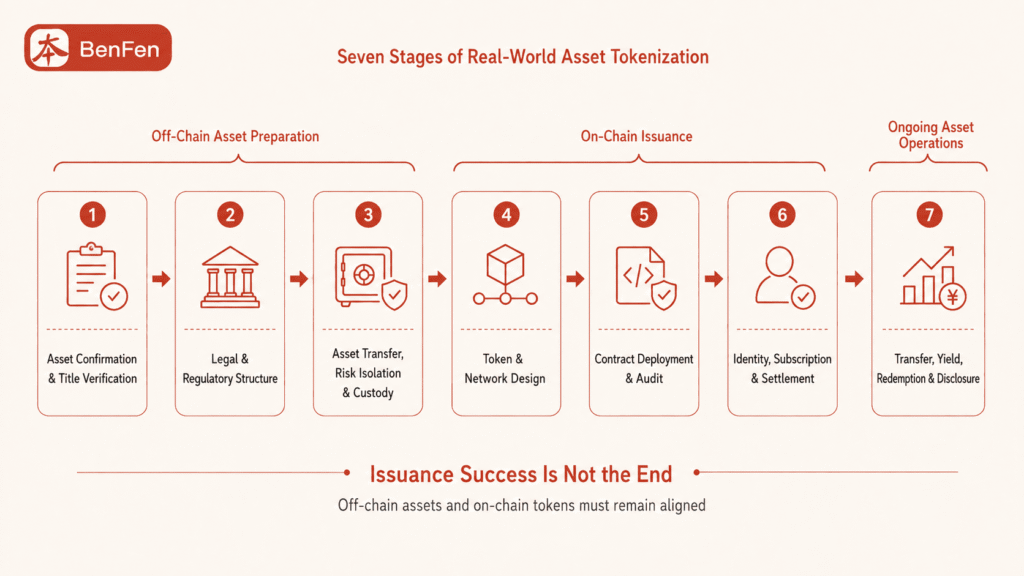
A standard RWA issuance typically includes the following seven stages:
Asset identification and title verification → Legal and regulatory structure design → Asset transfer or establishment of rights and custody → Token and network design → Smart contract deployment and auditing → Identity verification, issuance, and settlement → Transfer, income distribution, redemption, and ongoing disclosure
- Identify the Asset and Verify Ownership
Before issuance, the issuer must first confirm that the underlying asset actually exists, that its ownership is clear, and that the asset can be legally transferred or used for financing.
This stage typically includes:
- Verifying title documents, debt claim documents, or documents establishing rights to income;
- Reviewing whether the asset is subject to a mortgage, freeze, or ownership dispute;
- Assessing asset quality, cash flows, and credit risk;
- Confirming the asset valuation method;
- Identifying the applicable jurisdiction and regulatory requirements.
If the underlying asset has material defects in its ownership or title, subsequent token design cannot resolve the problem.
- Design the Legal and Regulatory Structure
An RWA token must be linked to the underlying asset through legal documents. Common structures include trusts, funds, special purpose vehicles, and asset-backed securities arrangements.
The legal structure needs to clarify:
- Who owns the asset;
- Who is the token issuer;
- What rights token holders have;
- How the asset is ring-fenced from the issuer’s own risks;
- Who is responsible for custody, management, and information disclosure;
- How the asset will be handled in the event of default or bankruptcy;
- How income and redemption funds will be paid.
When assets located in mainland China are issued in Hong Kong, the project must also address Hong Kong regulations, licensed institutions, cross-border transfers of rights, and the repatriation of funds. For further information, refer to “The Complete Guide to Issuing RWA Assets in Hong Kong.”
Regulatory Notice for the Overseas Issuance of Domestic Assets
In February 2026, the China Securities Regulatory Commission issued the Regulatory Guidelines for the Overseas Issuance of Asset-Backed Securities Tokens Based on Domestic Assets. The guidelines apply to activities involving the overseas issuance of tokenized interest certificates using cryptography, distributed ledger technology, or similar technologies, where repayment is supported by cash flows generated by domestic assets or related asset rights.
Where the guidelines apply, the domestic entity that effectively controls the underlying assets must file with the China Securities Regulatory Commission before conducting the relevant business and submit a filing report, a complete set of overseas issuance documents, information about the underlying assets, and the token issuance plan.
In addition, depending on the specific business, the project must comply with regulations concerning cross-border investment, foreign exchange administration, cybersecurity, and data security, and complete the relevant approval, filing, or security review procedures. The relevant business may not be conducted where there are prohibited circumstances, such as material ownership disputes or assets that cannot legally be transferred.
The guidelines do not mean that domestic assets can be freely issued overseas after completing a simple filing. The project must still conduct a specific legal assessment based on the nature of the assets, transaction structure, place of issuance, and investor type.
- Complete the Asset Transfer or Establishment of Rights, Risk Segregation, and Custody
After the legal structure has been determined, the transfer of the underlying assets, the establishment of relevant rights, or the required control arrangements must be completed in accordance with the issuance documents, together with the necessary risk segregation and custody mechanisms.
Some RWA structures transfer ownership of the assets to a trust, fund, or special purpose vehicle. Other structures may connect off-chain assets with on-chain tokens by establishing debt claims, security interests, rights to income, or other contractual rights.
Custody or corresponding asset control arrangements should be completed before token issuance or should satisfy the conditions for effectiveness specified in the issuance documents. This helps avoid situations in which tokens have already been minted while control and segregation of the underlying assets or related rights have not yet been completed.
This stage also needs to clarify:
- How the custodian confirms the assets;
- How the status of the assets is regularly verified;
- How cash flows are collected;
- How custody accounts are managed;
- How asset changes or losses are disclosed;
- Who releases funds or physical assets upon redemption.
- Design the Token and Underlying Network
Based on the legal rights and business requirements, the asset owner needs to determine:
- The rights represented by the token;
- The total supply and minimum unit;
- Whether additional issuance, burning, or redemption is permitted;
- Investor eligibility and transfer rules;
- The supported settlement assets;
- The issuance network and cross-chain arrangements;
- Administrator permissions and the governance structure.
When selecting an underlying network, projects should not compare only transaction speed and gas costs. They should also evaluate network security, development tools, wallet support, stablecoin liquidity, identity components, contract upgrade mechanisms, and long-term maintenance capabilities.
- Deploy and Audit the Smart Contracts
Smart contracts implement rules concerning token issuance, transfer restrictions, income calculation, redemption, and burning.
Before the official launch, the project will typically need to complete:
- Testnet deployment and business process testing;
- Edge-case and abnormal-transaction testing;
- Third-party smart contract security audits;
- Administrator permission reviews;
- Multisignature or timelock configuration;
- Disclosure of contract upgrade permissions;
- Design of emergency pause and recovery mechanisms.
An audit can reduce certain technical risks, but it cannot guarantee that a contract is absolutely secure. For upgradeable contracts, investors also need to be informed about who holds the upgrade permissions and how those permissions are restricted.
- Configure Identity Verification and Complete Subscription, Issuance, and Settlement
Securities, funds, debt claims, and other regulated assets usually require investor identity verification, KYC/AML reviews, sanctions screening, and investor suitability assessments.
Tokens can be issued to eligible investors only after the issuer and the relevant licensed or authorized institutions have completed subscription processing, investor verification, and settlement arrangements.
Where the product uses a whitelist, the smart contract can restrict token transfers to approved wallets. Investor identity information should generally not be written directly and publicly on-chain. Verification should instead be completed through compliant identity credentials, verification results, or controlled interfaces.
- Manage Transfers, Income Distribution, Redemption, and Ongoing Disclosure
Token issuance is not the end of the process. The project must continue to manage:
- Updates to investor identity status;
- Distribution of interest, rent, or other income;
- Updates to asset valuations and net asset values;
- Redemption requests and fund settlement;
- Token burning;
- Custody and audit reports;
- Disclosure of material asset changes and risk events.
The credibility of an RWA depends on whether the off-chain assets and on-chain tokens remain aligned over the long term, rather than merely on whether tokens were successfully minted at the time of issuance.
Should RWA Projects Use a Public Blockchain, Consortium Blockchain, or Private Blockchain?
Different assets have different requirements for openness, privacy, compliance controls, and liquidity. A public blockchain is not the only option for every RWA project. Consortium blockchains and private blockchains can also be used for cross-institutional collaboration or internal asset management.
| Dimension | Public Blockchain | Consortium Blockchain | Private Blockchain |
|---|---|---|---|
| Network Access | Typically permissionless to access and verify | Limited to consortium members or approved institutions | Controlled by a single organization |
| Ledger Transparency | Relatively high and publicly verifiable | Accessible to consortium members | Primarily limited to internal participants |
| External Liquidity | Easier to connect with wallets, stablecoins, and on-chain protocols | Mainly limited to participating institutions | Usually relatively low |
| Composability | Can connect with a wider range of public infrastructure | Depends on consortium interfaces | Primarily serves internal systems |
| Privacy Controls | Requires additional privacy and permission mechanisms | Easier to implement member-level access controls | Greater control over privacy and permissions |
| Governance | Maintained jointly by the network protocol and validators | Jointly governed by consortium members | Governed by a single organization |
| Suitable Use Cases | External issuance, on-chain distribution, and cross-ecosystem settlement | Cross-institutional collaboration, supply chains, and industry platforms | Internal enterprise registration and process management |
The openness of a public blockchain does not mean that RWA tokens deployed on it must circulate without permission. The network layer can remain open, while the asset layer can still control investor access through KYC, wallet whitelists, geographic restrictions, and smart contract transfer rules.
What Should Asset Owners Consider When Selecting a Blockchain?
Asset owners should focus on evaluating:
- Network security and historical stability;
- Smart contract languages and asset security models;
- Transaction fees and confirmation speed;
- Wallet, custody, and development tool support;
- Stablecoin and payment settlement capabilities;
- Identity, permission, and compliance components;
- Access to cross-chain assets and liquidity;
- Administrator permissions, upgrade mechanisms, and emergency plans;
- The maturity of the network ecosystem and its long-term maintenance capabilities.
For further discussion of the relationship between stablecoin settlement, RWA issuance, and competition among public blockchains, read “The New Public Blockchain Landscape Driven by Stablecoins and RWA.”
RWA Issuance Environments of Representative Networks
| Network | Issuance Environment Characteristics | Key Considerations |
|---|---|---|
| Ethereum | Mature standards and development tools, with a relatively large number of institutional projects and on-chain financial infrastructure | Transaction costs may be affected by network congestion, and complex products should assess long-term costs |
| BNB Chain | EVM-compatible, with relatively low transaction costs and a broad retail user base | Projects need to integrate compliance, custody, and identity components independently |
| Solana | High throughput, suitable for high-frequency interactions and user-facing financial products | Its development ecosystem differs from EVM-based networks, requiring compatible tools and service providers |
| Base | EVM-compatible and connected to the Ethereum and Coinbase ecosystems | Projects need to consider bridging between the L2 and Ethereum, withdrawal periods, and dependencies on the underlying infrastructure |
| BenFen Chain | Built on the Move asset model, providing infrastructure around asset issuance, stablecoin gas payments, sponsored transactions, and user onboarding | Ecosystem maturity, third-party service coverage, and suitability for the target market should still be evaluated on a project-specific basis |
There is no single network selection answer that applies to every project. Institutional funds, retail-oriented products, cross-border accounts receivable, and certificates representing physical assets may have completely different requirements for network liquidity, fees, identity, and privacy.
What Capabilities Should an RWA Issuance Platform Provide?
The value of an RWA issuance platform is not limited to helping a project create a token. It should standardize and combine the on-chain modules required for asset issuance.
A relatively complete issuance platform will typically need to support:
- Token creation, additional issuance, burning, and pausing;
- Investor identity and wallet permission management;
- Whitelists, holding limits, and transfer restrictions;
- Custody and audit attestation interfaces;
- Subscription, income distribution, and redemption processes;
- Stablecoin settlement and gas payments;
- Contract permissions, multisignature controls, and emergency management;
- On-chain data queries and information disclosure interfaces.
Issuance platforms primarily provide technical infrastructure. Legal structure design, verification of asset authenticity, determination of whether the product constitutes a security, investor suitability management, custody, and auditing must still be handled by the relevant professional institutions.
How Does BenFen Support RWA Tokenization and Issuance?
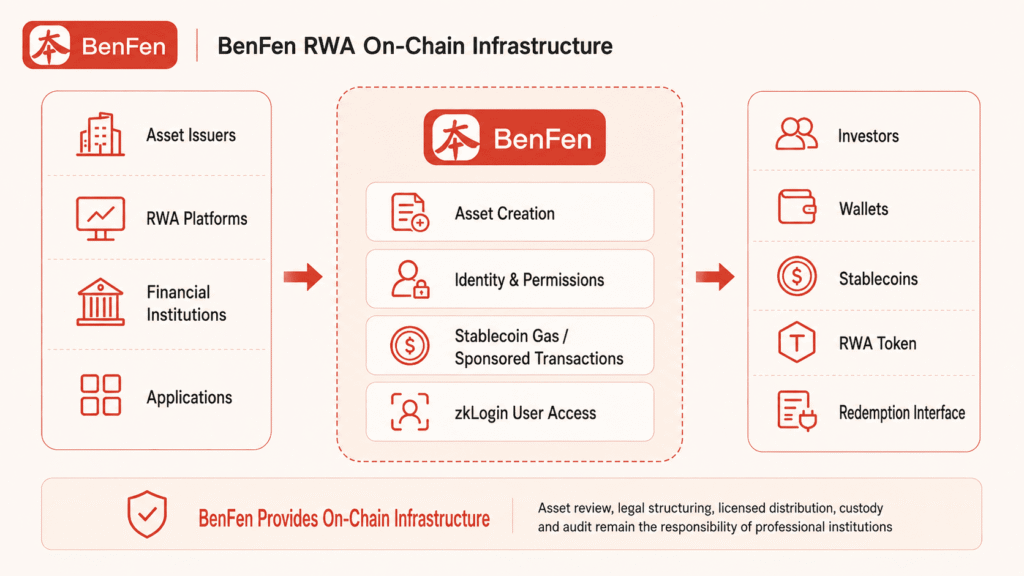
BenFen provides on-chain infrastructure for asset creation, identity and permission management, transaction fees, and user onboarding, helping asset owners reduce the technical complexity involved in moving from a business plan to on-chain deployment.
| RWA Issuance Requirement | BenFen Capability | Capability Boundary |
|---|---|---|
| Token Creation and Management | Move asset model and standardized issuance tools | Does not replace legal structure design or verification of the underlying assets |
| Investor Access | Supports integration with identity verification and KYC/AML components | Actual compliance requirements depend on the product and jurisdiction |
| Transfer Permissions | Whitelists, transfer conditions, and administrative permissions can be configured through smart contracts | Specific rules should be determined by the issuer and professional advisers |
| Transaction Fees | Supports gas payments using eligible project tokens or stablecoins, as well as sponsored transactions | Depends on supported assets, whitelist rules, and application configuration |
| User Onboarding | Supports account onboarding methods such as zkLogin | Does not replace KYC, sanctions screening, or investor suitability assessments |
| Custody and Auditing | The issuance process can require asset custody and audit documentation | BenFen does not provide off-chain asset custody or auditing; these functions must still be performed by qualified third-party institutions |
Asset Creation, Identity, and Permission Management
BenFen uses Move, an asset-oriented programming language. Move treats digital assets as resources with clearly defined ownership and transfer rules and can be used to build contracts for token issuance, asset transfers, and permission management.
Through standardized issuance tools, asset owners can configure token names, supply, transfer conditions, and management rules, reducing the amount of work required to develop basic contracts from scratch.
For products that need to restrict the eligible investor base, BenFen can support the integration of identity verification and KYC/AML components. Wallet whitelists, geographic conditions, and other transfer rules can then be configured through smart contracts.
These technical capabilities do not determine whether a product constitutes a security, nor do they replace licensed distribution, legal review, or investor suitability management. Actual issuance must still complete the required off-chain compliance arrangements based on the target market and product characteristics.
Fees and User Onboarding Experience
When traditional users enter an on-chain asset market, they often need to create a wallet, back up a seed phrase, and purchase the network’s native gas token. For RWA products targeting a broad user base, these steps increase the barrier to entry.
BenFen supports the payment of gas with eligible project tokens or stablecoins and also supports sponsored transactions. Application providers can cover part of the transaction fees for users according to their own rules, reducing the need for users to purchase an additional native gas token.
BenFen also supports account onboarding methods such as zkLogin. Users can create and use on-chain accounts through Web2 accounts such as Google and Apple, simplifying the wallet onboarding process for users who are not crypto-native.
For further information about these capabilities and their technical boundaries, refer to the BenFen Whitepaper and the One-Click Issuance Whitepaper.
Which Assets Are Suitable for RWA Tokenization?
Not every asset is suitable for tokenization. Assets that are relatively suitable usually have the following characteristics:
- Clear ownership;
- The ability to be legally transferred or used to establish rights to income;
- A relatively clear valuation method;
- Verifiable cash flows;
- The ability to establish custody and auditing mechanisms;
- Genuine financing, distribution, or settlement needs.
| Asset Type | Why It Is Suitable for Tokenization | Key Challenges |
|---|---|---|
| Government Bonds and Money Market Funds | Highly standardized, with relatively clear valuations and cash flows | Investor eligibility, licensed distribution, and custody |
| Gold and Commodities | Standardized units of measurement and relatively transparent market pricing | Proof of reserves, storage, insurance, and physical redemption |
| Real Estate and Income Rights | High-value assets that can be divided into smaller units | Property rights, valuation, taxation, and secondary-market liquidity |
| Accounts Receivable and Supply Chain Receivables | Relatively clear creditor relationships, maturities, and cash flows | Trade authenticity, duplicate financing, and debtor credit risk |
| Private Credit | Can generate interest income and support fixed-term arrangements | Credit assessment, default resolution, and information disclosure |
| IP and Copyright Income Rights | Can generate recurring licensing fees or royalties | Ownership verification, revenue verification, and cash flow volatility |
Representative public examples include:
- BlackRock’s BUIDL is its first tokenized fund issued on a public blockchain. It primarily invests in cash, U.S. Treasury bills, and repurchase agreements and is available only to eligible investors.
- Franklin Templeton’s FOBXX uses public blockchains as part of its fund transaction processing and share ownership recordkeeping system. Its transfer agent maintains the official record of share ownership through a blockchain-integrated system.
- PAXG, issued by Paxos, is backed by London Good Delivery gold bars, with each token representing the relevant interest in one fine troy ounce of gold.
What these examples have in common is not simply that they “issued tokens,” but that they established asset custody, legal rights, investor eligibility, and redemption arrangements.
What Are the Risks of RWA Tokenization?
- Rights and Legal Enforcement Risks
The fact that a token is recorded on-chain does not mean that the holder necessarily has enforceable off-chain rights. If the issuance documents, asset structure, or jurisdiction are defective, token holders may find it difficult to claim the underlying assets.
- Underlying Asset Authenticity and Credit Risks
The underlying assets may be fraudulent, pledged multiple times, inaccurately valued, affected by interrupted cash flows, or subject to debtor default. A blockchain can record data, but it cannot guarantee that the input data is genuine.
- Custody and Redemption Risks
If the custodian, issuer, or payment institution fails to fulfill its obligations, holders may be unable to receive the corresponding assets or funds even if the tokens continue to exist on-chain.
- Market Liquidity Risks
Tokenization lowers the technical barriers to asset transfers, but it does not automatically create buyers. Investor restrictions, product complexity, and insufficient market depth may all make a token difficult to sell or force investors to exit at a discount.
- Smart Contract and Cross-Chain Risks
Contract vulnerabilities, compromised administrator keys, incorrect upgrades, oracle failures, and cross-chain bridge attacks can all result in asset losses. High-value RWA projects need to strictly control contract permissions and establish emergency response mechanisms.
- Regulatory and Cross-Border Risks
RWA may simultaneously involve securities, funds, banking, payments, foreign exchange, data, and tax regulations. Cross-border issuance must also address regulatory coordination among multiple jurisdictions.
For further discussion of market opportunities, liquidity, and risk challenges in the RWA sector, read “The Double-Edged Sword of RWA: Riding the Trend while Navigating Hidden Risks.”
Conclusion: The Core of RWA Is the Right, Not Just the Token
The essence of RWA is to establish a clear, ongoing, and enforceable relationship between off-chain assets or rights and on-chain tokens. A token is only the digital representation of that relationship and is not the sole source of the asset’s credibility.
Blockchain technology can reduce technical friction in asset registration, issuance, transfer, and settlement, but it cannot replace title verification, custody, auditing, legal enforcement, or regulatory procedures. When evaluating an RWA product, the first step should be to understand what rights the token represents and how those rights can be verified and enforced.
BenFen provides on-chain infrastructure for asset creation, permission management, transaction fees, and user onboarding. Asset owners must still work with lawyers, licensed institutions, custodians, and auditors to complete the legal and business framework connecting off-chain assets with on-chain tokens.
RWA Frequently Asked Questions
Q1. Is RWA the Same as Tokenization?
They are not exactly the same concept. RWA refers to assets or rights in the real world. RWA tokenization is the process of using legal structures and blockchain technology to represent the relevant assets or rights as on-chain tokens. An RWA token is the on-chain digital certificate created after tokenization. In industry discussions, “RWA” is sometimes also used as a general term for RWA tokens and the entire tokenized asset market.
Q2. Does Holding an RWA Token Mean Owning the Underlying Asset?
Not necessarily. An RWA token may represent ownership, creditor rights, fund interests, rights to income, redemption rights, or price exposure. The specific rights held by the token holder must be determined by reviewing the issuance documents, custody arrangements, and applicable laws.
Q3. Why Is RWA Suitable for Deployment on Public Blockchains?
Public blockchains can provide publicly verifiable transaction records and connect with wallets, stablecoins, and other on-chain infrastructure. Public blockchains offer certain advantages for assets that require cross-regional distribution or on-chain settlement.
However, the openness of a public blockchain does not mean that RWA tokens must be freely tradable. Issuers can still restrict investor access through KYC, whitelists, and smart contract rules.
Q4. Can RWA Tokenization Improve Asset Liquidity?
Tokenization can lower the barriers to fractionalization, registration, and technical transfers, but it cannot guarantee that buyers will exist in the market. Asset quality, legal rights, investor eligibility, redemption mechanisms, and market demand are the primary factors determining liquidity.
Q5. What Conditions Are Usually Required for RWA Issuance?
RWA issuance will usually require:
- Verification of the ownership and title of the underlying assets;
- Legal and regulatory structure design;
- Transfer of the assets or establishment of the relevant rights;
- Risk segregation and custody;
- Token and network design;
- Smart contract deployment and auditing;
- KYC/AML and investor eligibility controls;
- Subscription, settlement, redemption, and ongoing disclosure arrangements.
The specific requirements depend on the asset type, product characteristics, and jurisdiction of issuance.
Q6. What Is the Difference Between RWA, Stablecoins, and STOs?
Stablecoins are primarily designed to maintain a relatively stable value. Common mechanisms include reserves of fiat currency or other assets, crypto-asset collateralization, and other stabilization mechanisms. Asset-backed stablecoins are included within the broader RWA category by some industry organizations, but classification standards vary among data providers. The Block dashboard cited at the beginning of this article explicitly excludes stablecoins and crypto-native assets.
STO focuses on the issuance activity and regulatory characteristics of security tokens. Its main concerns are the securities rights represented by the token and whether the issuance, distribution, and trading processes comply with securities regulations.
RWA is a broader asset category and market concept. It covers the on-chain representation of government bonds, funds, gold, real estate, credit, accounts receivable, and other real-world assets or rights. Some RWA products may also qualify as security tokens.
Q7. Is BenFen Responsible for RWA Asset Reviews and Legal Compliance?
BenFen primarily provides technical infrastructure for on-chain issuance, asset management, identity and permission controls, gas payments, and user onboarding. Reviews of the underlying assets, legal structure design, determination of securities status, licensed distribution, custody, auditing, and investor suitability management must still be handled by the issuer and the relevant professional institutions.
Risk Warning
This article is provided for industry information purposes only and does not constitute investment, legal, tax, or regulatory advice.
RWA involves risks related to the authenticity of underlying assets, legal rights, credit, custody, redemption, market liquidity, smart contracts, and cross-border regulation. Regulatory requirements may vary across countries and regions.
Before participating in or investing in a related project, carefully verify the underlying assets, issuer, legal documents, custody arrangements, investor eligibility requirements, sources of returns, and redemption conditions, and consult professional advisers based on your own circumstances.
Sources
- The Block: RWA Market Cap by Asset Class
- China Securities Regulatory Commission: Regulatory Guidelines for the Overseas Issuance of Asset-Backed Securities Tokens Based on Domestic Assets
- China Securities Regulatory Commission: Service Guide for Filing Materials for the Overseas Issuance of Asset-Backed Securities Tokens Based on Domestic Assets
- BenFen Whitepaper
- BenFen: One-Click Issuance Whitepaper
- Securitize: BlackRock Launches Its First Tokenized Fund, BUIDL
- Franklin Templeton: Digital Assets Technology
- Paxos: PAX Gold