November 5, 2026 · BenFen Research Team · ~21 min read + Data as of 09:00 UTC+8 on November 5, 2026.
The incident is still developing; Binance’s official announcements are authoritative
The Short Answer: What Broke Was the Exchange’s Front Door, Not the Chain
At the end of October 2026, Binance was hacked. The estimated total impact is about $6.3 billion — Binance’s own estimate, not a final confirmed net loss. TRM Labs has called it the largest cryptocurrency theft on record.
On November 3, Binance published its Initial Findings and Response Update and, for the first time, laid out the whole chain: attackers gained unauthorized access to an internal wallet signing service and initiated transactions outside the normal withdrawal process, using Ethereum’s EIP-7702 delegation mechanism along the way. Binance’s first notice said it had found no evidence of any private key being exposed.
What failed here was the exchange’s internal signing and withdrawal systems — not a public chain’s consensus, and not a smart contract. It is also a reminder that Web3 security has to be discussed layer by layer: how a platform manages permissions, how a chain executes transactions, and how an application confirms that a user qualifies. A public chain cannot fix an exchange’s internal systems for it; and a public chain has its own exposure in keys, contracts and nodes. This article uses BenFen as the case study to walk through what public chain security design involves, and what BenFen ID (on-chain KYC) can and cannot solve.
The Binance Hack, Step by Step: From ~$6.3 Billion Out to 98% Replenished
October 28–29: Two Days of Preparation, Then Abnormal Outflows From 20:05
Per TRM Labs, preparation began at least 36 hours before the theft: three small Tornado Cash withdrawals starting the morning of October 28 to cover gas, a first piece of attack code deployed early on the 29th and tested on two wallets, then the final version rehearsed on a third wallet before the test funds were routed back.
Binance confirmed the opening move: between 20:05 and 20:09 UTC, five hot wallets sent 233.46 million XRP to attacker-controlled addresses; hot wallets on Solana and Optimism sent about 970,500 SOL and 44.2 million OP; then 18,270 BTC went out. That matches TRM Labs’ own ordering: the XRP Ledger first, Solana and Optimism shortly after 20:10, then Bitcoin at 20:20.
The size estimates still diverge. TRM Labs measures roughly $6.36 billion across 10 blockchains in about 20 minutes, with Ethereum the largest tranche at about $3.79 billion. Binance’s own wording is “estimated total impact of approximately $6.3 billion,” and its initial findings give a more precise figure: about $6.34 billion.
One Induced Signature: 50 Transactions to Manipulate the Nonce
This is the technical crux. Binance’s own account: the attacker “used the signing service to exploit Ethereum’s EIP-7702 authorization mechanism,” giving an attacker-controlled smart contract partial execution rights over a Binance hot wallet. To land that authorization on a valid account state, the attackers submitted 50 signing transactions to manipulate the account nonce.
The timestamp on the on-chain side comes from third parties. Per TRM Labs’ reconstruction, one Ethereum transaction landed at 20:20 UTC. No transfer amount, no call data. Its only content was a batch of 50 EIP-7702 authorizations, each signed by the hot wallet Binance labels “Binance 14.” Binance did not publish a timestamp for that specific transaction.
EIP-7702 is a new feature introduced in the Ethereum Pectra upgrade, supporting functions such as delegating code execution in ordinary wallets. After the wallet signs the authorization, the account will point to a delegation code. This code can perform operations on behalf of the account, so users must carefully review the authorized content. The Ethereum specification also reminds wallets to review the access rights of the authorized code to the account.
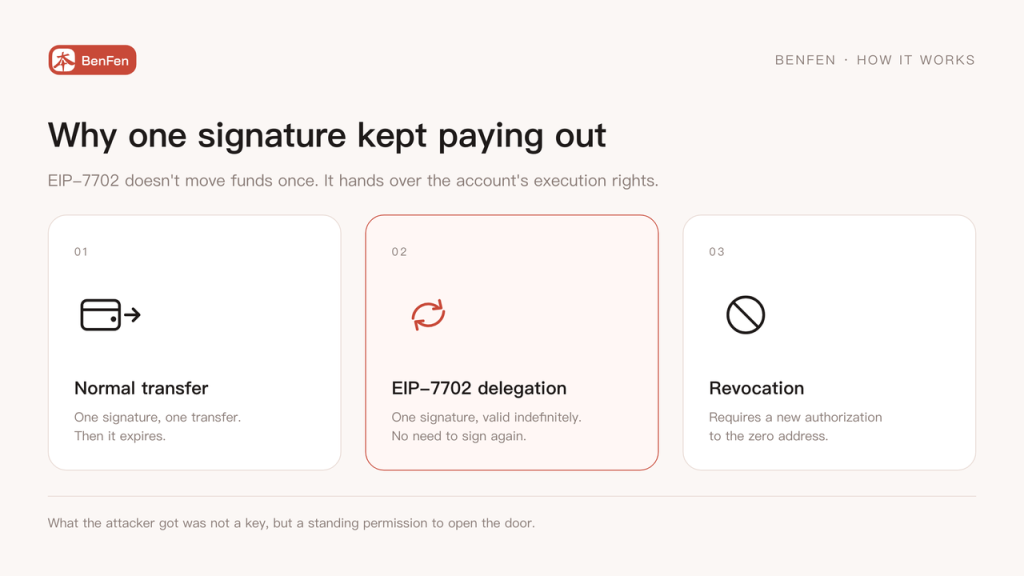
Per TRM Labs, what the chain shows is a batch of 50 pre-signed authorizations on consecutive nonces, with the net effect of pointing “Binance 14” at attacker-prepared delegation code. That and Binance’s “50 signing transactions to manipulate the account nonce” are two ways of counting the same set of actions — the company counts signing transactions, the on-chain reconstruction counts authorization entries. Both come to 50, but that does not mean 50 authorizations took effect at once. Under the EIP-7702 specification, the list is processed one entry at a time: each signer’s nonce must match the nonce declared in that authorization, and only then does the account’s code point at the delegated address and its nonce increment. Failed entries are skipped; processing continues. An authorization takes effect only at the moment the signer’s nonce matches.
Three minutes and 24 seconds later, the wallet’s ETH, USDT and dozens of other tokens were swept out in one transaction.
Why couldn’t Binance stop it faster? Its initial findings address exactly this. The hot wallet used Multi-Party Computation (MPC), so “there was no single private key that could be used to immediately revoke the malicious EIP-7702 authorizations.” Suspending withdrawals and shutting down hot wallet services also did not invalidate authorizations already on-chain. The team had to design and execute a specialized revocation procedure, which took additional time.
The timestamps are Binance’s: the final unauthorized transfer, 2,961.9 ETH, finalized on-chain at 23:56 UTC, with none observed afterwards; at 00:10 UTC on October 30, “Binance 14” issued a new authorization to the zero address, clearing the EIP-7702 delegation code.
Emptying “Binance 14” wasn’t the end. Per TRM Labs, the delegation stayed live: as new funds arrived, the attacker swept them again at 20:41, 20:59, 21:04, 21:44, 22:39 and 23:56 UTC. The wallet also served as the executor of a separate Binance smart account, which let the attacker pull 823 million USDC from it.
A Detail That Matters More: Binance 16
In the same window, another hot wallet, “Binance 16,” signed directly with its own private key and sent out 28,006 ETH, 55.7 million USDT and 25.9 million RLUSD. It had no EIP-7702 delegation. Per TRM Labs, the most likely explanation is that the attacker gained the ability to make Binance’s signing system sign transactions of its choosing across chains — not that one isolated key leaked.
In plain terms: “Binance 14” was drained by a standing authorization; “Binance 16” was drained by a signature made on the spot. Different routes, same precondition — the attacker had already gained the ability to get transactions signed. That is why the investigation keeps landing on signing and permissions rather than on one stolen key.
This is the part worth remembering. Ethereum did not malfunction. Binance’s own key signed. The chain verified it. The chain executed a forged instruction that was, by every rule it checks, valid. Not a consensus or contract exploit — an operating environment that couldn’t tell “I am signing a transfer” from “I am signing a delegation.” The same pattern hit Bybit in February 2025: the signer saw a normal transfer and signed a proxy contract upgrade instead, at a cost of about $1.5 billion.
The boundary matters too: EIP-7702 explains the “Binance 14” leg. It does not explain every abnormal outflow across every chain. Other chains saw outflows earlier, and the mechanisms may differ. The delegation stayed live for about 3 hours 51 minutes, so assets deposited in the meantime were still moved out.
What’s worth noting is that this mechanism is no longer just an on-chain analyst’s inference. Binance’s November 3 initial findings confirm three things: the signing service was accessed without authorization, EIP-7702 delegation was abused, and under MPC there was no single key that could revoke it. Binance stresses these are preliminary conclusions, that the investigation continues, and that some technical details will stay confidential to prevent reuse.
October 30: Withdrawals Paused, $3 Billion Frozen, Full Backstop Promised
Binance’s initial notice said withdrawals were paused for security checks, authorizations on affected addresses revoked, and law enforcement engaged to trace funds. An update specified that deposits and other unaffected services were operating normally, and that about $3 billion in affected assets had been frozen on-chain by then. The November 3 initial findings revised that figure to about $2.85 billion, noting it remains subject to reconciliation and market price volatility.
That evening, announcement #2, signed by co-CEOs Yi He and Richard Teng, committed that Binance, not users, would absorb the financial loss: more than $6.34 billion in company funds set aside, more than $5 billion equivalent in the relevant tokens already in place, about 80% of the shortfall covered.
October 31: The FBI Attributes the Attack to a North Korea-Linked Group
The FBI published an official alert attributing the theft to North Korea-linked cyber activity tracked as TraderTraitor, saying the assets were largely being converted to Ethereum, publishing associated addresses, and asking virtual asset service providers to block the transactions. This is the FBI’s attribution. Elliptic, Chainalysis and others had not issued formal statements at the time, and the investigation was ongoing.
November 1–3: 95% Backfilled, Withdrawals Reopened in Stages
Recovery update #4 put the backfill ratio up from 80% to 90%, now about 95%; the remaining ~5% is low-liquidity tokens outside the top ten. It confirmed BTC, ETH, USDT, BNB, SOL, USDC, XRP, USD1, RLUSD and ZEC were all fully backed at 100%. Withdrawals resumed in stages from 14:00 UTC+8 on November 1, the first phase opening 15 network-and-asset combinations.
Announcement #5 said the complete zero-knowledge proof for the 08:00 UTC+8 October 31 (00:00 UTC) reserve snapshot had been generated, and holders of any of those ten tokens could independently verify at least 1:1 backing. A new snapshot was completed at 00:00 UTC on November 4, expanding coverage from 10 tokens to 44; the updated full proof is now expected to take 50–60 hours — longer not because of weaker hardware, but because proving 44 tokens instead of 10 raises the computation.
Update #6, published 10:40 UTC+8 on November 3, said the second batch would begin opening from 12:00 UTC+8 on November 3, covering dozens of assets across BSC, ETH, SOL, XRP, SUI, Arbitrum, Optimism, TRX, Base and other networks. The notice stressed these assets would not open simultaneously and still needed individual security checks; deposits were normal. Binance also warned about scammers impersonating the exchange via direct messages, email, group chats, and even small transfers with notes attached. For current status, check Binance’s announcements and the withdrawal page.
November 3: Binance Publishes Initial Findings, Pushing the Timeline Back to June
The most valuable part of the report isn’t the loss figure. It’s how the attackers got in. Binance calls it a “sophisticated, multi-stage campaign” and explicitly rejects the single-breach or simple-phishing framing.
- June 2026 — supply chain. Engineer A on the wallet DevOps team searched for a popular AI coding tool and downloaded a tampered Homebrew installation package. Security detected the anomaly, replaced the device and rotated credentials — but the attacker already had A’s role and the names of his colleagues on the wallet infrastructure team.
- September 2026 — social engineering. Software Engineer B was contacted on a legitimate job platform by someone posing as a Project Director. Round one was a live video interview with an “HR” representative who shared a social media account with personal photos and videos to build trust. Round two moved to a chat app, where a “CEO” of a fictitious company asked B to download an “assignment” repository. The code executed during setup, used obfuscation and evasion to replace a legitimate development tool component (Binance even published the
pyenvreplacement script), and opened a channel to an external server. The 0-day malware was not caught by endpoint protection, and the attacker cleaned up traces. - October 20, 2026 — springboard. Using B’s compromised computer and an internal Binance AI tool, the attacker took control of Engineer A and another software engineer, C, and found a container deployment permission token on A’s machine.
- October 29, 2026 — execution. Between 17:15 and 19:56, the attacker logged onto C’s computer, used credentials stolen from A, deployed a container and triggered the malicious script.
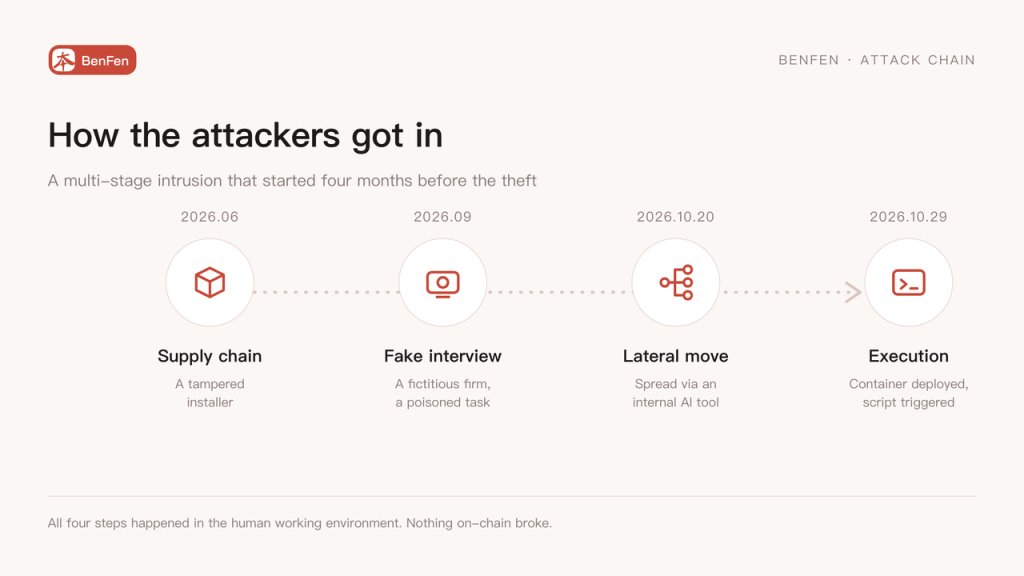
Not one link in that chain is a “chain” problem: search results, a job platform, a video interview, a developer tool, an internal AI tool, a permission token — all of it is the human working environment. Binance also disclosed that its security team detected and prevented 57 suspected North Korea-linked cases in 2026, using tactics including fake job interviews, malware disguised as developer tools, and compromised packages and browser extensions.
On remediation, Binance says it rebuilt the affected wallet system and internal AI tool, replaced devices, decommissioned credentials, ran enhanced scans across all employee devices, and strengthened wallet-service risk controls and AI-based behavioural anomaly detection. It is also engaging independent third parties and plans a security research fund.
The numbers were updated here too: about $6.34 billion impacted, about $2.85 billion frozen or intercepted, 98% replenished as of October 31. Note that “98%” coexists with the “95%” in announcements #4 and #5 — the latter was the November 1–2 progress figure, the former is the initial findings’ retroactive figure as of October 31.
November 4: 98% Replenished, Reserve Proof Expanded to 44 Tokens
Binance published recovery announcement #7 on November 4. Three things in it deserve separate attention.
One: the money is essentially back. Binance says it has set aside company funds exceeding 100% of what is needed to cover the loss and has replenished about 98% of affected assets; the remaining ~2% are low-liquidity small-cap tokens still being bought on the open market and via OTC. Be precise: 98% means Binance bought assets back to refill the hole, not that 98% was recovered from the hackers — recovery still sits at roughly $2.85 billion frozen or intercepted.
Two: the reserve proof covers far more. A new snapshot was taken at 00:00 UTC on November 4, expanding coverage from 10 tokens to 44; the full zero-knowledge proof is expected to take 50–60 hours, after which users can verify at least 1:1 backing themselves.
Three: withdrawals are not fully open. Binance says it will keep restoring them in stages but has given no date for full restoration; as of the morning of November 5, dozens of assets in the second batch were still being reopened network by network.
So as of November 5 the state of play is one sentence: compensation nearly done, withdrawals not fully open, independent review unfinished. Three progress bars, three different positions — do not read 98% as the incident being over.
Is My Money Safe? Three Things You Can Confirm Right Now
If you hold assets on Binance or any centralized exchange, three things here concern you.
First, check your withdrawal status
Look for a “withdrawals restricted” notice on the announcements and wallet pages. Staged restoration means different networks and assets open at different times — don’t judge from one announcement.
Second, look at proof of reserves
Per Binance’s instructions, download the verification tool from the proof of reserves page, run it locally, use the Merkle tree to confirm your balance is in the snapshot, then zk-SNARK verification to confirm at least 1:1 reserves — without disclosing any user balance. The value is that you can check it yourself.
Know the limit: it answers “did the platform hold this much at a given moment,” not “was any of it moved between snapshots.” The platform generates and publishes it, so it stays self-attestation. On-chain balances and transfers, by contrast, are public by default and checkable by anyone at any time — which is why many people now move long-term holdings into self-custody.
Third, decide who holds your coins
On a platform, you hand custody to its operations and risk controls. In your own wallet, you hold the keys and carry the responsibility. The two models fail in completely different ways.
Frozen Is Not Recovered: $2.85 Billion Was Stopped. Then What?
Plenty of people saw “about $2.85 billion frozen” and assumed the money came back. Those are two different things.
Start with the official arithmetic: about $6.34 billion impacted, about $2.85 billion frozen or intercepted — most of it was never frozen. And that $2.85 billion is “frozen or intercepted,” not “returned.” Binance notes the figure is still subject to reconciliation and price volatility.
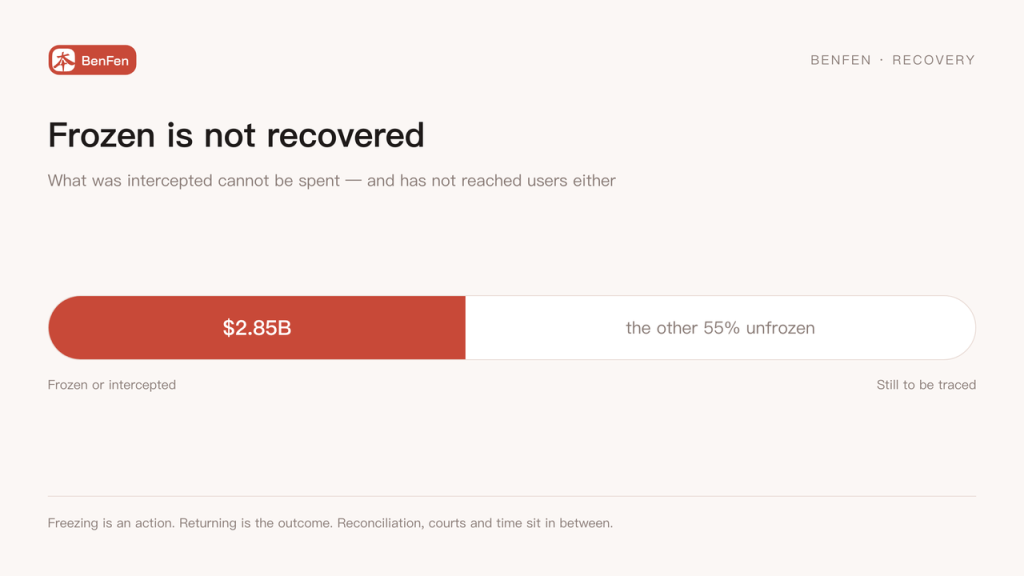
After the incident, Tether froze more than $1.5 billion in USDT within 30 minutes (on-chain tallies put it near $1.567 billion), Circle over $800 million USDC (confirmed by CEO Jeremy Allaire; up to more than $1.1 billion by November 2), and Ripple about $200 million RLUSD (per Binance co-founder Yi He). Each issuer disclosed on its own timeline, so the sum does not line up exactly with Binance’s $2.85 billion figure. But freezing is step one. TRM Labs’ Ari Redbord: “Freezing takes minutes, but returning funds takes longer” — law enforcement needs a court order before it can work with issuers to return assets to victims. Bitcoin and Ethereum have no centralized issuer, so they can’t be frozen at all; they can only be traced.
As for how much freezing actually recovers: Bitquery’s tracing found that about $729 million of stolen USDT was swapped into ETH and TRX before Tether’s freeze took effect, and 6 of the 11 frozen wallets were already empty when the restriction landed. One attacker wallet had put $60 million USDT into Aave and borrowed about $45 million in ETH against it — the collateral was already in the pool, so freezing the wallet could not touch it, which is why Aave froze DAO-operated markets that day. By Bitquery’s count roughly $1.76 billion in USDT was frozen (about 71% of the USDT taken), and about $2.7 billion was immobilized across issuers and emergency interventions — while the attackers still controlled about $3 billion as of November 2, mostly bitcoin and ether.
This incident also showed something the on-chain system does uniquely well: within 20 minutes, flows across 10 chains were visible in real time, and that visibility is what made it possible to freeze $2.85 billion. Public verifiability on-chain is not a bonus feature. It is the precondition for any recovery attempt.
But the full picture: transparency made the funds visible; the issuer privileges Tether and Circle wrote into their token contracts made them freezable. That second part is not a win for decentralization. Freezing hundreds of millions of dollars within hours is a rescue capability — and a centralized power.
CEX Security vs. Public Chain Security: Where’s the Difference?
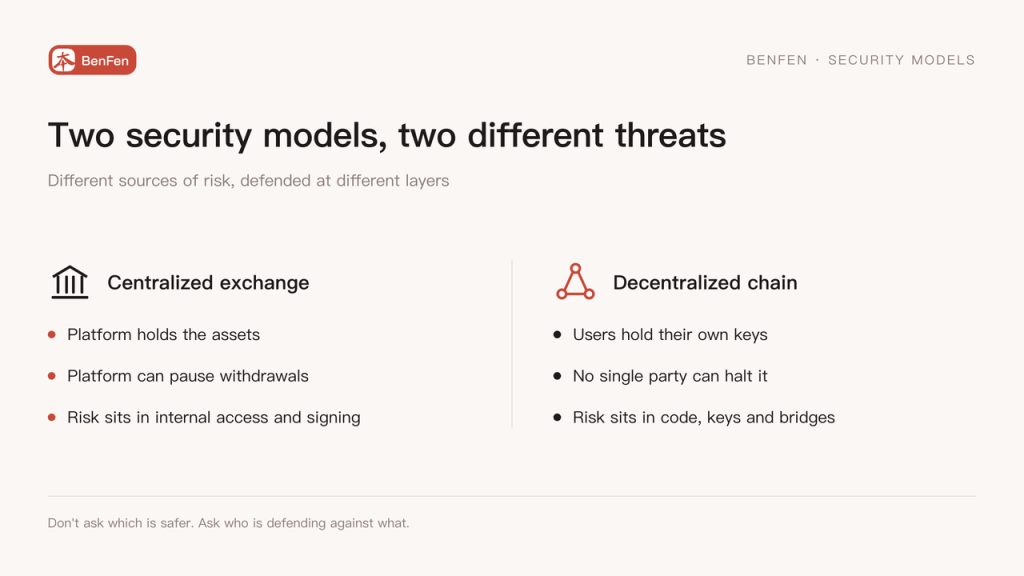
A centralized exchange is run by a company. It custodies assets and controls withdrawals, and users must trust its permission management and operating systems. A public chain is maintained by nodes; transaction rules and asset states are publicly verifiable, but it still contends with keys, contracts and bridges. The two security boundaries don’t sit at the same layer.
The CEX Boundary: Platform Privileges, Hot Wallets, Withdrawal Controls
You open an account; the platform manages it, runs withdrawals and holds the assets. Convenient — and the price is trusting it not to move the money itself. Everything Binance disclosed sits at this layer: an employee laptop, a job interview, a developer tool, an internal AI tool, a signing service, a hot wallet, an on-chain delegation not revoked in time. Binance’s own initial findings lay out the whole chain, and not one link points at a public chain’s consensus or contracts.
The Public Chain Boundary: Keys, Contracts, Bridges, Nodes
A public chain hands bookkeeping to a node network. You no longer trust one company, but the risk has only moved: private keys, contract code, bridges, node software — and your own computer. Bridges have been the most attacked surface in recent years, attackers exploiting flaws in cross-chain verification logic. We broke those down case by case in this 2026 analysis of cross-chain bridge attacks.
One Table, Two Security Models
| Dimension | Centralized exchange | Decentralized public chain |
|---|---|---|
| Who custodies the assets | Platform custody; users hold a platform ledger entry | Users hold their own private keys |
| Who can stop a transfer | The platform can freeze funds and pause withdrawals | Determined by network rules; no single party can halt it |
| Main failure points | Employee devices, internal privileges, signing systems, hot wallets, withdrawal review | Key storage, contract code, cross-chain bridges, node software |
| What users must trust | The platform’s operations, risk controls and ability to make users whole | Code and consensus — plus their own behavior |
| Remedies after an incident | Platform backstop, law-enforcement freezes, legal recovery | Depends on protocol design and on-chain governance; usually slower |
| Typical risk | Internal privileges compromised, hot wallet drained | Key leak, contract vulnerability, bridge drained |
So don’t ask “which is safer.” Ask “who is defending against what.” An exchange’s adversaries come from inside: employee laptops, internal privileges, hot wallets, withdrawal review. A public chain’s adversaries come from code and keys: contract bugs, key leaks, bridges.
How to Evaluate Public Chain Security: BenFen as a Case Study
Move assets on-chain and two new questions arrive fast. You hold the keys yourself, and no platform backstops you if you lose them. And many on-chain applications require KYC, so you submit documents to app after app. The first is the responsibility boundary of self-custody; the second is the privacy cost of on-chain identity. Both are questions a public chain answers by design.
BenFen is a public chain built for stablecoins and on-chain payments, based on Move and DAG consensus, with a native cross-chain bridge, native stablecoins, and the BenFen ID credential in its ecosystem.
What Move and DAG Consensus Can Solve
Move blocks a common class of bug — double-spending the same asset, for instance. It treats assets as resources that cannot be copied, only moved, ruling out a set of typical contract vulnerabilities at the language level. DAG consensus tackles a different problem: instead of queueing transactions into blocks, transactions link directly to one another, in theory allowing higher throughput and faster confirmation.
What They Cannot Solve: Audits, Key Management, Operations
Language and consensus are only the first gate. Move can’t stop someone writing buggy code, and it can’t stop a key from being stolen.
Real security also depends on whether the code was audited, who manages the keys, whether anyone can halt the system in an emergency, whether upgrades are controlled, and whether there’s continuous monitoring. Key management is one example: an MPC threshold signature scheme that splits a key into shares and has multiple nodes jointly produce signatures means one compromised node still can’t reconstruct the full key.
Decentralized ≠ Safer: Five Questions for Judging Chain Security
Questions you can verify yourself beat any label:
- Can transaction rules be inspected publicly? Check on a block explorer whether a transaction executed as expected.
- Are critical operations permissioned? Who can upgrade contracts or change parameters, and is there a multisig or timelock?
- Have the contracts been audited? Are the reports public, which modules do they cover, and did the code change afterwards?
- Does the user actually hold the wallet? Self-custody, or the platform holding it for you?
- Is there a clear incident response process? Any public incident record and handling procedure?
Those five answers tell you more about the risk you carry than whether a chain calls itself decentralized.
What On-Chain Identity Adds: The Role of BenFen ID
Security includes one more thing: how applications confirm a user meets the conditions for participating. RWA, lending or region-restricted DApps may need to verify completed KYC, an age requirement or a jurisdictional requirement. If every app collects documents again, users resubmit sensitive data over and over. This — verifying a condition without handing over the underlying documents — is usually called on-chain KYC.
According to the official BenFen ID page, BenFen ID is an on-chain identity credential based on zero-knowledge proofs. After verification, a user can prove specific conditions inside DApps that support it; in the normal flow, the DApp mainly receives the verification result rather than the full name, ID number or date of birth. In cryptography this is selective disclosure — prove the conclusion, don’t hand over the raw data.
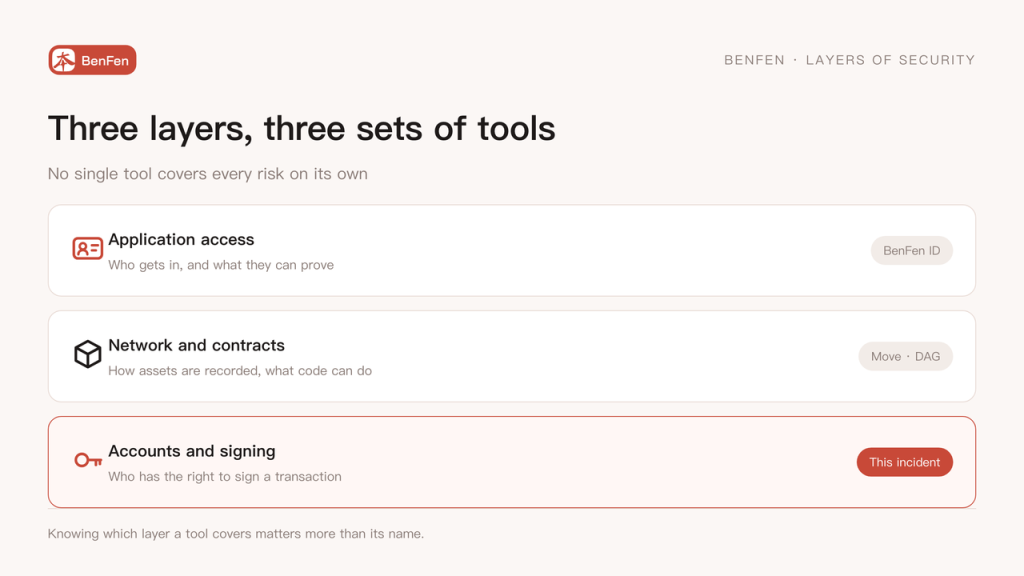
The boundary needs stating: BenFen ID governs “who you are and whether you can get in.” It does not govern “how money goes out.” Binance’s incident was the second kind. Identity credentials and account security are different layers; the latter depends on permission control, key protection, transaction risk controls, contract audits and a full incident response capability.
One more note: a chain being decentralized doesn’t mean the company issuing the credential is. Documents are still reviewed by someone. Read the authorization screen before you approve — especially which permissions it requests and who receives the data.
Conclusion: Different Systems Need Different Safeguards
Binance’s ~$6.3 billion incident came down to a failure in a centralized platform’s signing, permission and withdrawal layers. Binance has published its initial findings — the entry point was unauthorized access to an internal wallet signing service, and the path ran from a malicious installer in June, through a fake interview in September, to a container deployment on October 29 — alongside progress on freezing, backfilling, reserve verification and staged restoration, and a commitment to absorb the loss through the SAFU fund and company capital. The full report and independent review are still in progress.
The two sides never defended against the same things. BenFen’s consensus and contract design address the network operation layer; BenFen ID’s credentials address the application access layer. Knowing which segment each tool covers beats remembering its name.
To go further, start with three things: check your platform’s proof of reserves; confirm whether you hold the keys or the platform does; and before authorizing any DApp, read what permissions it asks for.
FAQ
What was the Binance $6.3 billion incident?
An unauthorized transfer event affecting Binance hot wallets, with an estimated total impact of about $6.3 billion — the largest cryptocurrency theft on record. Binance’s November 3 initial findings confirm that attackers gained unauthorized access to an internal wallet signing service, initiated transactions outside the normal withdrawal process, and used EIP-7702 to delegate partial execution rights over a hot wallet to an attacker-controlled contract. The trail reaches back to a tampered Homebrew package in June. The investigation continues.
Who carried out the Binance hack?
On October 31, 2026, the FBI published an alert attributing the theft to North Korea-linked cyber activity tracked as TraderTraitor. Binance’s initial findings cite that attribution but do not name a perpetrator independently. The full conclusion awaits further official updates.
Does the Binance incident mean a public chain was breached?
No. Binance’s announcements describe a failure in its own platform’s withdrawal and signing systems — a separate matter from any public chain’s consensus mechanism or smart contracts.
Is a decentralized public chain always safer than a centralized exchange?
Not necessarily. The two aren’t defending against the same things. An exchange fears insiders, privileges, custodied wallets and withdrawal flows; a public chain fears keys, contract code, bridges and users’ own devices. Security depends on specific design and operational competence, not the “decentralized” label.
Did ordinary users lose money in this incident?
Per Binance’s announcements, Binance will absorb the full loss rather than users, and said it had set aside more than $6.34 billion in company funds for the backfill. What users actually receive should still be confirmed against Binance’s announcements and their own account pages.
That said, covering the money doesn’t mean trust was untouched. Binance’s later, fuller disclosure: over the 46 hours to 04:00 UTC on November 3, it processed about $11 billion in withdrawals and $6 billion in deposits — roughly $5 billion in net outflows, about 3.1% of its $171 billion in assets. By 03:00 UTC on November 3, hourly deposits had overtaken withdrawals.
What did Binance’s own investigation say?
On November 3, 2026, Binance published Initial Findings and Response Update, confirming that attackers gained unauthorized access to an internal wallet signing service, bypassed the normal withdrawal process, and used 50 signing transactions to manipulate the account nonce and establish an EIP-7702 delegation to an attacker-controlled contract. The trail starts with a tampered Homebrew package in June, moves through a fake job interview in September that delivered malware, uses an internal AI tool as a springboard on October 20, and executes on October 29. Binance says the investigation continues, some technical details will stay confidential, and the findings will face independent review.
Can I withdraw from Binance now?
As of November 5, 2026, Binance has restored withdrawals in two stages: the first phase on November 1 opened 15 networks and assets, and the second opened from 12:00 UTC+8 on November 3. Binance has not declared a full restoration — the second batch is still rolling out network by network and asset by asset. Check Binance’s announcements and the withdrawal page. No date has been given for full restoration.
Sources
Binance official
- Binance, Initial Findings and Response Update, 2026-11-03
- Binance, Incident Progress Notice, 2026-10-30
- Binance, Incident Progress Announcement #2, 2026-10-30
- Binance, Recovery Progress Update #3, 2026-10-31
- Binance, Recovery Progress Announcement #4: Staged Restoration of Withdrawal Services, 2026-11-01
- Binance, Recovery Progress Announcement #5: Zero-Knowledge Proof for the Proof-of-Reserves Snapshot Generated, 2026-11-02
- Binance, Recovery Progress Update #6: More Assets Open for Withdrawal, 2026-11-03
- Binance, Recovery Progress Announcement #7: ~98% replenished, reserve-proof snapshot expanded to 44 tokens, 2026-11-04
- Binance, Proof of Reserves page and verification tool, ongoing
Stablecoin issuers
- Tether, Tether Freezes Over $1.5 Billion From Binance Hack, Keeping Funds Out of North Korea’s Reach, 2026-11-02
- Jeremy Allaire (Circle CEO) on X: more than $800 million USDC frozen, 2026-10-30
- Bitquery, Binance Hack on-chain investigation (frozen and escaped funds), 2026-11-03
Technical specifications, on-chain analysis and overseas reporting
- EIP-7702: Set EOA account code, Ethereum Foundation
- Jenny Lee, CNBC, Binance sees $3.64 billion in net outflows as withdrawals resume, 2026-11-02
- TRM Labs incident analysis, 2026-10-30
- FBI alert, 2026-10-31
BenFen official
This article was written by the BenFen team. BenFen is the public chain project described here; the descriptions of BenFen and BenFen ID are based on official documentation, and all third-party factual claims are sourced.